Bullpadel Neuron 02 Edge 2026 Review
Version and lineup identification
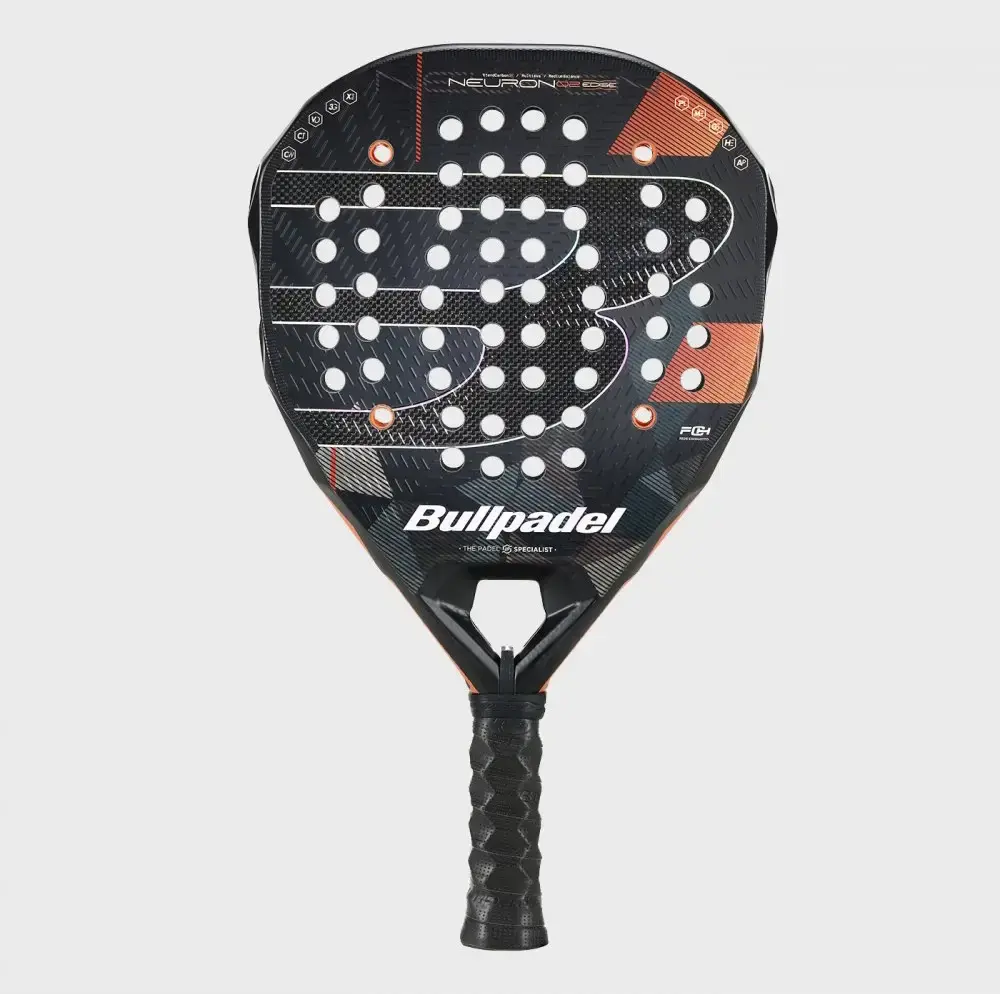
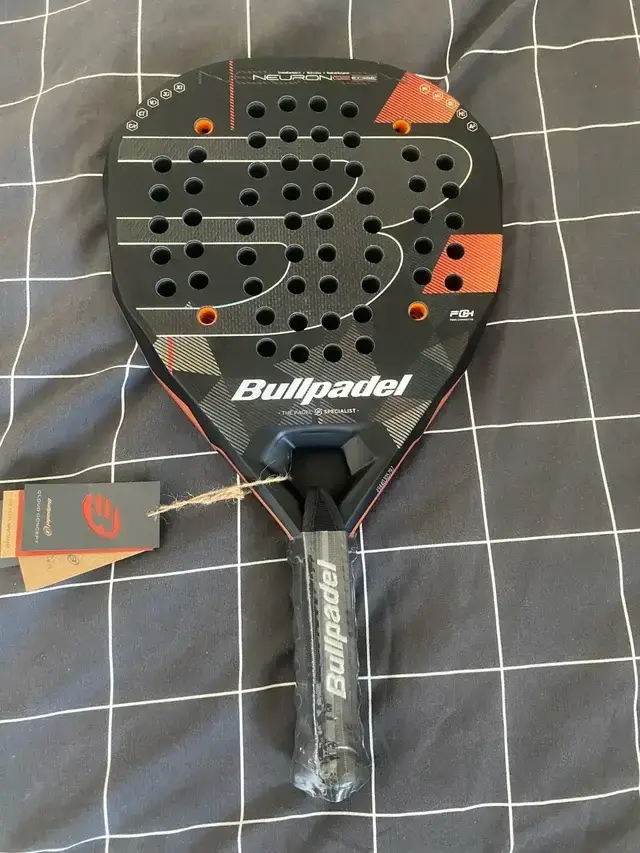
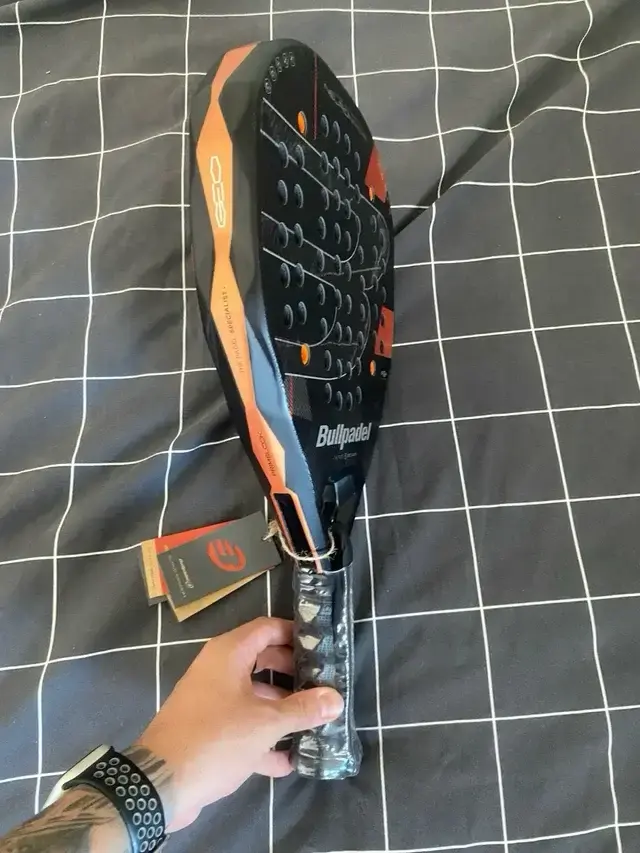
The Neuron 02 Edge sits within Bullpadel’s Neuron family as the more dynamic alternative to the standard Neuron 02. While both share the same core architecture and control-driven philosophy, the Edge version is tuned to deliver slightly more offensive output and faster ball exit, particularly in mid-speed exchanges and counter-attacking situations.
In Bullpadel’s 2026 lineup, the Neuron series is positioned below pure power frames such as Hack or Vertex and above entry-level control rackets. It targets players who want a modern control platform that remains playable under tempo, rather than maximum smash-oriented performance.
Technical specifications
| Spec | Value | What it means |
|---|---|---|
| Shape | Hybrid / teardrop-leaning geometry | Balanced power and control |
| Thickness | 38 mm | Thicker = more power and rebound |
| Weight range (claimed) | ~365–375 g (without overgrip) | Heavier = more stability, lighter = more speed |
| Measured weight (typical) | ~370–373 g (depending on CustomWeight configuration) | Heavier = more stability, lighter = more speed |
| Balance (measured) | medium to slightly head-heavy | Versatile, suits all styles |
| Face material | Xtend Carbon 12K | Good stiffness and durability |
| Core | MultiEVA (dual-density EVA) | Good balance of control and feel |
| Frame | CarbonTube (100% carbon construction) | Structural rigidity and durability |
| Surface texture | 3D textured finish | Determines feel and response |
| Adjustable balance system | Removable CustomWeight system at the head, allowing balance and swing inertia adjustment by adding or removing factory-installed weights (up to ~9 g total) | Very fast, control-focused |
Construction and materials
The Neuron 02 Edge is built around Bullpadel’s Xtend Carbon 12K face, which sits in the medium-firm range compared to classic 3K or fiberglass constructions. The carbon layup prioritizes structural stability and directional control rather than elastic rebound. Under load, the face deforms minimally, producing a clean and controlled ball exit rather than a trampoline effect.
The MultiEVA core combines two different EVA densities. The outer layer is firmer, stabilizing impact on volleys and overheads, while the inner layer is softer and absorbs vibration during defensive shots. In practice, this dual-density structure smooths impact without making the racket feel muted or overly soft.
The CarbonTube frame adds torsional rigidity, especially noticeable on off-center contact in the upper half of the face. Frame flex is limited, reinforcing the racket’s emphasis on consistency and controlled acceleration.
Shape and mould behavior
The hybrid mould positions the sweet spot slightly above center, but not as high as a full diamond design. Measured balance sits in the medium to slightly head-heavy range, which places the Neuron 02 Edge firmly between classic control frames and aggressive attack rackets.
This geometry favors structured rally play and controlled overheads rather than raw finishing power. The racket accelerates predictably through the swing, and the hybrid shape avoids the abrupt balance shifts typical of extreme attack moulds.
The removable weight system allows fine-tuning within this mould philosophy. Removing the weights shifts the racket closer to a neutral balance, improving maneuverability and defensive handling. Installing the weights increases swing inertia and stabilizes the head during overheads, particularly on flat smashes and controlled bandejas.
Stiffness, feel, and comfort
Despite the structured carbon face, overall feel is not harsh. The MultiEVA core filters vibration effectively, preventing excessive shock on defensive blocks and slower swings. Impact feedback is clear and informative, allowing precise ball placement without excessive stiffness.
Comfort levels are above average for a racket with this level of structural rigidity. However, it is not a soft or arm-protective frame. Players with sensitivity issues may prefer lighter or more elastic alternatives within the Bullpadel lineup.
Sweet spot and forgiveness
The sweet spot is medium-sized and positioned slightly above the geometric center. Compared to round control rackets, the effective hitting area is narrower, but more stable in the upper half of the face. Vertical forgiveness is better than lateral forgiveness, reflecting the hybrid geometry.
Off-center contact remains playable within a reasonable margin, especially when weights are installed, which reduce twisting on high-face impacts. However, mis-hits toward the lower face result in noticeable loss of depth and firmer feedback.
Power and smash behavior
Power output from the Neuron 02 Edge is controlled rather than explosive. The 12K carbon face does not generate significant free rebound, so depth and pace depend on player acceleration. On full swings, the racket delivers sufficient power for point construction and finishing when placement is prioritized over sheer speed.
Flat smashes benefit from the added head mass when weights are installed, increasing stability and consistency rather than peak velocity. Kick smashes and aggressive topspin overheads require clean mechanics, as the racket does not provide additional lift or elastic assistance.
Overall, power behavior aligns with a right-side or control-oriented attacking profile rather than a left-side finisher setup.
Net play and fast exchanges
At the net, the Bullpadel Neuron 02 Edge 2026 prioritizes stability over speed. The hybrid geometry and relatively firm face construction allow volleys to remain directional and controlled when the player is well positioned. Under pace, the racket resists twisting effectively, and blocked volleys tend to stay low rather than floating upward, which is a key advantage for right-side players managing pressure.
However, swing acceleration is not instantaneous. With real-world setups typically sitting around ~370–375 g and balance leaning slightly head-heavy, reaction speed in very fast hand battles is lower than with lighter or more neutral control frames. Late reactions are penalized more clearly than on softer rackets, as the face offers limited dwell time to “save” mistimed contact. In structured exchanges, the racket feels precise; in chaotic net scrambles, it demands anticipation rather than reflex.
Stability on off-center contact
Off-center stability is one of the stronger aspects of the Neuron 02 Edge. Impacts in the upper-central area of the face remain solid and predictable, with minimal frame deformation and consistent depth. This supports confident volleying and overhead preparation, particularly when absorbing pace from aggressive opponents.
Below the center and toward the lateral edges, performance drops more noticeably. Depth loss is gradual rather than abrupt, but feedback becomes firmer and more direct. Compared to the standard Neuron 02, the Edge version sacrifices a small amount of forgiveness in exchange for a cleaner, more decisive response. The sweet spot is moderately sized and vertically biased, favoring compact, well-prepared strokes rather than stretched defensive contact.
Practical on-court takeaways
In match conditions, the Neuron 02 Edge 2026 performs best in tempo-controlled rallies where positioning and structure define the point. From the right side, it excels at blocking, resetting pace, and transitioning forward with confidence. Volleys feel reliable when taken early, and the racket’s stability encourages assertive placement rather than passive defense.
Defensively, the racket provides sufficient depth when the player commits fully to the swing, but it does not generate free length. Lobs and resets under pressure require correct technique and timing. The Edge is less forgiving than the standard Neuron 02, but more precise once the player adapts to its firmer response.
Overall, the racket rewards consistency, anticipation, and clean mechanics. It is not designed to mask technical flaws, but for players who value repeatable outcomes and controlled aggression, it delivers a stable and modern on-court experience.
Comparison within the Bullpadel lineup
Bullpadel Neuron 02 2026 The baseline Neuron model emphasizes consistent control and directional stability. Its hybrid shape and carbon layup deliver reliable performance across defensive shots and structured attacks. It is positioned as a balanced control racket for intermediate to advanced players.
Bullpadel Neuron 02 Edge 2026 The Edge version builds upon the standard Neuron 02 platform by introducing faster response and controlled aggression, primarily through tuning and balance bias. Its hybrid geometry and 12K face material remain control-oriented, but the Edge has marginally higher tempo potential, making it better suited for players who want precision with the ability to accelerate without sacrificing stability. The removable CustomWeight allows players to fine-tune swing inertia and balance.
Bullpadel Vertex 05 2026 The Vertex 05 sits in the power category with a diamond head and 18K carbon face. It offers a higher attack ceiling compared to the Neuron models, making it effective for players who finish points with smashes and aggressive overheads. Its higher balance supports energy transfer on offensive strokes but reduces defensive ease.
Bullpadel Hack 04 2026 This model represents Bullpadel’s extreme power segment. With a head-heavy profile and stiff face, the Hack 04 maximizes smash output and explosive acceleration. It is tailored for players who prioritize offensive point endings over lateral forgiveness or soft defense.
Bullpadel Vertex Comfort 2026 The Comfort variant bridges power and accessibility. It retains 18K carbon but incorporates comfort-biased elements that improve forgiveness compared to the pure Vertex 05. This makes it suitable for players seeking power with reduced harsh feedback.
Comparison with other brands
When compared to control-oriented and hybrid rackets from other manufacturers, the Bullpadel Neuron 02 Edge 2026 positions itself as a tempo-control platform with modern tuning flexibility, rather than a classic soft control frame or an explosive power racket. Its defining characteristics are directional stability, predictable rebound, and the ability to slightly adjust swing inertia via removable weight, without pushing the racket into a demanding or overly stiff category.
Bullpadel Neuron 02 Edge 2026 vs NOX AT10 12K 2026 The NOX AT10 12K 2026 is more universally balanced and slightly firmer in feel. It offers a cleaner, more linear response under acceleration and higher stability at medium swing speeds. Compared to it, the Neuron 02 Edge feels marginally softer and more forgiving on defensive shots, especially lobs and resets. The AT10 12K favors players who want neutral all-court control, while the Neuron 02 Edge favors right-side players who prioritize placement, tempo variation, and consistency under pressure rather than raw punch.
Bullpadel Neuron 02 Edge 2026 vs Adidas Metalbone CTRL 3.5 2026 The Metalbone CTRL 3.5 is structurally stiffer and more compact in its response. It delivers sharper feedback and more immediate ball release, but its sweet spot is smaller and more sensitive to off-center contact. The Neuron 02 Edge, by contrast, offers a wider usable hitting area and smoother rebound, making it more forgiving in extended rallies. The Metalbone CTRL suits players who want precise, fast ball exits; the Neuron 02 Edge suits those who want margin and repeatability.
Bullpadel Neuron 02 Edge 2026 vs Head Coello Motion 2025 The Coello Motion emphasizes maneuverability and dynamic transitions, with easier acceleration and quicker recovery at the net. However, it provides less directional stability on slower, controlled shots. The Neuron 02 Edge feels calmer and more planted, particularly on blocks and controlled volleys. For right-side intermediate players focused on defensive reliability, the Neuron offers a more stable platform, while the Coello Motion favors speed and agility.
Bullpadel Neuron 02 Edge 2026 vs Babolat Technical Viper Soft 2026 The Viper Soft introduces significantly more elastic rebound and higher free power at medium swing speeds. While this helps generate depth easily, it also increases launch variability. The Neuron 02 Edge is notably more restrained and predictable, especially in flat exchanges and counter-attacks. Players seeking controlled construction of points will generally prefer the Neuron, whereas those looking for easier acceleration and offensive lift will gravitate toward the Viper Soft.
Technical positioning
The Bullpadel Neuron 02 Edge 2026 occupies a clearly defined position within the modern padel racket landscape: a controlled hybrid platform optimized for right-side players who prioritize consistency, tempo management, and directional reliability over raw power output.
From a technical standpoint, the racket sits between classic round control frames and neutral teardrop all-court designs. Its geometry and balance aim to stabilize the swing path and reduce variability on medium-speed shots, while still allowing controlled acceleration when the player commits fully. Unlike stiff control rackets that rely on sharp, immediate rebound, the Neuron 02 Edge deliberately softens ball exit to keep trajectories predictable and margins manageable during long rallies.
The use of a removable weight system is central to its positioning. Rather than transforming the racket’s character, the weight allows fine adjustment of swing inertia—typically in the range of a few grams—letting players increase head presence slightly for stability or reduce it for maneuverability. This tuning capability differentiates the Neuron 02 Edge from many competitors in the same segment, which lock the player into a fixed balance profile.
Importantly, the racket avoids extreme specialization. It does not chase maximum smash speed, nor does it attempt to feel ultra-soft or ultra-stiff. Instead, it is engineered to maintain repeatable output under pressure, especially in defensive exchanges, blocks, controlled volleys, and placement-focused overheads. This makes it particularly suitable for intermediate to advanced right-side players who build points patiently and rely on minimizing errors rather than forcing finishes.
In the broader market, the Neuron 02 Edge aligns with rackets designed for match stability rather than highlight shots. It competes directly with modern control-leaning hybrids that emphasize reliability, comfort, and tactical flexibility, offering a technically coherent option for players who want structure and consistency without sacrificing adaptability.
Technical performance score
Ten categories, each 0–10. Methodology →
- Maneuverability and handling8.0
- Net performance under pace8.0
- Control and placement precision8.0
- Defensive output and depth access8.0
- Off-center stability and torsional resistance7.0
- Sweet spot usability8.0
- Spin generation potential7.0
- Power ceiling6.0
- Power accessibility7.0
- Comfort and impact feedback8.0
Final verdict — Bullpadel Neuron 02 Edge scores 75/100. A strong performer with strong control and placement precision, a solid choice for intermediate to advanced players.
Common questions
This racket makes the most sense for right-side players and for all-court players who prioritize stable net play, predictable blocks, and controlled construction of points. It fits players who win rallies through placement, tempo control, and consistent transitions rather than constant maximum-power overhead sequences.
The Edge version is typically the more defined and more “structured” interpretation of the Neuron family. In practical terms, it tends to feel a bit more selective about contact quality: the best output comes when you meet the ball cleanly, while imperfect contact is less “smoothed over” than on more forgiving hybrids. Players who like a clearer response and more direct feedback usually prefer Edge; players who want more automatic forgiveness typically prefer the non-Edge direction.
It is best described as a control-first performance racket with enough offensive capacity to finish when you accelerate correctly. It is not designed as a pure smash amplifier. If your expectation is that the racket should generate depth and speed with medium effort, this one will feel more disciplined and player-driven.
Net performance is one of its main use cases. When you are set early, volleys and blocks tend to stay stable and directional, with fewer accidental pop-ups than highly elastic faces. The trade-off is that late reactions are still punished—this is not a “miracle rescue” racket—but it is generally consistent for prepared, compact volleying.
Defensive depth is accessible, but not “automatic.” You can build depth reliably when your technique is clean, but the racket does not behave like a trampoline frame that gives free length on short swings. If your game is heavy on defensive lobs and resets under stress, you will benefit most if you already have solid timing and structure.
It can make a real, noticeable difference because you are adding or removing physical mass rather than changing feel through marketing terms. The effect is straightforward: more installed weight increases stability and finishing authority, but also increases swing inertia and fatigue over long exchanges. Less weight improves handling and reaction speed, but reduces “plow-through” on hard impacts. It is tuning, not transformation—but it is tangible.
Based on direct use, the practical difference is minimal. The more noticeable effect is that the foam response around the damper areas can feel slightly altered, sometimes in a way that reduces the clean uniformity of rebound. Treat Ease Vibe as optional—your decision should be driven by the racket’s underlying behavior, not by the dampers.
Yes, if the player values structure and consistency. It is not an “easy power” racket, but intermediates who play controlled padel and want stable results—especially on the right side—can use it effectively. Players who rely on free depth or very elastic help may prefer a softer, more trampoline-oriented alternative.
Buying it expecting it to behave like a pure comfort frame or a pure power trampoline. The Neuron 02 Edge is strongest when you play organized padel: stable blocks, deliberate volleys, and controlled acceleration. If your game is mostly improvisation, late contact, or “quick flicks for free depth,” you may find it less forgiving than expected.