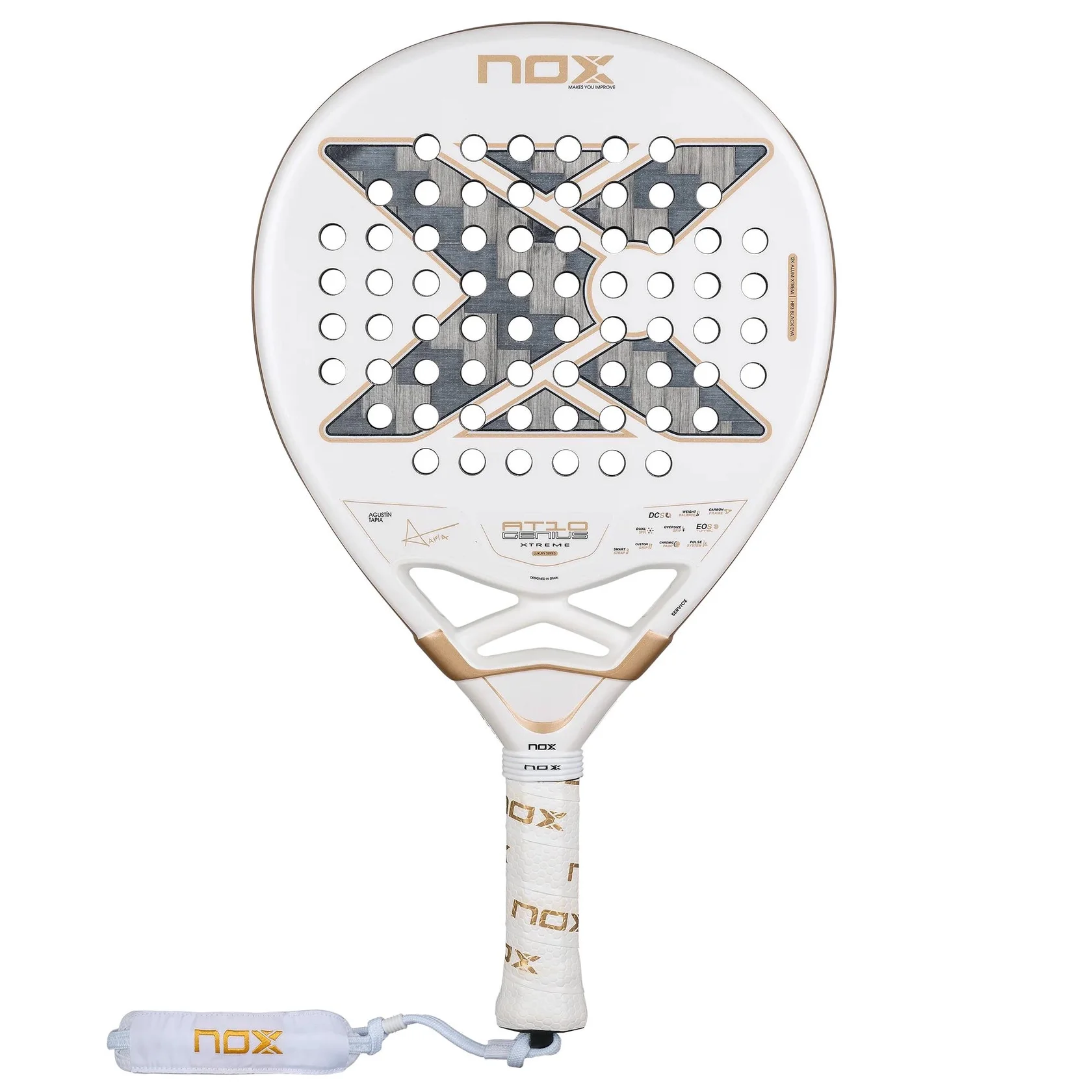
NOX AT10 Luxury Genius 12K Alum XTREM 2026
Version and lineup identification
This review covers the AT10 Luxury Genius 12K Alum XTREM 2026 in the teardrop, or hybrid, shape. Within the 2026 AT10 lineup, this model exists alongside several closely related but materially different versions. The AT10 18K Alum uses a softer carbon and core combination aimed at comfort and higher ball output. The AT10 Attack shifts weight upward in a diamond shape to prioritize overhead power. The AT10 Lite reduces static weight and softens the core to improve maneuverability and arm comfort.
The 2026 generation introduces a unified technology platform across the AT10 family. The Weight Balance system allows fine adjustment of swing weight using small removable weights, enabling measurable shifts in effective balance without altering grip setup. Dual Spin applies a combined 3D texture and sandy finish across the entire face to stabilize grip. The EOS Tunnel redesign in the throat improves airflow and subtly redistributes mass, while Dynamic Composite Structure extends frame material deeper into the face to improve durability and off-center stability. Together, these changes explain why the 2026 AT10 feels meaningfully different on court despite similar headline numbers.
Technical specifications
The AT10 12K 2026 uses a 38 mm teardrop frame with a published weight range of 360 to 375 grams, equivalent to approximately 12.7 to 13.2 ounces. In real playing setups with one or two overgrips, most rackets fall between 360 and 365 grams. Independent measurements reported by testers commonly place balance between 25.2 and 25.9 centimeters, depending on grip thickness and whether head weights are installed.
The face is built from 12K Alum carbon tuned by NOX to be firmer than its 18K equivalent. The core is HR3 Black EVA, a high-density foam designed to reduce excessive ball pocketing and return energy more directly. Surface roughness is provided by the Dual Spin treatment across the entire face. An extended handle increases grip length by roughly 30 millimeters to support two-handed backhands and overhead leverage.
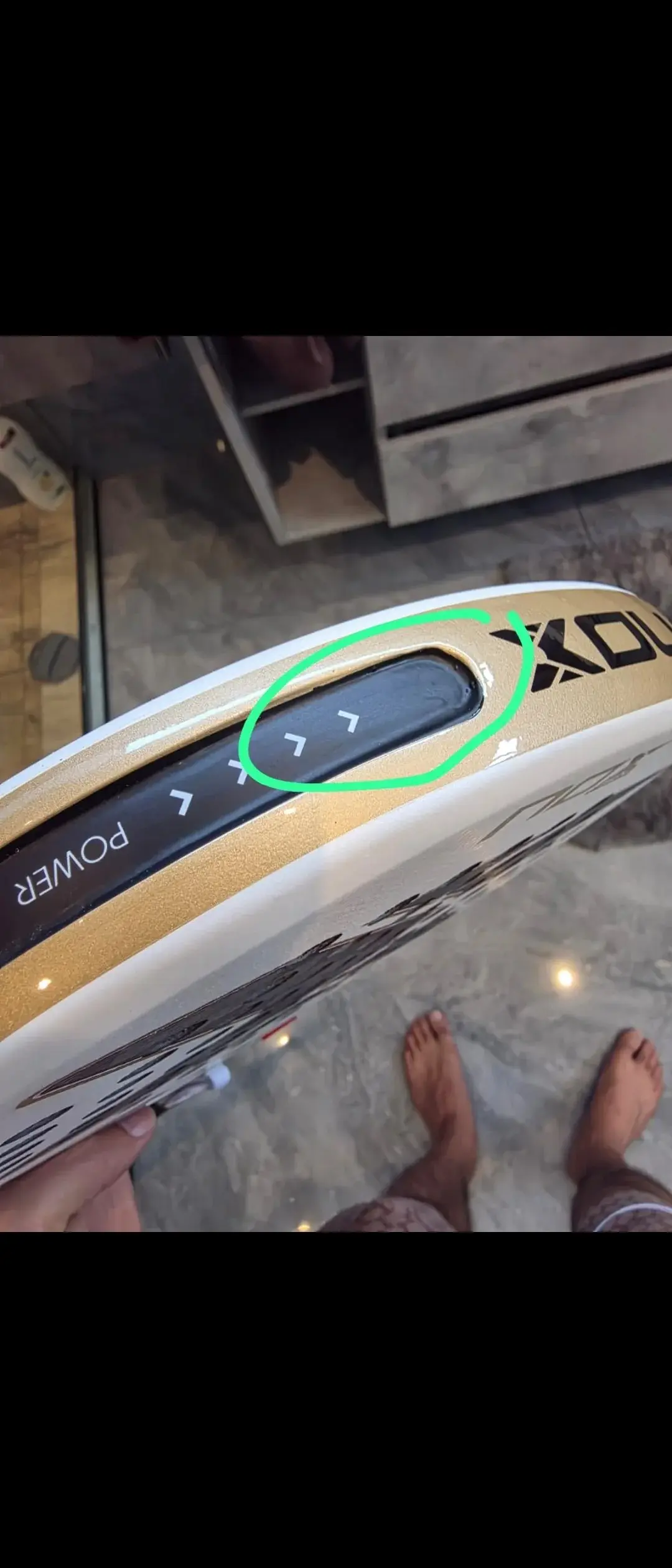
Across the entire Nox 2026 lineup with the additional weight-adjustment feature, the extra-weight strips are glued onto the racket and are not removable.
Construction and materials
The defining construction change in the AT10 12K 2026 is the interaction between the 12K Alum carbon face and the HR3 Black EVA core. Compared to earlier AT10 faces, the 12K Alum layer flexes less under load, which shortens dwell time and produces a more linear rebound profile. The HR3 Black EVA engages later in the compression cycle, reducing the trampoline effect associated with softer foams.
The EOS Tunnel throat redesign reduces air resistance and shifts mass slightly toward the handle. This helps explain why many measured setups show a balance reduction of several tenths of a centimeter compared to 2025 configurations. Dynamic Composite Structure reinforces the transition between frame and face, improving durability and torsional stability without significantly increasing swing weight. These construction choices create a racket that feels firmer and more controlled without becoming excessively heavy or harsh.
Shape and mould behavior
In teardrop form, the AT10 12K maintains a neutral balance profile that supports all-court play. The center of mass remains close enough to the hand to preserve defensive stability and quick reactions at the net. Compared to the Attack version, which shifts balance upward and increases rotational inertia, the teardrop 12K requires less physical effort over long matches and behaves more predictably in transition situations.
12K versus 18K in the AT10 family
A recurring point of confusion is the relationship between 12K and 18K carbon. In the AT10 lineup, the 12K version is intentionally stiffer than the 18K. On court, this difference is immediate. The 18K models provide higher ball output and deeper shots at moderate swing speeds, while the 12K produces lower output but greater directional control.
Static weight ranges overlap, but the feel diverges due to core behavior. The 18K compresses more deeply and masks timing errors, whereas the 12K requires more swing speed to achieve the same depth. For players who generate their own pace, the 12K offers clearer feedback and more precise placement. For players who rely on the racket for assistance, the 18K remains the easier option.
Stiffness, feel, and comfort
The AT10 12K 2026 delivers a firm but controlled feel. Compared to the 2025 AT10 18K, dwell time is shorter and feedback is more immediate. At medium swing speeds, the ball exits the face more slowly but with improved directional stability. At higher swing speeds, rebound remains predictable rather than explosive.
Comfort is acceptable for advanced players, aided by vibration-damping elements in the handle. However, compared to softer AT10 versions, arm fatigue can increase during long sessions, particularly for players who rely on the racket to absorb impact during defense. The 12K rewards clean mechanics and timing but offers less passive assistance.
Sweet spot and forgiveness
The physical sweet spot remains large, covering roughly the central 60 percent of the face. Within this zone, stability is excellent and shot outcomes are repeatable. Outside the sweet spot, forgiveness drops more quickly than on the 18K models. Shots struck high on the face or toward the edges lose depth and stability earlier, especially on defensive lobs.
Compared to the 2025 AT10 18K, which tended to carry the ball even on imperfect contact, the 2026 12K demands better positioning and preparation. For players who prioritize consistency over error masking, this behavior is often preferable.
Power and smash behavior
Power delivery on the AT10 12K 2026 is linear rather than explosive. At approximately 70 to 80 percent swing speed, output is controlled and measured. At full acceleration, the HR3 Black EVA engages fully and produces enough pace to finish points, particularly on topspin overheads.
Flat smashes require more effort than with higher-balance rackets or softer cores. Adding head weight can raise effective balance from around 25.2 centimeters toward 26.0 or 26.3 centimeters, increasing smash effectiveness without dramatically slowing handling. The racket favors controlled finishing over raw power.
Net play and fast exchanges
Net performance is one of the strongest areas of the AT10 12K 2026. The lower effective balance and reduced rotational inertia make reaction volleys faster than on many competing control rackets that sit closer to 26.5 or 27.0 centimeters in balance.
Under pace, the firmer face keeps blocks low and predictable, reducing accidental pop-ups. Punch volleys and finishes require a more active swing compared to softer AT10 versions, but the benefit is improved placement and confidence when absorbing speed.
Stability on off-center contact
On centered hits, the racket remains stable and composed. On off-center contact, particularly near the tip, torsional stability drops more quickly than on heavier, higher swing-weight rackets. Compared to the 2025 AT10 18K, the 2026 12K is less forgiving laterally. Compared to the 2025 12K, the difference is present but smaller.
Adding 4 to 8 grams of head weight improves stability noticeably, at the cost of slightly slower hand speed. This adjustability allows players to tune the racket toward their preferred balance between speed and forgiveness.
Practical on-court takeaways
On court, the AT10 12K 2026 plays like a racket that removes assistance in exchange for clarity. In defensive situations, the lower rebound helps keep blocks and counters from flying long, making placement easier under pressure. During slower exchanges such as resets and controlled drops, players must apply a more deliberate push to reach the same depth as with softer rackets. Once adjusted, depth control becomes more repeatable because the response is linear rather than spring-loaded.
At the net, faster handling and calmer rebound stand out immediately. Reaction volleys feel quicker, and it is easier to change direction late without over-rotating the face. Overheads reward full commitment and good technique, favoring topspin and placement over brute force. Over the course of a match, the racket supports consistent play but does not hide technical flaws.
Comparison with NOX rackets
2026 versus 2025
Compared to the AT10 18K 2025, the 2026 12K is firmer, lower output, and more precise. Effective balance is typically 0.3 to 0.5 centimeters lower, resulting in faster handling but less inherent power. Compared to the AT10 12K 2025, the 2026 version is stiffer and slightly less forgiving, with similar static weight but a clearer, more defined feel at impact.
Upgrading from 2025 makes sense primarily for players who felt the earlier models were too soft or vague. Players who valued comfort and assistance may prefer to stay with the previous generation.
2026 versus 2024
Relative to AT10 models from 2024, the 2026 12K feels closer in stiffness while offering improved maneuverability. Balance distribution is more refined, and rebound behavior is more predictable. Players upgrading from 2024 will likely find the feel familiar but notice faster handling and better control in fast exchanges.
Comparison with other brands
Compared to control-oriented teardrop rackets such as the Bullpadel Vertex Control, Adidas Metalbone Ctrl, and Head Speed Pro, the AT10 12K 2026 sits on the firmer and more technical end of the spectrum. Rackets like the Vertex Control typically provide higher ball output at medium swing speeds, offering easier depth but livelier response under pace. The AT10 produces less free depth but greater directional stability.
Against the Metalbone Ctrl, balance differences are significant. Many Metalbone setups approach 26.5 to 27.0 centimeters in balance, while the AT10 commonly sits closer to 25.2 to 25.6 centimeters. That 1.0 to 1.5 centimeter gap translates into faster hand speed for the AT10, especially in reaction volleys, at the cost of some overhead leverage.
Compared to the Head Speed Pro, which emphasizes dampening and pocketing, the AT10 feels drier and more immediate. Players switching from the Speed Pro often need to generate more depth themselves but gain confidence in placement once adjusted.
Relative to power-oriented designs such as the Babolat Technical Viper, the AT10 sacrifices smash ceiling in exchange for lower fatigue and better consistency over long matches. Spin performance is competitive but not class-leading, favoring consistency over extreme bite.
Technical positioning
The NOX AT10 12K Alum XTREM 2026 is a control-focused evolution of the AT10 concept. Its strengths lie in predictable response, fast handling, and precision under pace. Its weaknesses are reduced forgiveness and lower free power compared to softer variants.
Upgrading from previous AT10 generations is justified if the goal is tighter control and clearer feedback. It is not justified if comfort and assistance were the primary reasons for choosing an AT10. Within the broader market, the AT10 12K remains one of the more technically demanding teardrop rackets, aimed squarely at upper-intermediate and advanced players who value control over convenience.
Final score: 77 / 100
A final score of 77 places the NOX AT10 Luxury Genius 12K Alum XTREM 2026 firmly in the category of strong, specialized control rackets with clear strengths and equally clear trade-offs. It excels in handling speed, net performance, and placement precision, while sacrificing free power, forgiveness, and easy depth.
This racket is best suited for upper-intermediate to advanced players who generate their own pace and value predictability over assistance. Upgrading from earlier AT10 generations makes sense for players who found previous versions too soft or imprecise. For those prioritizing comfort or effortless depth, softer alternatives within or outside the NOX lineup may be a better fit.
Technical performance score
Ten categories, each 0–10. Methodology →
- Maneuverability and handling9.0
- Net performance under pace9.0
- Control and placement precision9.0
- Defensive output and depth access7.0
- Off-center stability and torsional resistance7.0
- Sweet spot usability8.0
- Spin generation potential7.0
- Power ceiling8.0
- Power accessibility6.0
- Comfort and impact feedback7.0
Final verdict — NOX AT10 Luxury Genius 12K Alum XTREM scores 77/100. A strong performer with strong control and placement precision, a solid choice for intermediate to advanced players.
Common questions
Yes. The 2026 12K is tuned to feel firmer and more linear on impact, with shorter dwell time and less “free bounce” than the 2025 AT10 variants. In practical terms, this typically shows up as calmer blocks under pace, tighter placement on medium-speed shots, and less automatic depth from defensive positions. The trade-off is that you have to generate a bit more of your own length and speed, especially when defending or when playing at 70–80% effort rather than full acceleration.
Yes — and this is one of the most important “don’t get confused” points for AT10 buyers. In the AT10 family, the 12K version is intentionally tuned to be stiffer than the 18K version. The 18K typically feels softer, pockets the ball more, and produces depth more easily at moderate swing speeds. The 12K feels drier and more direct, which tends to improve directional control and reduce random pop-ups under pace, but also reduces passive assistance. If your priority is comfort and easy output, the 18K is often the safer choice; if your priority is control clarity and net stability, the 12K is the more technical tool.
Not really. Defensive depth is achievable, but it is not “free.” Compared with softer or more elastic rackets, the AT10 12K requires more deliberate technique to get the ball deep from awkward positions. You’ll usually need a more active push on lobs and resets, and if you play too passively the ball can land short. The upside is that the racket is less likely to over-launch the ball long when you are simply trying to survive a fast rally. If you are a player who defends primarily by absorbing pace rather than creating it, you may prefer the 18K or a softer competitor; if you defend by placing the ball accurately and you don’t want trampoline behavior, the 12K works extremely well.
Its biggest strength is staying calm under pace while still being fast in the hand. With typical playing weights around 360–365 g and an effective balance commonly reported around 25.2–25.6 cm (depending on grip setup and weights), the racket tends to feel quicker than many control-oriented models that live closer to 26.5–27.0 cm in balance. In real play, that shows up as faster reaction volleys, easier last-second redirection, and more predictable blocks and counters. You get a “clean” rebound rather than a lively one, which reduces accidental pop-ups in hand battles.
It depends on what you want to change. The upgrade makes sense if you want a firmer, more precise response with less free bounce and a clearer sense of direction on impact. Players who felt the 2025 generation was a bit too soft, too springy, or too vague in fast exchanges are the most likely to benefit. If your priority is comfort and forgiveness, and you already like how the 2025 AT10 behaves in defense and on off-center contact, the 2026 12K may feel less friendly. In that case, either staying on the 2025 model or moving to the 2026 18K version is often the more logical choice.
The two faces of NOX rackets are technically identical, with rare exceptions limited to certain LTD models. The “Service” marking does not indicate any difference in performance, materials, or playing characteristics of that side of the racket. It is used only before the match to determine which team serves first. Players can spin the racket on the court, and if the side with the “Service” marking ends up facing up, the guessing team starts the match with the serve.