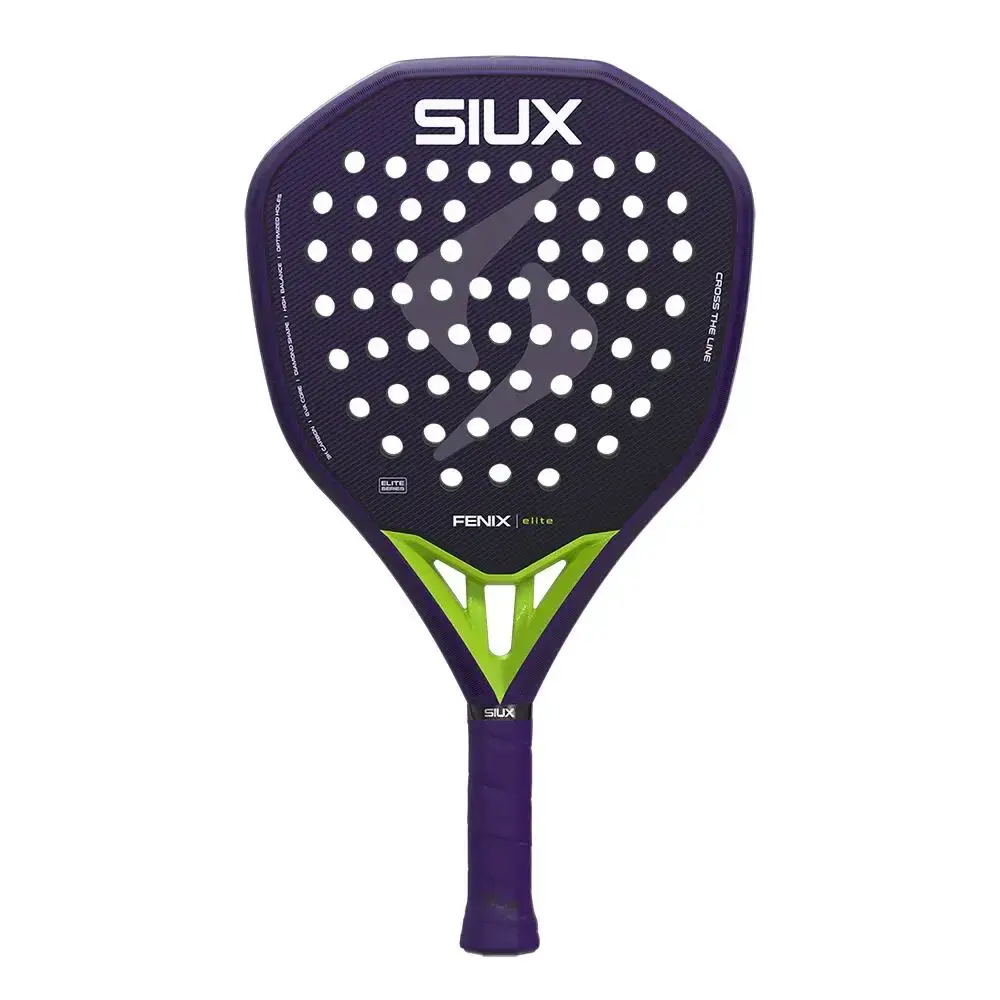
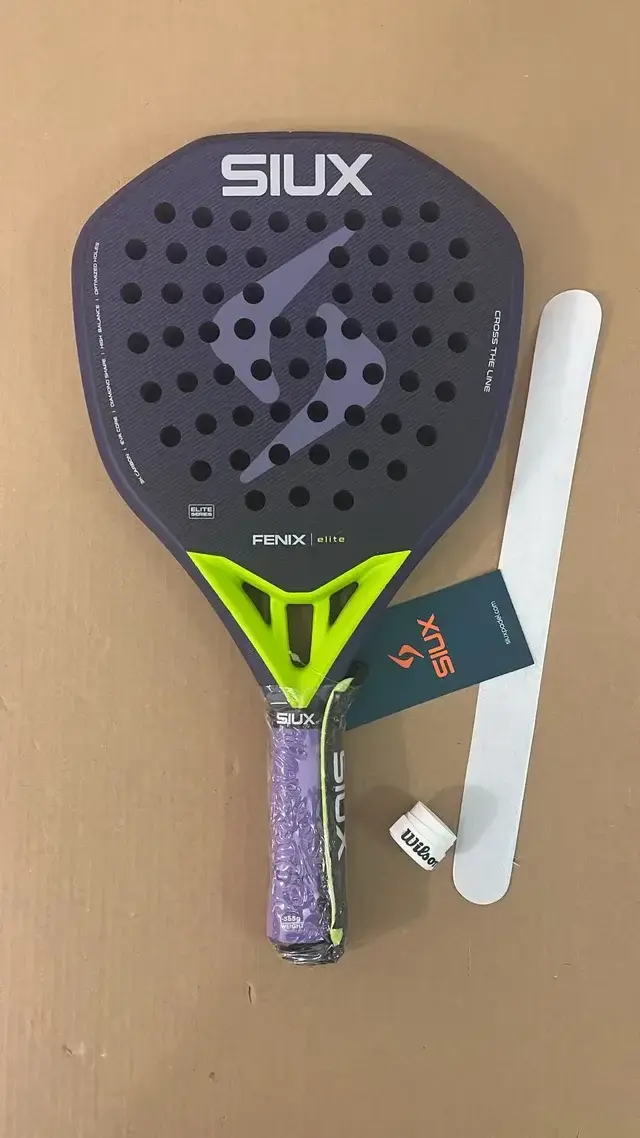
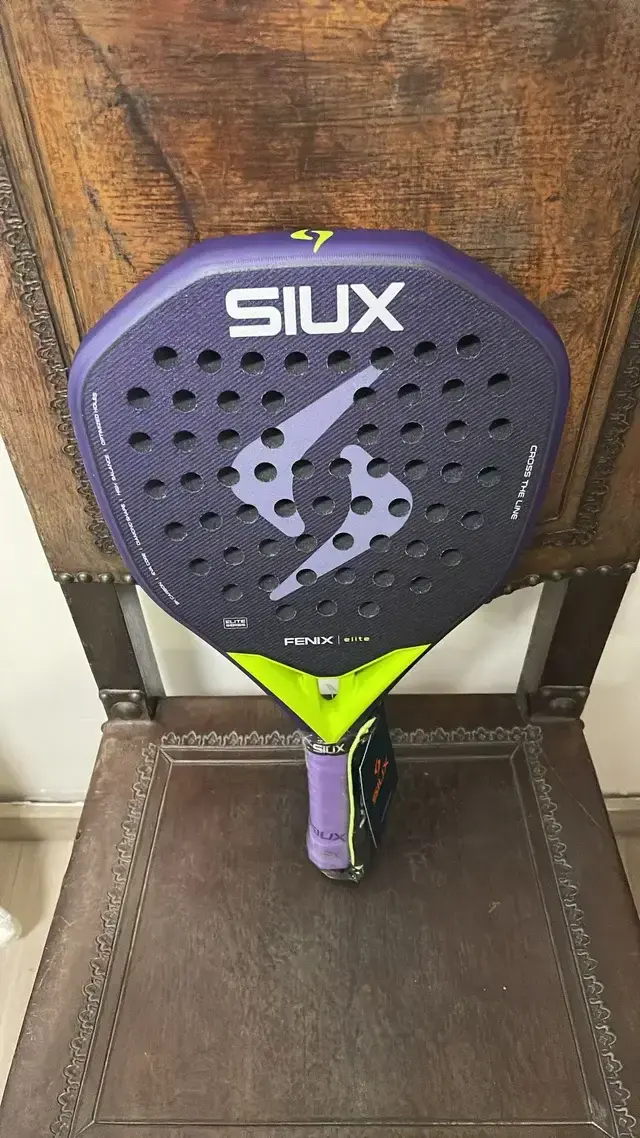
SIUX Fenix Elite 2026
Version and lineup identification
Within the SIUX Fenix lineup, the Fenix Elite 2026 sits below the Pro model and above comfort-oriented alternatives.
• Fenix Pro — stiffer, more demanding, higher power ceiling, maximum precision at speed • Fenix Elite — easier power access, higher reactivity, broader sweet spot, reduced physical demand • Other SIUX offensive models — typically lower balance or softer profiles
Compared to the Pro, the Elite trades stiffness and precision for accessibility and ball output. It is aimed at advanced amateurs and competitive players who want offensive assistance without the technical demands of the Pro-level frame.
Technical specifications
| Spec | Value | What it means |
|---|---|---|
| Shape | Diamond | High balance, power-oriented |
| Weight | ~355–375 g | Heavier = more stability, lighter = more speed |
| Profile | 38 mm | |
| Balance | High (≈ 27.0–27.2 cm) | More power, less maneuverability |
| Face material | Carbon 3K | Stiff, precise and powerful |
| Core | Hard EVA | Good balance of control and feel |
| Frame | Carbon with Bitube reinforcement | Structural rigidity and durability |
| Surface finish | Sand / sandblasted | Determines feel and response |
| Hole pattern | Optimized drilling | |
| Strap system | Switch Strap | |
| Player level | Advanced amateur / Competitive | Ideal skill level for this racket |
| Racket type | Offensive power-oriented diamond |
Construction and materials
The SIUX Fenix Elite 2026 uses a Carbon 3K face combined with a Hard EVA core, resulting in a reactive and firm impact feel. The 3K carbon provides quicker ball exit and slightly more dwell time than stiffer carbon constructions, improving accessibility while maintaining offensive intent.
Structural rigidity is supported by a Bitube carbon frame, designed to enhance torsional stability and distribute impact forces more evenly across the face. This contributes to the racket’s solid response on clean contact, particularly in the upper hitting zone.
A sandblasted surface finish improves friction at contact, supporting spin generation on vibora and slice shots. The optimized hole pattern concentrates fewer perforations around the upper sweet spot, reinforcing the area most frequently used in attacking play.
Vibration filtering is functional but not a primary focus. Impact feedback remains direct and firm, aligning with the racket’s power-oriented design.
Shape and mould behavior
The Fenix Elite 2026 features a classic diamond mould with a clearly high balance, pushing the sweet spot toward the upper section of the face. This geometry enhances leverage and power on overheads, vibora, and smashes.
In play, the mould promotes fast ball exit and aggressive trajectories. The racket naturally favors forward acceleration and aerial finishing, while demanding greater effort in defensive recovery and low-position shots.
The sweet spot is moderately sized and readable, but not forgiving. Clean contact in the upper-middle zone produces strong output, while off-center hits lead to noticeable drops in control and rebound efficiency.
Overall, the mould behavior reinforces the Fenix Elite’s role as a purpose-built attacking diamond, optimized for players who rely on aerial dominance rather than extended defensive rallies.
Stiffness, feel, and comfort
The SIUX Fenix Elite 2026 delivers a firm and reactive impact feel, positioned slightly above medium stiffness. The combination of Carbon 3K faces and a Hard EVA core results in a quick rebound with limited dwell time, especially at higher swing speeds.
At low tempo, the racket feels lively rather than cushioned, requiring controlled input to avoid over-hitting. As acceleration increases, the frame stabilizes and produces a more predictable response, aligning with its offensive design.
Comfort is not the primary focus of the Fenix Elite. While vibration transmission is not excessive, the high balance and firm core contribute to increased arm fatigue during long sessions, particularly for players who rely heavily on defensive blocking or quick recovery shots.
Sweet spot and forgiveness
The sweet spot on the Fenix Elite 2026 is medium in size and positioned clearly in the upper section of the face. This placement favors overhead play and aggressive attacking strokes but reduces forgiveness on lower or lateral mis-hits.
Lateral forgiveness is limited, with off-center contact resulting in noticeable drops in control and consistency. Vertical mis-hits below the sweet spot are especially penalizing, requiring additional swing compensation to maintain depth.
Overall, the racket offers functional but limited forgiveness, reinforcing the need for clean technique and accurate contact timing.
Power and smash behavior
Power generation is one of the defining strengths of the SIUX Fenix Elite 2026. The high balance and reactive construction provide strong leverage on overheads, allowing players to accelerate the ball effectively with less effort.
Flat smashes benefit from fast ball exit and solid impact, while kick smashes receive additional assistance from the elevated sweet spot and sandblasted surface. When contact is clean, the racket delivers a high power ceiling suitable for point-finishing play.
However, this power comes at the expense of control margins. Smash effectiveness drops significantly outside the sweet spot, emphasizing precision over forgiveness. The Fenix Elite rewards confident, aggressive swings but does not compensate for late or poorly positioned contact.
Net play and fast exchanges
At the net, the SIUX Fenix Elite 2026 emphasizes power over agility. The high balance and head-heavy feel reduce maneuverability in rapid hand exchanges, requiring earlier preparation and deliberate positioning.
When the racket is set in front of the body, volleys carry noticeable weight and depth, making it effective for finishing points quickly. Blocking volleys benefit from the racket’s mass and stiffness, but passive reactions often result in short or uncontrolled responses.
In fast exchanges, the Fenix Elite demands physical commitment and anticipation. Players who rely on reflex-based play may find the racket slow to reposition, while those who prefer proactive, attacking net play will extract more value.
Stability on off-center contact
The Fenix Elite 2026 offers adequate structural stability, but its tolerance for off-center contact is limited. The Bitube carbon frame helps control torsional twisting, yet the high balance amplifies the effects of mis-hits.
Lateral off-center impacts lead to noticeable loss of control and directional accuracy. Vertical mis-hits, particularly below the sweet spot, significantly reduce rebound efficiency and require compensatory swing adjustments.
While the racket remains solid on clean contact, it does not mask technical errors. Stability is functional but clearly secondary to offensive output in the overall design.
Practical on-court takeaways
In real match conditions, the SIUX Fenix Elite 2026 performs best in aggressive, aerial-focused game plans.
Players who build points through vibora, bandeja, and smash will benefit from the racket’s power assistance and high sweet spot. It rewards confident acceleration and assertive positioning at the net.
Conversely, players who depend on defensive scrambling, fast exchanges, or prolonged rallies may find the racket physically demanding and less forgiving.
Overall, the Fenix Elite 2026 is most effective in the hands of offensive-minded players, particularly on the left side, who prioritize finishing potential over defensive ease and maneuverability.
Comparison within the SIUX lineup
Within SIUX’s offensive lineup, the Fenix Elite 2026 is positioned as the accessible power option, sitting below the Pro version and above older or softer attacking models.
Compared to Fenix Pro, the Elite version offers easier power access and lower technical demand, but sacrifices precision, stability at pace, and overall control. The Pro is clearly aimed at high-level players who generate their own speed, while the Elite supports offensive play with more assistance.
Against models like SIUX Pegasus or Diablo, the Fenix Elite stands out through its higher balance and more aggressive diamond geometry. While those models prioritize balance and versatility, the Fenix Elite commits fully to attack-first behavior.
Comparison with other brands
When compared to offensive rackets from other brands, the SIUX Fenix Elite 2026 aligns with power-assisted diamond frames, favoring aerial dominance over maneuverability.
Against Bullpadel Vertex 05 GEO, the Fenix Elite feels more reactive and easier to power, but significantly less stable and less controlled under high tempo. Vertex GEO offers a more disciplined power profile with better torsional resistance.
Compared to Adidas Metalbone Attack, the Fenix Elite is less adjustable and less explosive at the top end, but provides quicker access to power for players who do not generate maximum swing speed consistently.
Against NOX AT10 Attack, the Fenix Elite delivers higher raw power and faster ball exit, while the AT10 Attack maintains superior control, spin consistency, and defensive comfort.
Compared to StarVie Triton, the Fenix Elite feels less refined and less stable, but more immediately aggressive. Triton favors structured power and control, while the Fenix Elite leans toward instant offensive output.
Technical positioning
The SIUX Fenix Elite 2026 is best positioned as a power-forward diamond racket designed for players who want offensive assistance without stepping into fully professional-level demands.
It is not a versatile all-round platform, nor is it intended to support defensive consistency or rapid net exchanges. Instead, it excels when used proactively, rewarding players who dictate play through overheads and attacking pressure.
Within the SIUX lineup, the Fenix Elite serves as the gateway to the Fenix Pro, offering a taste of high-balance, attacking performance with a reduced technical threshold.
Technical performance score
Ten categories, each 0-10. Methodology →
- Maneuverability and handling6.0
- Net performance under pace6.5
- Control and placement precision6.5
- Defensive output and depth access7.0
- Off-center stability and torsional resistance6.5
- Sweet spot usability6.5
- Spin generation potential7.0
- Power ceiling8.5
- Power accessibility7.5
- Comfort and impact feedback6.5
Final verdict — SIUX Fenix Elite scores 70/100. A competent mid-range option with balanced performance across categories, well suited to developing and recreational players.
Common questions
The Fenix Elite 2026 is best suited for advanced amateurs and competitive players who want an attack-first diamond with clear help in overhead play. The defining trait is its high balance (~27.0–27.2 cm), which increases leverage on vibora, bandeja, and smash, but also makes the racket slower in fast exchanges. If your game plan relies on taking space, playing above shoulder height, and finishing points, the Elite fits the profile. If your style is defense-heavy, counter-punching, or based on rapid net reactions, the high balance and firm rebound will feel physically demanding.
Think of the Elite as the accessible offensive version and the Pro as the precision-demanding offensive version. Retail specs consistently place Elite around Carbon 3K + Hard EVA, while Pro is typically listed with a stiffer carbon construction (often 12K). In practice, the Elite provides easier power access—the ball leaves the face faster with less effort—while the Pro tends to offer a higher control ceiling at maximum pace if you have the technique to exploit it. If you want offensive assistance without the Pro’s demand for perfect timing and full acceleration, the Elite is the easier entry point.
Forgiveness is limited. The racket’s sweet spot is medium-sized and positioned upper on the face due to the diamond geometry and high balance. Clean contact in the upper-middle zone produces strong output; contact below that zone tends to lose rebound efficiency and requires swing compensation to keep depth. Lateral mis-hits also reduce directional accuracy noticeably. In short: it is not punitive like some extreme power frames, but it does not hide mistakes—especially in defense and under pressure.
It can be used on the right side, but it is not optimized for that role. Right-side play often requires fast preparation, quick volley resets, and high defensive volume, and the Fenix Elite’s high balance (~27 cm) makes these tasks more demanding. A right-side player with strong technique and proactive net positioning can still make it work—especially if they finish points early—but for most players the Elite will feel more natural on the left side where overhead dominance is a bigger part of the job.
Defense is playable, but it requires active mechanics. The racket can provide decent depth thanks to its power assistance, but the control margin at low tempo is narrower than on balanced or control-oriented models. Passive blocks and late defensive swings are where the Elite feels least comfortable: the head-heavy inertia slows recovery, and the firm core reduces “cushioning.” If your baseline game is built around controlled lobs, resets, and repeated defensive contacts, you will likely prefer a lower-balance hybrid or a softer all-round platform.
This is one of the racket’s strongest areas. The high balance increases lever effect and helps generate weight in the ball when you accelerate through vibora and bandeja. The sand finish supports bite and directional control on slice-based overheads. The key requirement is preparation: the Elite rewards players who arrive early and swing through the shot rather than improvising late. If your overheads are a core part of your point construction, the Elite provides measurable performance upside.
Yes, relative to many Pro-level frames. The Elite offers a high power ceiling and good accessibility: players typically do not need extreme swing speed to generate meaningful overhead pace. Flat finishing benefits most from the racket’s quick exit, while kick smashes are supported by the elevated sweet spot and textured face—provided contact is clean. The main limitation is forgiveness: the power payoff drops quickly outside the sweet spot, so timing still matters.
Comfort is acceptable but not a strength. The feel is firm, and high balance increases fatigue over time—especially for players who defend a lot or play long rallies. If you play multiple sessions per week and have any elbow/shoulder sensitivity, you should be cautious with high-balance, firm-core rackets. As a general rule, the Elite is easier to tolerate when your match style is proactive and point length is moderate, and harder to tolerate when your style forces long defensive sequences.