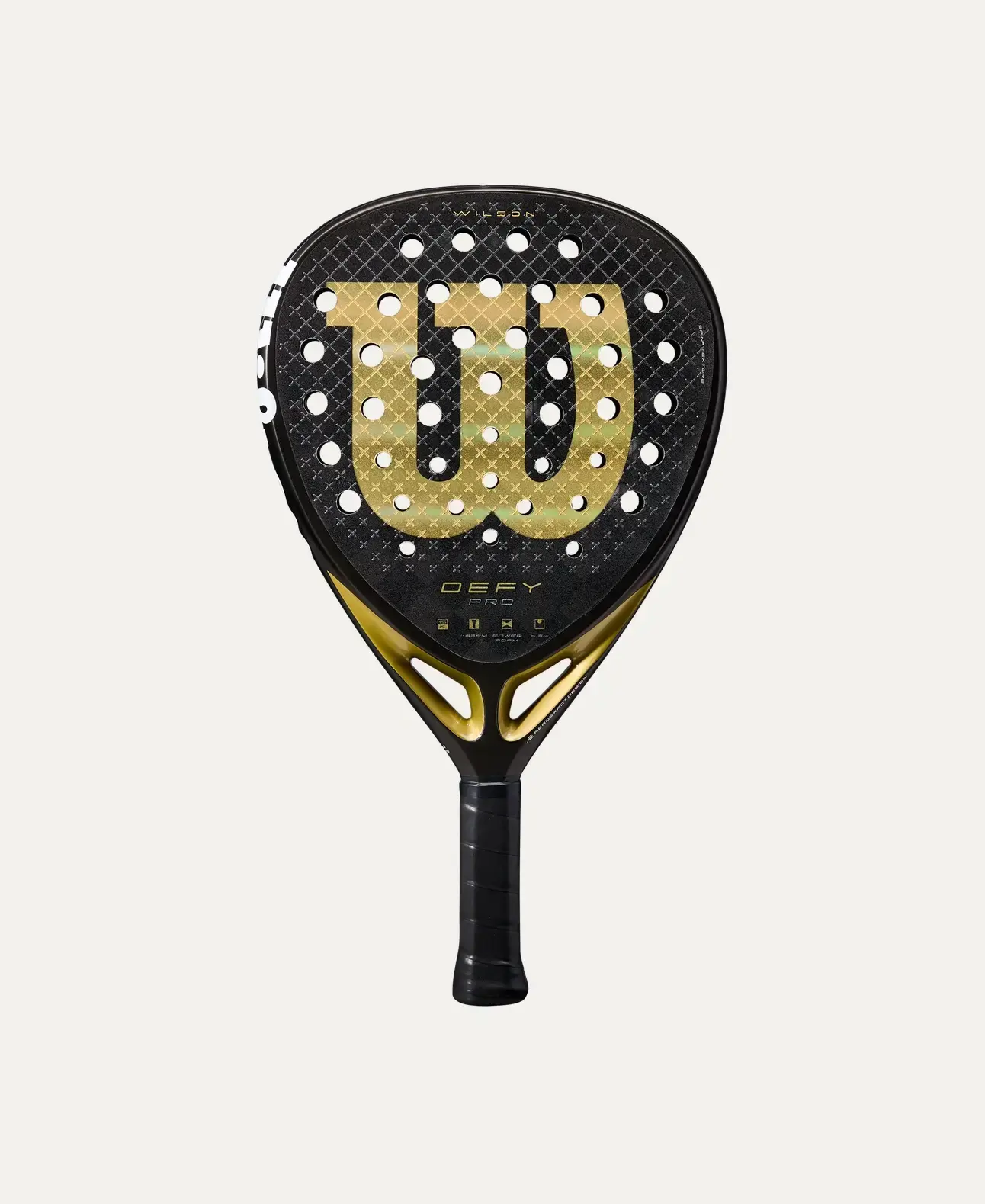
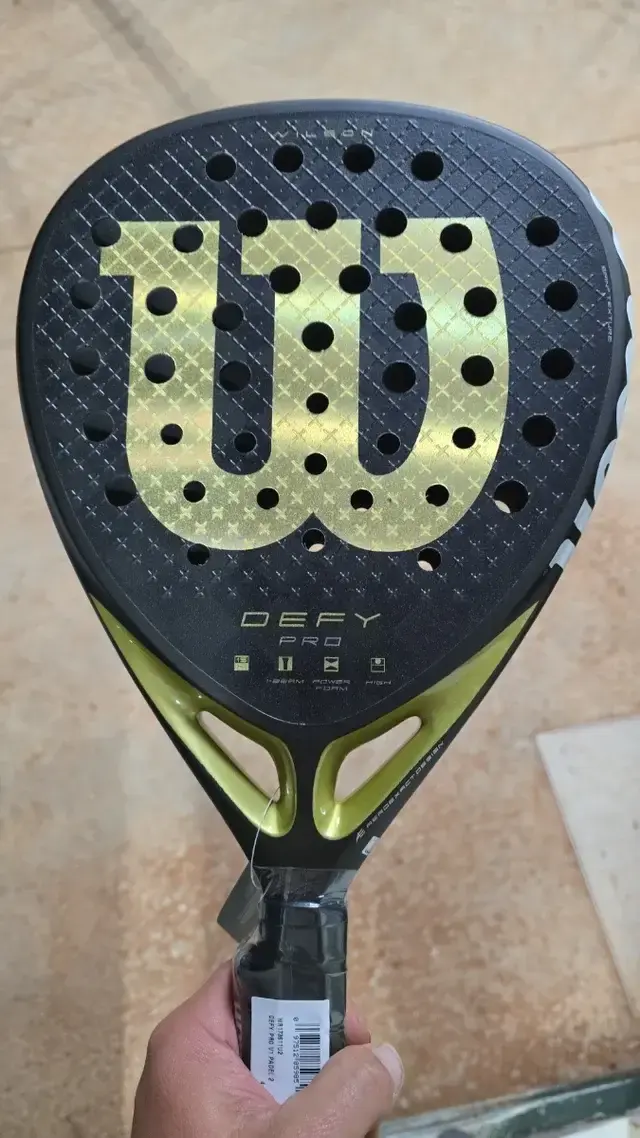
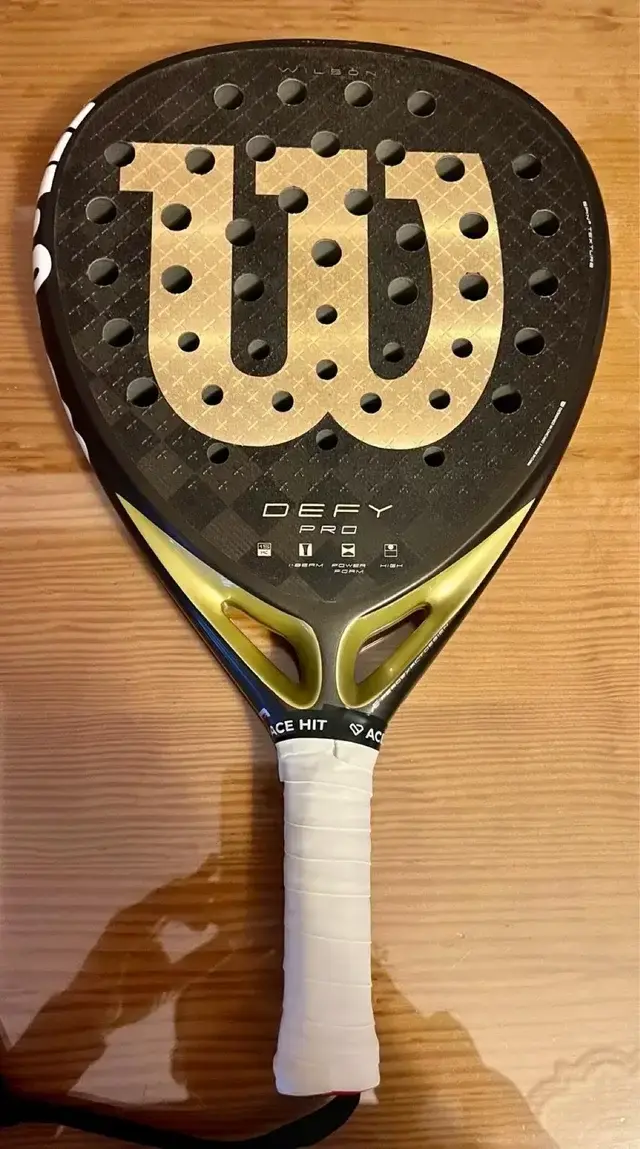
Wilson Defy Pro V1
Version and lineup identification
Within Wilson’s padel lineup, the Defy Pro V1 represents the top-tier performance version of the Defy family.
• Defy Pro V1 — highest material grade, most demanding, maximum responsiveness • Defy V1 — slightly softer, more accessible • Defy LS — lighter, more comfort-oriented
The Pro version is positioned for advanced players seeking fast acceleration and aggressive intent without excessive head heaviness. Compared to other Wilson lines such as Blade, the Defy Pro V1 is designed to feel quicker and more maneuverable, even in a diamond shape.
Technical specifications
| Spec | Value | What it means |
|---|---|---|
| Shape | Diamond | High balance, power-oriented |
| Weight | ~370 g | Heavier = more stability, lighter = more speed |
| Profile | 38 mm | |
| Balance | Medium–high (≈ 26.3 cm) | More power, less maneuverability |
| Face material | Carbon (Pro-grade, commonly listed as 15K) | Stiff, precise and powerful |
| Core | Power Foam | Affects rebound and comfort |
| Frame | Carbon | Structural rigidity and durability |
| Surface finish | Textured (3D + sand-style rough) | Determines feel and response |
| Player level | Advanced | Ideal skill level for this racket |
| Racket type | Offensive diamond with speed-oriented handling |
Construction and materials
The Wilson Defy Pro V1 is built around a high-grade carbon face paired with Wilson’s Power Foam core, a combination intended to maximize energy transfer during accelerated swings. The face material is commonly listed as 15K carbon for the Pro version, reinforcing its position as the most performance-oriented Defy model.
The frame is fully carbon-based, contributing to a relatively stiff structure that favors responsiveness over dwell time. This construction supports quick rebound when the ball is struck cleanly but offers limited cushioning on imperfect contact.
A textured hitting surface, combining 3D elements with a sand-style rough finish, enhances grip on the ball. This texture supports spin generation on aggressive volleys, vibora, and overhead shots, provided contact occurs within the effective zone.
Vibration dampening is present but subtle. Rather than filtering impact through softness, the racket relies on its structural stiffness, resulting in a muted, low-frequency impact feel that prioritizes solidity over feedback clarity.
Shape and mould behavior
The Defy Pro V1 uses a classic diamond mould with a medium–high balance, placing the sweet spot relatively high on the face. While this geometry supports offensive intent, the effective hitting zone is noticeably compact.
In play, the mould promotes fast swing acceleration and direct ball trajectories when contact is centered. The racket feels lively and efficient through the air, encouraging aggressive shot selection.
The limitation becomes evident on off-center contact. Even minor deviations laterally or vertically result in a sharp reduction in rebound efficiency, producing a “dead” response. This sensitivity defines the racket’s behavior more than any other factor and places a premium on precise timing and positioning.
As a result, the mould rewards clean, confident mechanics but offers little margin for error, reinforcing the Defy Pro V1’s identity as a precision-dependent offensive tool rather than a forgiving power platform.
Stiffness, feel, and comfort
The Wilson Defy Pro V1 sits in the medium–firm stiffness range, but its impact feel is defined less by hardness and more by muted feedback. Contact produces a very dull, low-volume sound, which reduces acoustic and tactile cues during play.
At medium and high swing speeds, the racket feels structurally solid, without excessive vibration. However, the lack of feedback makes it harder to judge contact quality, especially in defensive situations and touch shots. Players who rely on sound and feel to fine-tune depth may find this disorienting.
Comfort is acceptable in terms of vibration management, but the combination of muted feel and narrow effective zone increases mental and physical load over time. Long sessions can become fatiguing not because of harshness, but due to the constant need for precise centering.
Sweet spot and forgiveness
The sweet spot is small and highly localized, positioned in the upper-middle area of the face. This is the defining limitation of the Defy Pro V1.
When the ball is struck cleanly within this zone, output is strong and controlled. However, even slight lateral deviation results in a sharp drop in rebound efficiency, producing a noticeably “dead” response. The contrast between centered and off-center hits is extreme.
Forgiveness is therefore very limited. The racket does not mask errors, and off-center contact is immediately punished with loss of depth and pace. This behavior places a premium on timing, footwork, and preparation, and reduces consistency under pressure.
Power and smash behavior
Power on the Wilson Defy Pro V1 is conditional. The racket does not provide free power, but when contact is clean and swing speed is high, it delivers solid output thanks to its quick acceleration and responsive construction.
Flat smashes benefit from the racket’s swing speed, allowing players to generate pace through acceleration rather than leverage. However, the narrow sweet spot limits the effective power window. Outside the optimal contact zone, smash effectiveness drops abruptly.
Kick smashes and spin-based overheads are supported by the textured surface, but again depend heavily on precise contact. The racket rewards clean technique but offers little assistance when timing or positioning is off.
Overall, the Defy Pro V1 provides usable but inconsistent power, constrained more by sweet spot behavior than by raw material capability.
Net play and fast exchanges
At the net, the Wilson Defy Pro V1 benefits from its excellent maneuverability and swing speed. The racket moves quickly through short motions, making it comfortable in rapid exchanges and reactive situations—an uncommon trait for a diamond-shaped frame.
When contact is centered, volleys come off clean and controlled, allowing for confident redirection and aggressive placement. The racket feels stable enough to finish points when the player is well positioned and prepared.
However, the narrow sweet spot again defines the limits. In fast exchanges, where contact quality naturally degrades, even slight misalignment leads to muted response and short balls. This reduces consistency in pressured net play and forces players to remain technically sharp at all times.
Stability on off-center contact
Stability on off-center contact is the weakest aspect of the Defy Pro V1.
Despite a solid carbon frame, the racket exhibits pronounced drop-off in performance outside the sweet spot. Lateral mis-hits result in significant loss of rebound and depth, while vertical deviations—especially below the sweet spot—produce a dull, underpowered response.
Torsional resistance is adequate structurally, but energy transfer collapses quickly when contact is not clean. The racket does not compensate for imperfect positioning, making consistency under match pressure more difficult.
This behavior reinforces the Defy Pro V1’s identity as a precision-dependent tool rather than a forgiving performance platform.
Practical on-court takeaways
In real match conditions, the Wilson Defy Pro V1 rewards players with clean mechanics, good footwork, and disciplined preparation.
Its strongest qualities are maneuverability, swing speed, and centered-shot performance. Players who strike the ball cleanly and proactively will appreciate how easily the racket accelerates and how solid it feels in the optimal contact zone.
At the same time, the small sweet spot and muted feedback significantly reduce tolerance for errors. Under fatigue, defensive scrambling, or rushed situations, consistency drops quickly.
Overall, the Defy Pro V1 suits advanced players who value speed and precision and are willing to trade forgiveness for responsiveness. For most competitive players, however, the sweet spot limitation becomes a decisive constraint over longer matches.
Comparison within the Wilson lineup
Within Wilson’s padel range, the Defy Pro V1 represents the most performance-oriented and demanding version of the Defy family, prioritizing swing speed and responsiveness over forgiveness.
Compared to the Defy V1 (non-Pro), the Pro version feels firmer and more precise on clean contact, but also less tolerant of errors. The standard Defy V1 offers a slightly wider effective zone and marginally more comfort, making it easier to manage over long rallies.
Against the Defy LS, the difference is fundamental. The LS is lighter, more forgiving, and clearly oriented toward accessibility and comfort. The Pro version, by contrast, targets advanced players who are willing to accept inconsistency outside the sweet spot in exchange for speed and direct response.
When compared to Wilson Blade, the Defy Pro V1 is noticeably more maneuverable and faster through the air, but significantly less forgiving. Blade models tend to offer a broader sweet spot and more uniform response, while the Defy Pro emphasizes acceleration and precision at the cost of stability.
Comparison with other brands
Against offensive rackets from other manufacturers, the Wilson Defy Pro V1 stands out less for raw power and more for swing speed combined with a narrow performance window.
Compared to Bullpadel Vertex 05 GEO, the Defy Pro V1 feels faster and easier to accelerate, but far less stable and forgiving. The Vertex GEO provides a larger sweet spot and more predictable power delivery, especially under pressure.
Against SIUX Fenix Pro, the Defy Pro V1 is more maneuverable but significantly less consistent. The Fenix Pro offers a higher control ceiling and better torsional stability, while demanding more physical input.
Compared to Adidas Metalbone Attack, the Defy Pro V1 lacks the same adjustability and power ceiling. Metalbone Attack delivers more accessible finishing and a broader effective zone, albeit with less swing speed.
When placed next to NOX AT10 Attack, the contrast is clear: the AT10 emphasizes control, dwell time, and consistency, while the Defy Pro V1 prioritizes speed and direct response, sacrificing forgiveness.
Technical positioning
The Wilson Defy Pro V1 is best positioned as a high-speed, precision-dependent offensive diamond.
Its defining traits are excellent maneuverability, quick acceleration, and strong performance on perfectly centered shots. At the same time, its very small and inconsistent sweet spot severely limits reliability under match pressure.
Rather than being a universally strong attacking racket, the Defy Pro V1 functions as a specialist tool for players with clean mechanics who consistently strike the ball in the optimal zone. For most advanced players, the lack of forgiveness and muted feedback will outweigh its speed advantages over longer matches.
Technical performance score
Ten categories, each 0-10. Methodology →
- Maneuverability and handling8.5
- Net performance under pace7.0
- Control and placement precision7.0
- Defensive output and depth access6.5
- Off-center stability and torsional resistance6.0
- Sweet spot usability5.5
- Spin generation potential7.5
- Power ceiling7.5
- Power accessibility6.5
- Comfort and impact feedback6.5
Final verdict — Wilson Defy Pro V1 scores 69/100. A entry-level option with balanced performance across categories, ideal for beginners building their first padel game.
Common questions
The Defy Pro V1 is best suited for advanced players with consistently clean mechanics. Players who routinely strike the ball in the central zone and generate their own swing speed will benefit most. Its balance (~26.3 cm) and fast swing profile favor proactive players rather than defensive scramblers.
The defining weakness is the very small and inconsistent sweet spot. Even slight deviations (a few centimeters laterally) result in a dramatic loss of rebound efficiency. This makes the racket unforgiving and reduces consistency during fast rallies and under pressure.
No. Power is conditional. When swing speed is high and contact is clean, output is good. Outside the sweet spot, power drops sharply. Compared to other offensive diamonds, power accessibility is below average.
Impact feel is muted and acoustically dull. While vibrations are well managed, the lack of sound and tactile feedback makes it harder to judge contact quality, particularly in defense and touch shots.
From a vibration standpoint, yes. From a performance standpoint, it can be tiring. The constant need for precise centering increases mental and physical fatigue over long sessions.
Compared to models like Bullpadel Vertex 05 GEO or SIUX Fenix Pro, the Defy Pro V1 is faster through the air but significantly less forgiving. Those rackets offer larger sweet spots and more stable output under pressure.
Only if swing speed and maneuverability are your top priorities and you are comfortable sacrificing forgiveness. For most players, Defy V1 or Defy LS will deliver higher match consistency.