Bullpadel Vertex 05 Woman 2026 Review
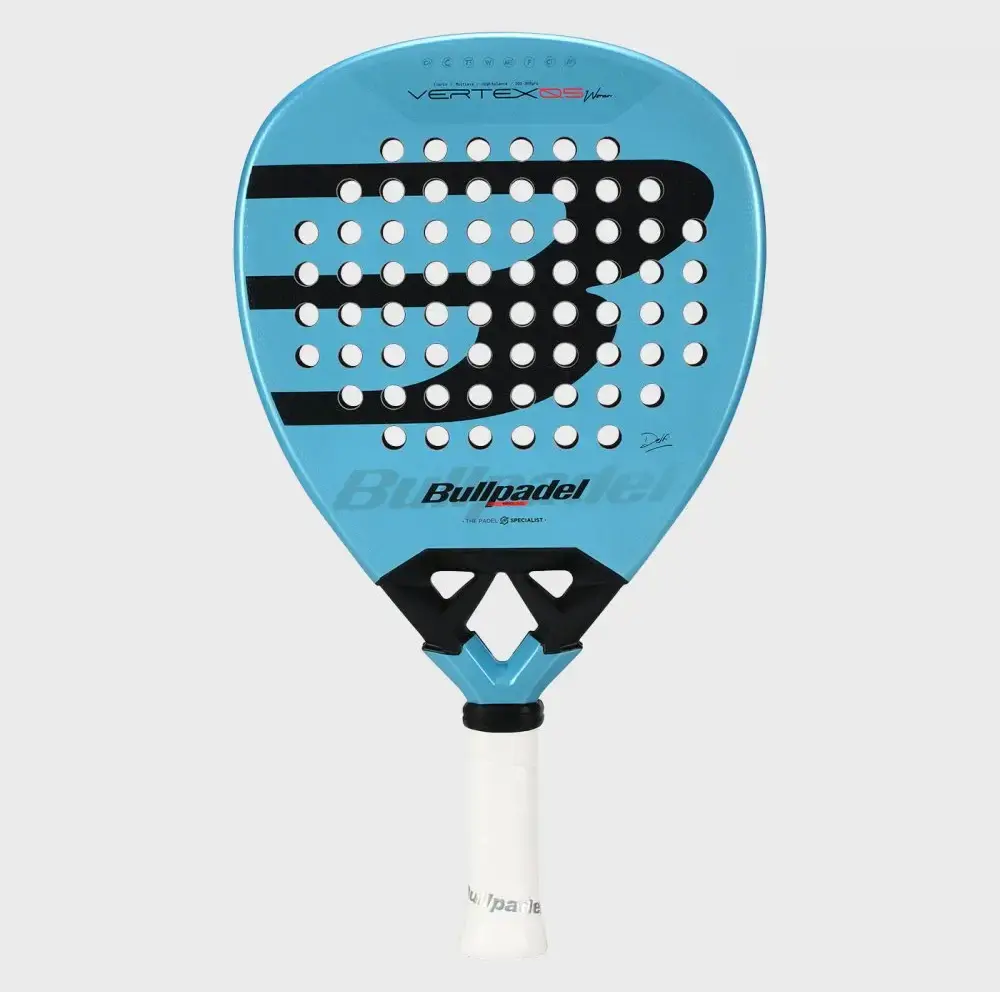
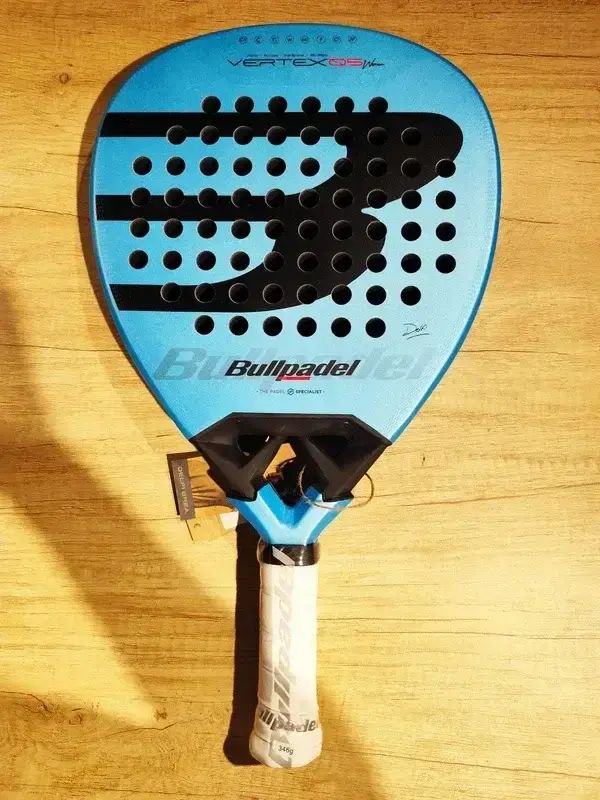
Version and lineup identification
The Vertex 05 Woman sits within Bullpadel's 2026 women's professional range alongside the Elite W (Gemma Triay), Flow Legend (Alejandra Salazar), Wonder (Claudia Fernández), and Pearl (Beatriz González). The 05 designation indicates the fifth generation of the Vertex diamond platform, following the 03 and 04 iterations that established this mould as a benchmark for lightweight offensive rackets. Delfi Brea's signature places this model at the technical apex of the women's range, above comfort-oriented alternatives.
The 2026 lineup revision introduces the Vertex 05 Hybrid and Vertex 05 GEO as sibling models targeting different geometric preferences, while the Vertex 05 Woman maintains the pure diamond profile with reduced weight specification. Bullpadel positions this racket between the Pearl's raw power ceiling and the Wonder's placement precision, offering balanced offensive capability for complete players who construct points from the right side before finishing overhead.
Market positioning places the Vertex 05 Woman at €319 retail, premium pricing justified by pro-level construction quality and tournament-validated geometry. The racket competes directly with NOX's lighter AT10 variants, Adidas Metalbone Carbon configurations under 360 grams, and HEAD's Extreme Motion platform in the lightweight diamond attack category.
Technical specifications
| Spec | Value | What it means |
|---|---|---|
| Shape | Diamond (attack-oriented geometry) | High balance, power-oriented |
| Thickness | 38 mm | Thicker = more power and rebound |
| Weight claimed | 350–360 g (without overgrip) | Heavier = more stability, lighter = more speed |
| Weight measured | 345 g (test unit, unstrung without wristband) | Heavier = more stability, lighter = more speed |
| Balance | High (~27.0 cm from handle base) | More power, less maneuverability |
| Face material | Fibrix (carbon + fiberglass hybrid composite) | Soft feel, comfort-oriented |
| Core | MultiEVA (tri-density EVA construction) | Good balance of control and feel |
| Surface texture | Top Spin (rough sandblasted finish) | Determines feel and response |
| Bridge design | Vertex Core (triangular geometry, dual diagonal reinforcement) | |
| Frame technology | CurvAktive (controlled torsion system) | Structural rigidity and durability |
| Aerodynamic feature | Air Power (enlarged lower channel, 50% wider than previous generation) | |
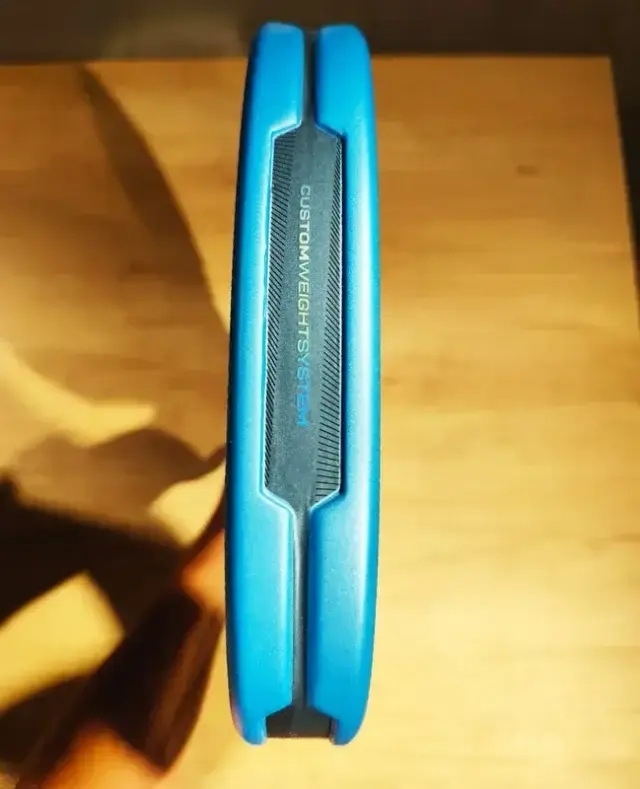
| Weight customization | CustomWeight system (removable weights sold separately) | Heavier = more stability, lighter = more speed |
| Handle | Standard Bullpadel grip, slightly thicker diameter | |
| Wristband | Adjustable safety cord included | |
| Target player | Intermediate to advanced female, intermediate male players seeking lightweight control |
Construction and materials
The Fibrix face represents Bullpadel's strategic compromise between carbon stiffness and fiberglass comfort, blending both materials to create a composite layer that responds more linearly than pure fiberglass while avoiding the harsh feedback of full carbon construction. This hybrid approach targets players requiring ball feel for placement control without sacrificing the crisp rebound necessary for offensive versatility. The material demonstrates measurable grip on textured surfaces, aiding spin generation through increased contact duration.
MultiEVA core architecture employs three distinct density layers arranged to balance power output against arm-friendliness. The outer layers utilize firmer EVA formulation to maximize energy return on centered impacts, while the central layer incorporates softer density to absorb high-frequency vibrations before they reach the handle. This graduated stiffness profile explains the racket's ability to feel simultaneously responsive and comfortable, though the 2026 version clearly biases toward the firmer end of Bullpadel's women's range.
The Vertex Core bridge introduces triangular geometry with dual diagonal reinforcement struts, directly addressing torsional stability under off-axis loading. This structural revision measurably increases frame stiffness compared to previous Vertex Woman generations, contributing to the racket's reputation as the most rigid in the lineage. The bridge design channels impact forces toward the frame perimeter rather than allowing flex concentration, resulting in sharper energy transmission but reduced cushioning on mishit contacts.
Air Power technology expands the lower aerodynamic channel by 50 percent relative to previous Air React implementations, reducing air resistance during swing acceleration. The enlarged aperture removes mass from the throat region while maintaining frame integrity through strategic reinforcement placement. Field testing confirms this feature enables faster racket head speeds without proportional increases in swing effort, particularly beneficial during rapid volley exchanges and emergency defensive retrievals.
Shape and mould behavior
The Vertex 05 Woman registers as medium-firm in the touch spectrum, notably stiffer than the 2024 generation but remaining softer than unisex carbon attack platforms. Initial ball contact produces crisp acoustic feedback with minimal cushioning, confirming the racket's bias toward responsive energy return over plush comfort. The Fibrix composite delivers tangible ball feel without the harsh vibration typical of pure carbon construction, maintaining sufficient tactile information for precise placement control.
Dwell time measures shorter than typical women's fiberglass platforms, with the ball departing the face rapidly on centered impacts. This abbreviated contact duration reduces the effortless power sensation common in softer constructions, requiring players to generate pace through active stroke mechanics rather than relying on trampoline effect. Advanced players appreciate the predictable rebound behavior, while intermediate users initially perceive reduced power accessibility compared to more forgiving alternatives.
Arm comfort remains acceptable through extended sessions despite the increased rigidity, largely attributable to the MultiEVA core's vibration damping capability. The tri-density foam construction absorbs high-frequency shock before it propagates to the handle, preventing the elbow strain associated with harder carbon platforms. Players with existing arm sensitivity should test tolerance during trial periods, as the racket clearly prioritizes performance over cushioned feedback.
The rigid Vertex Core bridge transmits impacts more directly than previous generations, contributing to the racket's reputation as the stiffest Vertex Woman iteration. This structural firmness enhances stability on blocked volleys and reduces frame deflection during off-center contacts, but simultaneously decreases the forgiving sensation that defined earlier models. The evolution represents deliberate tuning toward competitive performance rather than recreational comfort.
Stiffness, feel, and comfort
The Neuron 02 delivers a medium-firm playing feel that positions it toward the stiffer end of Bullpadel's comfort spectrum without reaching the maximum rigidity of platforms like the Hack 04 or Vertex 05 GEO. Multiple testing sources characterize the impact sensation as "medium-hard" or "dry," indicating limited ball penetration into the face materials and relatively quick energy return compared to softer alternatives. This stiffness profile results from the combination of firm Xtend Carbon 3K face materials and the inverted MultiEVA core configuration.
The playing sensation differs noticeably from traditional soft-EVA platforms that provide extended dwell time and cushioned impact absorption. Contact feedback arrives with immediate clarity — players receive direct tactile information about impact location, ball trajectory, and energy transfer efficiency without the dampening or mushy sensation associated with ultra-soft foams. This direct feedback supports the racket's precision-oriented design philosophy, enabling experienced players to make micro-adjustments to swing mechanics based on detailed impact information.
Comfort characteristics emerge from the comprehensive vibration management system rather than core softness alone. The combination of Vibradrive handle elastomer, Hesacore grip installation, and four Ease Vibes face dampeners effectively reduces high-frequency oscillations that contribute to discomfort and arm fatigue. Testing feedback consistently notes the absence of harsh vibrations even during off-center impacts or extreme-pace defensive situations.
Sweet spot and forgiveness
The sweet spot dimensions measure smaller than the 2024 Vertex Woman, concentrated in the upper third of the diamond face where geometry and balance converge. Players consistently contacting this zone report excellent energy transfer and controllable power output, while those missing the preferred impact area experience noticeable performance degradation. The forgiveness window narrows particularly on lob attempts, where off-center contacts produce insufficient depth and require recovery sequences.
Edge contacts and low-face mishits reveal the racket's technical demands clearly. Strikes below the optimal zone generate muted responses with dead feel, lacking the resilience to convert poor preparation into serviceable outputs. This characteristic distinguishes the Vertex 05 Woman from round control platforms that maintain playability across broader face areas, positioning this diamond as a precision instrument requiring accurate ball striking.
Vertical sweet spot positioning favors high contact points, aligning with the racket's offensive design philosophy. Overhead smashes and attacking volleys naturally engage the preferred impact zone, while low volleys and defensive slice shots require conscious adjustment to maintain performance consistency. Players accustomed to round geometries initially struggle with the narrow usability window before adapting their preparation timing.
The reduced forgiveness relative to previous generations represents a calculated trade-off prioritizing power ceiling over ease of use. Bullpadel clearly targets advancing players willing to develop technical precision in exchange for enhanced finishing capability, accepting that less skilled users may find the racket demanding. This design decision filters the addressable market toward competent ball strikers seeking lightweight offensive tools.
Power and smash behavior
Maximum power output remains modest relative to heavier unisex diamonds, constrained by the 345-gram mass and Fibrix face construction. Players generate satisfying overhead velocity when selecting appropriate balls and executing clean technique, but the racket refuses to grant automatic winners on poorly chosen smash attempts. The power ceiling proves sufficient for intermediate competition while falling short of professional-level finishing capacity.
Smash effectiveness depends heavily on ball selection and contact quality. High, comfortable setups convert efficiently into penetrating downward trajectories, while rushed attempts on lower balls produce insufficient pace to trouble prepared opponents. The diamond geometry amplifies swing speed when players commit fully to overhead sequences, but the reduced mass prevents the racket from compensating for technical shortcomings through sheer weight.
Vibora execution emerges as a particular strength, with the rigid construction and spin-friendly surface combining to produce venomous side-spin trajectories. The high balance enables adequate racket head speed for kick generation, while the Fibrix composite maintains sufficient ball contact to impart rotation. Players report success using viboras as offensive weapons to create uncomfortable returns, particularly effective when targeting opponents' backhand positions.
Power accessibility measures lower than trampoline-effect fiberglass platforms, requiring active stroke production rather than passive energy reflection. Recreational players seeking effortless depth may find the racket demanding, while competitive users appreciate the control accompanying the measured power output. The construction rewards proper weight transfer and full extension, refusing to generate pace from abbreviated swings or static positioning.
Net play and fast exchanges
Volley performance represents the racket's standout characteristic, combining rapid maneuverability with stable blocking capability. The rigid Vertex Core bridge resists deflection during high-pace exchanges, enabling confident punch volleys and aggressive angle creation. The 345-gram mass permits swift repositioning between contacts, maintaining reactivity during extended net sequences where heavier platforms would fatigue.
The Fibrix surface texture enhances touch volley control, providing sufficient grip to generate backspin on drop volleys and slice blocks. Players report excellent feel for delicate placements, with the shorter dwell time actually benefiting precision rather than hindering it. The racket responds predictably to varied swing speeds, allowing nuanced pace modulation from soft dinks to aggressive drives within single exchanges.
Reflex volleys at close range benefit from the diamond's concentrated mass, delivering satisfying punch despite the lightweight specification. The high balance creates leverage for redirecting pace without requiring full swing preparation, particularly effective when opponents drive balls directly at the body. The narrow sweet spot demands accurate contact positioning, but players consistently engaging the preferred zone access reliable blocking capability.
Defensive volleys under pressure maintain adequate depth control, though the firm feel provides less margin for error than softer alternatives. Players must commit to decisive swing paths rather than relying on the racket to cushion difficult angles, rewarding aggressive net positioning over reactive scrambling. The platform suits players who impose pressure through forward positioning rather than those seeking to absorb opponent pace from mid-court.
Stability on off-center contact
Torsional resistance proves adequate for the weight class, with the Vertex Core bridge and CurvAktive frame technology providing measurable stability improvements over earlier generations. Edge impacts and off-axis contacts generate less frame twist than expected from a 345-gram platform, maintaining directional control even when missing the sweet spot centrally. The rigid construction prevents excessive energy loss through frame flex, converting mishits into serviceable outputs rather than complete dead-spots.
Horizontal stability during cross-court exchanges remains reliable, with the diamond geometry and dual bridge reinforcement resisting rotation around the handle axis. Players pushing pace from baseline positions report consistent directional control, though power output predictably decreases when contacting outside the optimal zone. The racket maintains alignment better than pure fiberglass alternatives, justifying the firmer feel through enhanced precision.
Vertical stability on high and low contacts varies considerably, with the sweet spot's upper positioning creating performance asymmetry. Low-face impacts below the optimal zone produce noticeably weaker responses, while strikes above the sweet spot maintain reasonable output through proximity to the balance point. This vertical sensitivity requires players to adjust preparation timing for varying ball heights, demanding technical awareness beyond what round platforms require.
]The stability characteristics position the Vertex 05 Woman in the middle tier of lightweight diamonds, superior to entry-level fiberglass offerings but trailing heavier carbon platforms. The construction delivers appropriate stability for the weight class, accepting that extreme off-center impacts will inevitably produce degraded responses. Players prioritizing forgiveness over finishing power would benefit from round alternatives, while those accepting technical demands access capable stability performance.
Practical on-court takeaways
Real-match utility centers on constructive right-side play with measured offensive capability. The racket excels in sequences where players build points through precise placement before finishing with well-selected overheads, rather than forcing power from neutral positions. Baseline rallies require active footwork and early preparation to compensate for the high balance, while net exchanges reward aggressive positioning and decisive volley execution.
The platform suits players who construct attacks through tactical awareness rather than raw power overwhelming opponents. Lob depth control enables effective court positioning, while the responsive volley capability allows capitalizing on short balls through angle creation. The reduced power ceiling actually benefits tactical development by forcing shot selection discipline, preventing reliance on compensatory pace generation.
Defensive capabilities remain functional despite the offensive geometry, with adequate maneuverability for emergency retrievals and sufficient comfort for extended baseline exchanges. The racket maintains playability during pressure sequences, though players must consciously engage the sweet spot to generate effective counter-depth. Purely defensive specialists would benefit from round alternatives, but balanced players access sufficient versatility.
Fatigue resistance proves excellent across multi-hour sessions, with the lightweight specification preventing cumulative arm strain even during tournament play. The rigid feel remains consistent throughout extended use, avoiding the performance degradation common in softer cores that compress with repeated impacts. The platform maintains energy return characteristics from first ball to final point, supporting reliable performance across varied playing durations.
Comparison within the brand lineup
The Vertex 05 Woman occupies the offensive pole of Bullpadel's 2026 women's range, delivering maximum power and rigidity among lightweight diamond options. Compared to sibling models, this platform sacrifices ease of use for finishing capability, targeting advancing players rather than recreational users.
The Vertex 05 Woman differentiates through its technical demands and performance specificity. The Elite W provides superior baseline versatility through hybrid geometry, while the Wonder prioritizes placement precision over power ceiling. The Flow Legend serves defensive specialists seeking maximum comfort, and the Pearl targets players wanting automatic power without control sophistication. The Vertex occupies the middle ground: offensive capability requiring technical execution, suitable for complete players transitioning toward attack-oriented game styles.
Comparison with other brands
Cross-brand positioning places the Vertex 05 Woman among lightweight diamond platforms balancing power accessibility against technical precision. The Fibrix construction distinguishes Bullpadel's approach from pure carbon and pure fiberglass alternatives.
The Vertex 05 Woman distinguishes through its Fibrix composite balancing feel against responsiveness, contrasting with NOX's softer carbon and HEAD's power-focused foam cores. The Bullpadel platform demands greater technical precision than the HEAD alternative while offering superior lob control unavailable in Wilson's compact geometry. Adidas provides comparable weight but sacrifices overhead capability for baseline consistency. Players prioritizing tactical flexibility with offensive potential favor the Vertex, while those seeking automatic power or maximum forgiveness should explore HEAD or NOX alternatives respectively.
Technical positioning
The Vertex 05 Woman occupies a narrow performance corridor between recreational accessibility and professional specialization. The platform assumes intermediate to advanced technical capability, rewarding precise ball striking while punishing timing errors. The construction targets complete players developing offensive game components rather than pure power specialists or defensive grinders seeking comfort-first platforms.
Weight classification positions the racket in the lightweight diamond category, competing against reduced-mass attack platforms rather than standard 365-gram offerings. The 345-gram specification enables extended play without fatigue penalties while maintaining sufficient mass for stable volleys and adequate overhead velocity. The high balance compensates for reduced total weight, concentrating swing inertia toward the tip to preserve finishing capability.
Material selection through Fibrix composite reveals strategic middle-ground positioning between carbon performance and fiberglass comfort. Bullpadel deliberately avoids the extremes characterizing competitor platforms, accepting that moderate specifications in both dimensions create versatile capability rather than specialization excellence. The approach suits players requiring multi-dimensional performance rather than single-attribute optimization.
The technical profile filters toward female players rated 4.5–6.0 NTRP or male players rated 3.5–4.5 seeking lightweight alternatives to unisex platforms. The racket assumes competent stroke mechanics and tactical awareness, refusing to compensate for technical deficiencies through forgiving construction. Advancing players appreciate the performance ceiling, while recreational users would benefit from the Elite W or Flow Legend alternatives offering superior accessibility.
For broader fit criteria, read padel rackets for women.
Technical performance score
Ten categories, each 0-10. Methodology →
- Maneuverability and handling8.5
- Net performance under pace8.0
- Control and placement precision7.5
- Defensive output and depth access8.5
- Off-center stability and torsional resistance7.0
- Sweet spot usability7.0
- Spin generation potential7.0
- Power ceiling6.5
- Power accessibility8.0
- Comfort and impact feedback8.0
Final verdict — Bullpadel Vertex 05 Woman scores 77/100. A strong performer with balanced performance across categories, a solid choice for intermediate to advanced players.
Common questions
The "Woman" designation refers exclusively to reduced weight specification rather than performance limitations. The 345-gram playing weight combined with high balance and responsive construction makes this racket suitable for intermediate male players (3.5–4.5 NTRP) seeking lightweight alternatives to standard 365-gram platforms. The technical characteristics—firm feel, narrow sweet spot, offensive geometry—demand competent ball-striking regardless of player gender. Male players prioritizing maneuverability over maximum power access appropriate performance, particularly effective for right-side constructive play rather than pure overhead finishing. The platform suits any player capable of consistent sweet spot engagement seeking tactical offensive capability within a lightweight envelope.
The 2026 generation introduces measurably increased rigidity through the redesigned Vertex Core bridge and firmer MultiEVA tuning, creating a notably stiffer platform than the 2024 predecessor. The sweet spot dimensions reduce slightly, concentrating forgiveness in the upper face third rather than maintaining broad usability across the entire surface. Power accessibility decreases marginally as the construction prioritizes control precision over effortless output, requiring more active stroke production for equivalent pace generation. Lob capability remains excellent across both generations, though the 2026 version demands more accurate contact positioning to achieve optimal depth. The 2024 model serves recreational to early-intermediate players seeking maximum forgiveness, while the 2026 iteration targets advancing intermediates willing to accept technical demands for enhanced control and structural stability.
The platform suits complete players who construct points through tactical awareness before finishing with selective overhead aggression. Right-side players emphasizing lob depth control, precise volley placement, and measured offensive capability find optimal synergy with the racket's characteristics. The construction rewards early preparation, accurate sweet spot engagement, and disciplined shot selection rather than compensating for rushed technique or forcing power from neutral positions. Players developing offensive game components while maintaining baseline consistency benefit from the balanced capabilities, whereas pure power specialists seeking automatic finishing or defensive grinders prioritizing maximum comfort would find superior alternatives elsewhere in the market.
The Fibrix composite deliberately trades absolute power ceiling for enhanced ball feel and comfort, creating strategic middle-ground positioning rather than performance compromise. The carbon-fiberglass hybrid delivers superior control precision and tactile feedback compared to pure fiberglass while avoiding the harsh vibration and demanding technique requirements of full carbon construction. Players requiring surgical placement accuracy and nuanced pace modulation benefit from Fibrix characteristics, whereas those prioritizing maximum overhead velocity and structural rigidity would prefer pure carbon platforms. The material choice reflects Bullpadel's philosophy emphasizing versatile capability over specialized extremes, serving balanced game styles more effectively than single-dimension optimization.
The concentrated sweet spot demands accurate vertical contact positioning and proper preparation timing, penalizing rushed swings and late reactions more severely than round or hybrid alternatives. Lob execution proves particularly sensitive to off-center impacts, with mishits producing insufficient depth and requiring recovery sequences. Competent intermediate players adapt to the technical requirements within several sessions, developing contact consistency through repetition and focused practice. Recreational users or those with inconsistent ball-striking may struggle initially, experiencing frustrating performance variability during competitive play. The sweet spot dimensions prove appropriate for the racket's target audience—advancing players seeking responsive tools—while filtering less developed users toward more forgiving platforms like the Elite W or Flow Legend.
The CustomWeight system enables modest customization of total mass and balance point through removable weights positioned in the frame head, sold separately from the base racket. Adding maximum weight increases playing mass toward 365 grams while shifting balance further toward the tip, creating more head-heavy character that amplifies overhead power but reduces maneuverability proportionally. The adjustment range remains limited compared to rackets with integrated weight systems, preventing dramatic personality transformations while allowing fine-tuning for individual preferences. Players should test the base configuration extensively before investing in weight customization, as the fundamental characteristics—sweet spot dimensions, Fibrix feel, diamond geometry—remain unchanged regardless of weight additions. The system serves players seeking incremental refinement rather than wholesale performance alteration.
The transition demands significant adaptation to diamond geometry, high balance, and reduced sweet spot dimensions. Players accustomed to round platforms enjoying broad forgiveness and low balance will initially struggle with the Vertex's technical requirements, particularly regarding vertical contact positioning and preparation timing. The adjustment period typically spans 5–10 playing sessions as users develop consistency engaging the preferred impact zone and adapting to altered swing dynamics. Successfully transitioning players appreciate the enhanced offensive capability and tactical versatility, while those finding the demands excessive should consider the Elite W or Wonder as intermediate steps offering hybrid geometries bridging round and diamond characteristics. The direct transition proves most successful for competent intermediates specifically seeking to develop attack-oriented game components