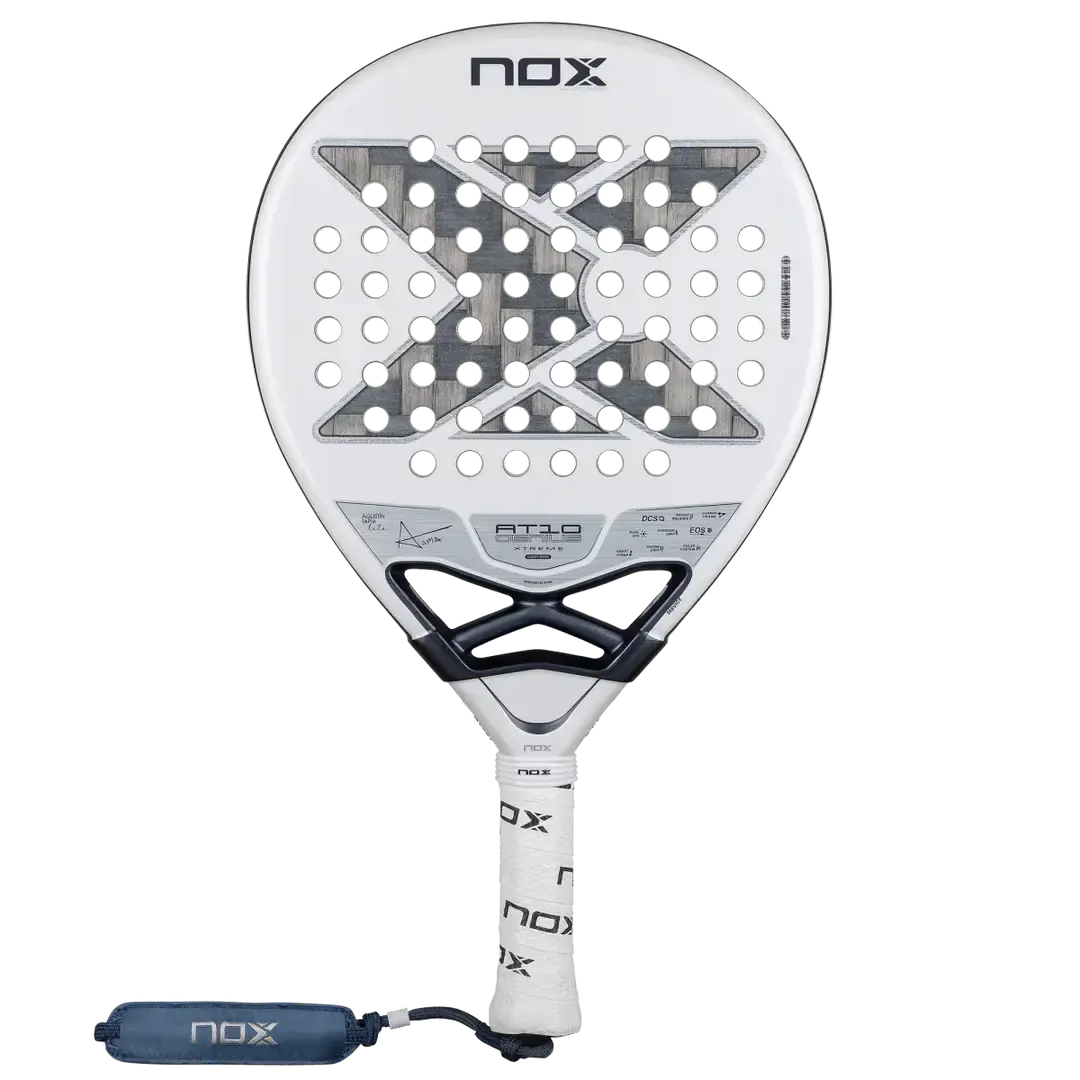
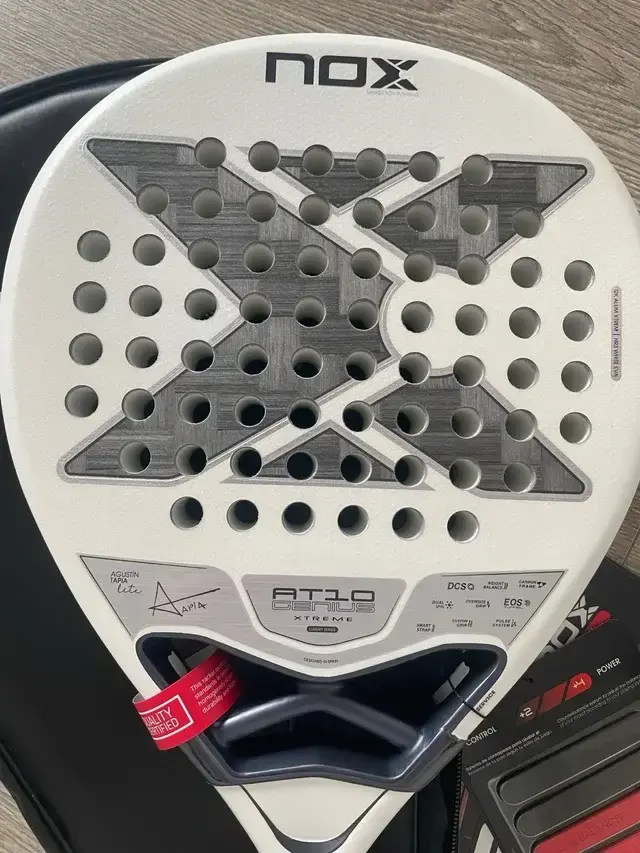
NOX AT10 Luxury Genius 12K Alum XTREM Lite 2026
Version and lineup identification
The NOX AT10 Luxury Genius 12K Alum XTREM Lite 2026 belongs to the 2026 AT10 Luxury Genius lineup and represents the Lite branch of the 12K teardrop platform. It is not a different mould and not a simplified construction; instead, it is a deliberately rebalanced version of the standard AT10 12K, targeting players who value control, comfort, and adaptability over raw stiffness and physical demand.
Both the Lite and the standard AT10 12K share the same core technologies: a 12K aluminized carbon face, Dual Spin surface treatment, full carbon frame, and the Weight Balance System. The key difference lies in overall mass distribution and core tuning, which directly affect swing inertia, rebound behavior, and perceived stiffness.
In practical terms, the lineup positioning is clear. The standard AT10 12K 2026 sits higher in the performance hierarchy, offering a firmer response and higher power ceiling for advanced, aggressive players. The XTREM Lite version sits slightly below in absolute ceiling but above many mid-range control rackets in terms of precision and technical refinement, making it the most universal AT10 option for the majority of competitive amateurs.
Technical specifications
| Spec | Value | What it means |
|---|---|---|
| Shape | Teardrop | Balanced power and control |
| Thickness | 38 mm | Thicker = more power and rebound |
| Weight range (claimed) | 355–370 g | Heavier = more stability, lighter = more speed |
| Measured weights | ~356 g, ~362 g | Heavier = more stability, lighter = more speed |
| Balance (measured) | ~25.3–25.7 cm | Affects swing feel and power |
| Face material | 12K Aluminized Carbon | Good stiffness and durability |
| Core | HR3 White EVA | Good balance of control and feel |
| Frame | 100% Carbon | Structural rigidity and durability |
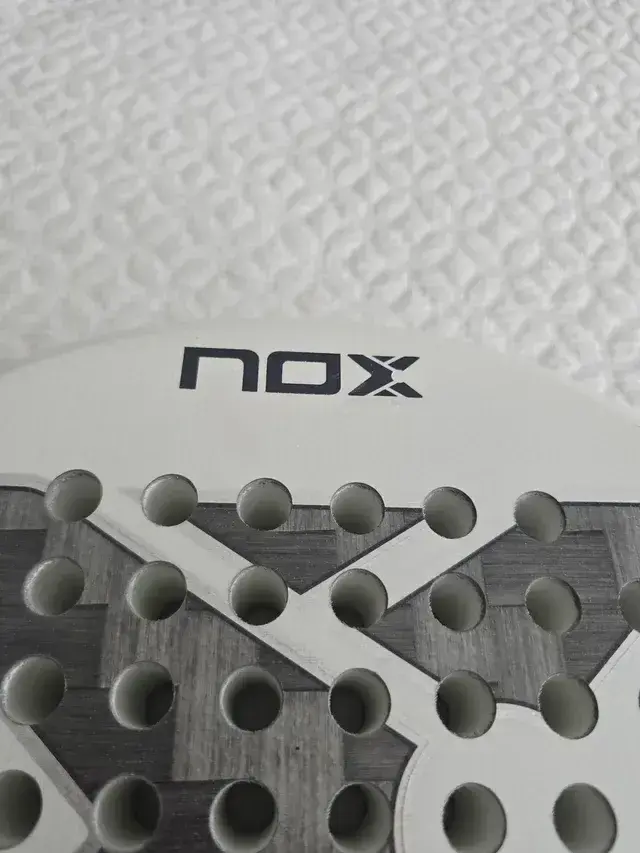
| Surface | Dual Spin (3D texture + sand finish) | Determines feel and response |
| Adjustable balance | Weight Balance System (2–4 g modules) | Affects swing feel and power |
Construction and materials
Although both the AT10 12K XTREM Lite and the standard AT10 12K use a 12K Alum carbon face, the overall construction philosophy differs noticeably. The aluminized 12K weave remains stiff and low-elastic compared to 18K variants, but the Lite version pairs it with a softer EVA formulation and lower overall mass, changing how energy is transferred during impact.
The HR3 White EVA core used in the Lite version sits clearly softer than the Black EVA found in the standard AT10 12K. This increases dwell time and improves vibration absorption, especially on medium-speed impacts. As a result, the Lite feels less abrupt at contact and more forgiving during defensive shots and controlled rallies.
The full carbon frame maintains structural rigidity, but reduced swing inertia allows the frame to feel less demanding during rapid direction changes. Compared directly to the standard AT10 12K, the Lite sacrifices some firmness under maximum acceleration but gains comfort, consistency, and tolerance to imperfect contact.
Shape and mould behavior
Both rackets use the same teardrop mould, but their on-court behavior diverges due to differences in weight and balance. The XTREM Lite version typically measures around 25.3–25.7 cm in balance, compared to approximately 25.6–26.0 cm for the standard AT10 12K, depending on setup.
This seemingly small difference translates into noticeably lower swing inertia. The Lite initiates swings faster, recovers more easily after volleys, and feels more agile during transitions from defense to attack. Overhead stability remains adequate, but mass transfer is reduced compared to the heavier original version.
In practice, the mould favors all-court play in the Lite configuration. The racket feels more neutral and easier to manage under pressure, whereas the standard AT10 12K pushes the same geometry toward a more demanding, performance-oriented interpretation.
12K versus 12K Lite within the AT10 family
Despite sharing the same 12K Alum carbon face and teardrop mould, the AT10 12K 2026 and the AT10 12K XTREM Lite 2026 behave as two distinct rackets on court. The difference is not cosmetic and not limited to static weight; it is primarily a result of swing inertia, core tuning, and effective stiffness under load.
The standard AT10 12K is built around higher overall mass and a firmer EVA configuration. This produces a shorter dwell time and a more direct energy transfer when swing speed increases. Ball speed does not come easily, but when the player accelerates fully, the racket remains stable and does not saturate. This makes the original version suitable for aggressive players who generate pace themselves and want a linear, physically honest response.
The XTREM Lite version lowers the system mass and pairs the same 12K face with a softer HR3 White EVA. This increases dwell time and improves rebound at medium swing speeds. The result is a racket that produces usable depth and speed earlier in the swing, with less physical commitment. The trade-off is that at maximum acceleration the Lite version compresses earlier, limiting the absolute power ceiling.
In short, the original AT10 12K is a performance ceiling tool, while the XTREM Lite is a performance accessibility tool. Both preserve the AT10 identity, but they serve different stages of player development and different tactical roles on court.
Stiffness, feel, and comfort
Perceived stiffness is one of the clearest differentiators between the two versions. The standard AT10 12K feels firm and structurally rigid, especially on high-speed impacts. Contact feedback is immediate and precise, but also unforgiving when timing or positioning is off. Over long sessions, this firmness translates into higher physical load, particularly for players without consistently clean mechanics.
The XTREM Lite feels noticeably softer at contact, despite using the same carbon face. The difference comes from the EVA and reduced inertia. The ball stays on the face slightly longer, smoothing out feedback and filtering vibration more effectively. This is especially noticeable on blocks, defensive lobs, and medium-speed rallies.
In terms of comfort, the Lite version clearly wins. It reduces cumulative arm stress over long matches and training sessions, making it more suitable for frequent play. The original AT10 12K remains comfortable for its category, but it is aimed at players who prioritize precision over impact softness.
Sweet spot and forgiveness
Both rackets share a centrally positioned sweet spot typical of teardrop moulds, but their usable hitting area differs in practice. On the standard AT10 12K, the effective sweet spot is tighter and more sensitive to contact quality. Mis-hits outside the central zone result in faster loss of depth and a sharper feedback response.
The XTREM Lite expands the usable sweet spot by virtue of softer rebound and lower swing inertia. While the geometric sweet spot is similar, the Lite version tolerates late contact and low-face hits more effectively. In practical terms, the Lite provides an estimated 10–15% increase in usable forgiveness during defensive and transitional play.
This difference is particularly relevant for right-side players and amateurs who spend more time reacting than dictating. The original version rewards precision; the Lite version rewards consistency.
Power and smash behavior
Power generation highlights the philosophical split between the two rackets. The standard AT10 12K is strictly player-driven. At medium swing speeds, it offers limited assistance and can feel underpowered unless the player accelerates decisively. However, when fully loaded, the racket delivers a high and stable power ceiling, particularly on flat smashes and aggressive overheads.
The XTREM Lite version accesses power earlier. At approximately 70–80% swing effort, it produces noticeably more ball speed and depth than the original. This makes it easier to finish points opportunistically, especially for players without elite physical output. However, at maximum acceleration the Lite compresses sooner, limiting top-end smash speed and reducing authority compared to the standard version.
Por-3 and kick smashes are achievable with both rackets, but the path is different. The original AT10 12K favors flat, force-driven finishes, while the Lite version favors controlled placement and tactical overheads rather than outright power dominance.
Net play and fast exchanges
At the net, the Lite version clearly favors speed and reaction. Its lower swing inertia allows quicker adjustments, faster volley preparation, and more reliable redirections during hand battles. Blocks feel calmer, and the racket helps keep the ball low even when contact is late.
The standard AT10 12K offers superior directional precision when the player is set early. Volleys are crisp and controlled, but recovery between shots is slower. In fast exchanges, especially when reacting late, the heavier setup becomes more demanding and less forgiving.
This difference strongly influences player preference by position. Right-side players and all-court amateurs tend to benefit from the Lite’s agility, while left-side aggressors who dictate tempo may prefer the original’s solidity.
Stability on off-center contact
Off-center stability is one of the most revealing areas when comparing the NOX AT10 12K 2026 and the NOX AT10 12K XTREM Lite 2026, because both rackets share the same stiff 12K Alum face but differ meaningfully in mass and swing inertia.
On the standard AT10 12K, off-center contact—particularly slightly above or laterally outside the sweet spot—remains relatively controlled. The additional mass (~360–365 g) and neutral teardrop balance (~25.6 cm) provide better resistance to frame deflection. When contact is not perfectly clean, ball trajectory tends to stay flatter and depth loss is moderate rather than abrupt. This is especially noticeable on defensive blocks and controlled counter-drives, where the racket absorbs incoming pace more effectively.
Lateral mis-hits on the standard version still penalize precision, as expected from a firm face, but torsional stability is sufficient to keep the ball inside the court when technique is sound. Vertical mis-hits below the center lead to reduced depth, yet the racket maintains directional integrity better than the Lite version.
The XTREM Lite 12K behaves differently. Reduced mass (~355–360 g) lowers resistance to twisting on off-center impacts. As a result, depth drops off more quickly when contact drifts away from the central hitting zone. On late defensive pickups or stretched volleys, the Lite version transmits more feedback and requires more active wrist and forearm control to stabilize the shot.
However, this does not automatically mean worse real-world consistency. The Lite’s improved maneuverability allows many players—especially right-side and intermediate-level players—to reach the ball earlier and strike closer to the sweet spot. In match conditions, this often offsets the lower intrinsic stability, leading to fewer extreme mis-hits despite the narrower margin for error at impact.
For players who frequently absorb heavy pace or defend under pressure, the standard version is more forgiving. For players whose consistency depends on speed and anticipation rather than brute stability, the Lite version remains viable despite its stricter punishment of late contact.
Practical on-court takeaways
In real match scenarios, the XTREM Lite version proves easier to live with. It supports longer rallies, smoother transitions, and consistent depth without constant physical effort. It is particularly well suited for players who play multiple matches per week or who rely on placement and consistency rather than raw power.
The standard AT10 12K excels when the player controls tempo and can attack decisively. It rewards full commitment and punishes passivity. In extended defensive sequences or late-match fatigue, its advantages diminish more quickly than those of the Lite.
Choosing between the two is not about quality but about role and physical profile. The Lite version is the more universal tool; the original is the sharper weapon in the right hands.
Comparison within the NOX lineup
Within the AT10 family, the 12K Original vs 12K XTREM Lite comparison represents a shift in accessibility, not philosophy. Both rackets share the same teardrop mould and 12K Alum face, but differ meaningfully in swing inertia, balance, and tolerance under pressure.
Comparison with other brands
When compared to all-court and control-oriented rackets from other manufacturers, the NOX AT10 Luxury Genius 12K Alum XTREM Lite 2026 positions itself as a highly balanced, technique-friendly option that prioritizes maneuverability, predictability, and fatigue management over raw power or extreme stiffness. Its defining advantage is not explosive output, but consistency across long rallies, ease of acceleration, and reduced physical demand without sacrificing directional control.
AT10 12K XTREM Lite 2026 vs Bullpadel Vertex 04 CTRL 2026
The Bullpadel Vertex 04 CTRL 2026 is a control-focused racket built around a rounder geometry, typically playing in the ~365–375 g range with balance around ~25.5–26.0 cm. Its MultiEVA core and carbon face provide a softer rebound and a larger perceived sweet spot, especially in defensive scenarios.
By comparison, the AT10 12K XTREM Lite usually measures closer to ~355–360 g with balance around ~25.2–25.4 cm. This lower mass and more neutral balance translate into faster swing initiation and easier handling in fast exchanges. While the Vertex 04 CTRL offers more passive stability on off-center contact, the AT10 Lite feels quicker and more precise when changing direction at the net or transitioning from defense to attack.
In practical play, the Vertex CTRL favors players who rely on stability and depth from slower tempos, while the AT10 12K XTREM Lite favors players who value mobility, timing, and continuous pressure through positioning rather than sheer ball weight.
AT10 12K XTREM Lite 2026 vs Adidas Metalbone CTRL 2026
The Adidas Metalbone CTRL 2026 combines a 16K aluminized carbon face with a customizable weight system and a high-memory EVA core. Effective balance often sits around ~26.0–26.4 cm once configured, with total weight frequently exceeding 370 g depending on setup. This results in higher swing inertia and greater stability at full acceleration.
Against this, the AT10 12K XTREM Lite feels noticeably lighter and less demanding. While the Metalbone CTRL can deliver stronger ball weight when fully committed, it also requires more preparation and physical effort over long matches. The AT10 Lite sacrifices some maximum power potential but offers superior ease of use, particularly in quick net exchanges, defensive scrambling, and late adjustments.
Players who enjoy customizing balance and playing with mass will gravitate toward the Metalbone CTRL. Players seeking a more “plug-and-play” racket with minimal fatigue accumulation will generally find the AT10 Lite easier to sustain across extended sessions.
AT10 12K XTREM Lite 2026 vs Babolat Counter Viper 2026
The Babolat Counter Viper 2026 is designed for counter-attacking players, typically weighing ~365–375 g with balance around ~26.0–26.5 cm. Its X-EVA core and carbon face generate strong rebound and depth even at medium swing speeds, making it forgiving in defensive resets and counter-smashes.
Compared to the Counter Viper, the AT10 12K XTREM Lite feels more linear and restrained. It produces less automatic depth but offers greater control over trajectory and placement, especially on flatter shots and controlled volleys. The Lite version requires more active swing input for finishing, but rewards clean technique with predictable outcomes.
In essence, the Counter Viper favors elastic response and defensive power absorption, while the AT10 Lite favors rhythm, positioning, and tactical ball placement.
AT10 12K XTREM Lite 2026 vs StarVie Astrum / Raptor series 2026
StarVie’s control-oriented rackets, such as the Astrum or Raptor series, often sit in a similar weight category (~360–370 g) but use softer cores and more elastic face constructions. These designs tend to offer comfortable feel and easy depth, particularly for players who prefer longer rallies and higher margins.
Against these models, the AT10 12K XTREM Lite feels firmer and more direct. Its aluminized 12K face produces less trampoline effect, resulting in a calmer response under acceleration and fewer unexpected launch variations. While StarVie models may feel more forgiving on slow or defensive shots, the AT10 Lite provides clearer feedback and sharper directional control when tempo increases.
AT10 12K XTREM Lite 2026 vs Head Speed / Radical series 2026
Head’s Speed and Radical series typically emphasize balanced performance with moderate stiffness and neutral handling, often weighing ~360–375 g with balanced distributions designed for all-court play. These rackets tend to offer smooth feel and good access to depth without extreme demands.
The AT10 12K XTREM Lite differentiates itself by being lighter and more maneuverable, particularly in the upper half of the swing. While Head rackets may feel slightly more forgiving in extended baseline exchanges, the AT10 Lite excels in fast transitions, net play, and situations where rapid preparation and recovery are critical.
Technical positioning
The NOX AT10 Luxury Genius 12K Alum XTREM Lite 2026 occupies a distinctly different technical position from both the standard AT10 12K and the Attack-oriented AT10 variants. Its purpose is not to maximize power output or swing inertia, but to preserve the core AT10 control philosophy while reducing physical demand and expanding usability.
From a construction standpoint, the Lite version maintains the same fundamental architecture as the standard AT10 12K: teardrop mould, aluminized 12K carbon face, and MLD Black EVA core. The critical difference lies in overall mass and effective swing inertia, not in materials or geometry. With real-world weights typically landing in the mid–350 g range and balance remaining closer to neutral (~25.2–25.4 cm), the racket shifts its performance window toward maneuverability, timing, and consistency.
Technically, this places the AT10 12K XTREM Lite closer to an all-court control reference than to an attack-oriented tool. Compared to the standard AT10 12K, it sacrifices some ball weight and finishing authority, but gains noticeably in preparation speed, recovery, and fatigue management. Compared to hybrid or soft-core rackets, it remains firmer, more precise, and more linear, avoiding excessive trampoline behavior.
Within the broader market, the AT10 12K XTREM Lite positions itself as a high-skill, low-fatigue control racket. It is not designed for beginners seeking free power, nor for advanced attackers chasing maximum smash output. Instead, it targets players who value rally stability, directional accuracy, and long-session consistency — particularly right-side players, tactical left-side players, and advanced amateurs who want professional-level control without professional-level physical load.
Technical performance score
Ten categories, each 0–10. Methodology →
- Maneuverability and handling9.0
- Net performance under pace8.0
- Control and placement precision9.0
- Defensive output and depth access8.0
- Off-center stability and torsional resistance7.0
- Sweet spot usability8.0
- Spin generation potential8.0
- Power ceiling7.0
- Power accessibility8.0
- Comfort and impact feedback8.0
Final verdict — NOX AT10 Luxury Genius 12K Alum XTREM Lite scores 79/100. A strong performer with strong control and placement precision, a solid choice for intermediate to advanced players.
Common questions
The Lite version is designed for players who want the technical behavior of the AT10 12K without the physical demand of the standard weight. In practice, this means advanced amateurs, right-side players, and tactically oriented competitors who prioritize maneuverability, consistency, and long-session stability over raw finishing power. It is also a strong option for players transitioning from softer or lighter rackets who want more structure without jumping straight into a heavier, stiffer frame.
The difference is immediately noticeable in swing speed and recovery. With real-world weights typically 5–10 g lower and balance slightly closer to neutral, the Lite version accelerates faster and feels easier to manage in quick exchanges. Ball output is slightly lower, especially on flat overheads, but control, timing, and fatigue management improve significantly. The core response and face stiffness remain familiar, so the racket never feels “soft” or vague.
No, but it changes how power is accessed. The Lite does not deliver the same ball weight on finishing shots as the standard AT10 12K, particularly on smashes. However, power remains fully playable when generated through technique and placement. For most amateur players, the improved timing and swing speed compensate for the reduced mass, resulting in more consistent offensive play rather than less.
It can be, but with caveats. Left-side players who rely on placement, angles, and rally construction will appreciate the Lite’s speed and control. Players who depend heavily on mass-driven smashes and point-ending power will generally prefer the standard AT10 12K or an Attack variant. The Lite rewards precision and tempo rather than brute force.
Forgiveness is slightly improved in practical play due to easier swing acceleration and better recovery on late contact. While the sweet spot geometry is similar, the lower inertia reduces penalty on off-center hits. This makes the Lite feel more playable under pressure, especially in defensive and transitional situations.
Yes. Reduced mass and swing inertia translate directly into lower fatigue over time. Players who train frequently or play long matches often report better consistency late in sessions with the Lite version compared to heavier AT10 models.
No. The Lite retains the same materials, construction quality, and linear response. The difference is not in build quality or control philosophy, but in physical demand. It is a performance-oriented racket tuned for sustainability rather than maximum output.
Players seeking maximum smash power, heavy ball penetration, or an aggressive left-side finishing tool may find the Lite underpowered. Those players are better served by the standard AT10 12K or the Attack versions.
The two faces of NOX rackets are technically identical, with rare exceptions limited to certain LTD models. The “Service” marking does not indicate any difference in performance, materials, or playing characteristics of that side of the racket. It is used only before the match to determine which team serves first. Players can spin the racket on the court, and if the side with the “Service” marking ends up facing up, the guessing team starts the match with the serve.