NOX AT10 Luxury Genius 18K Alum 2026
Version and lineup identification
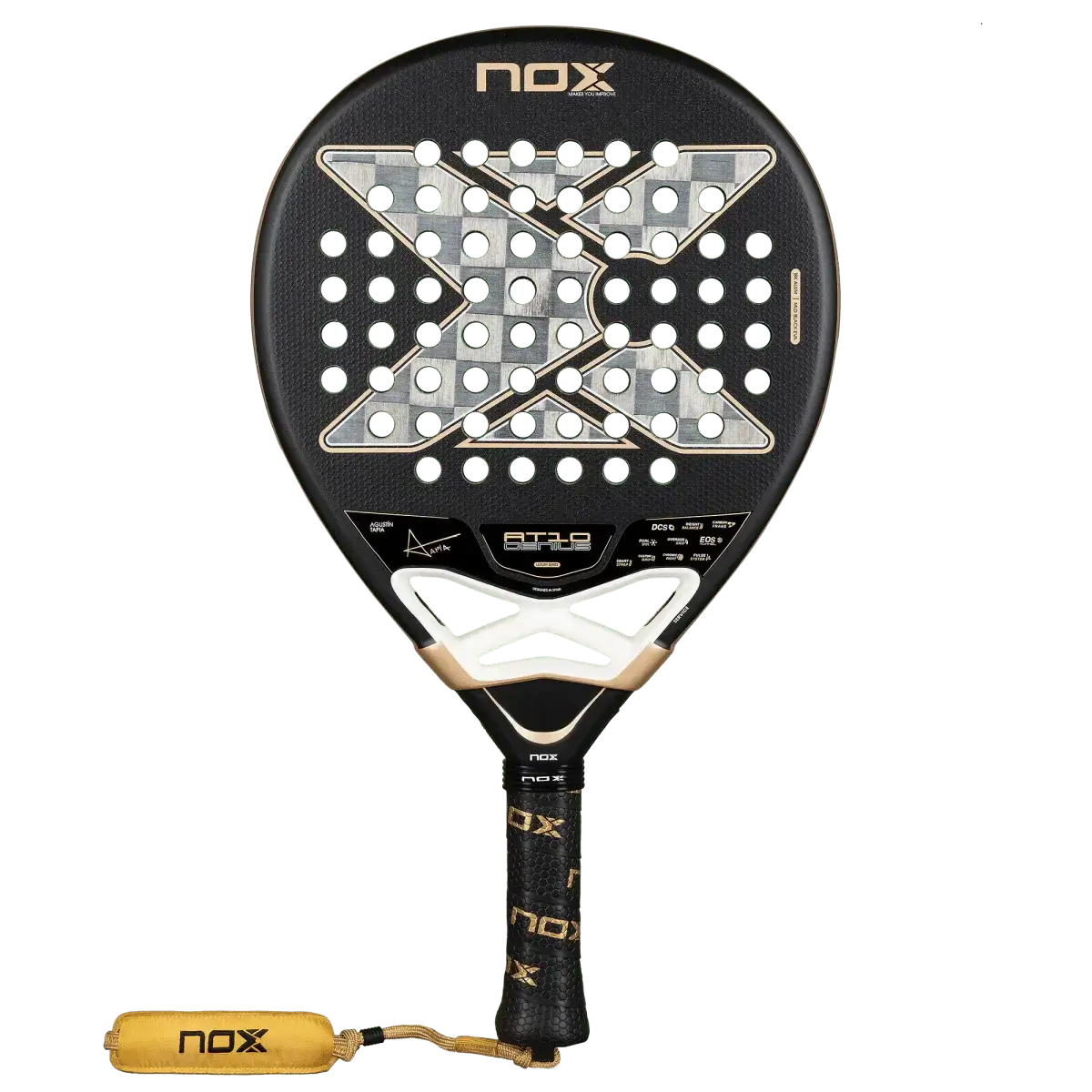
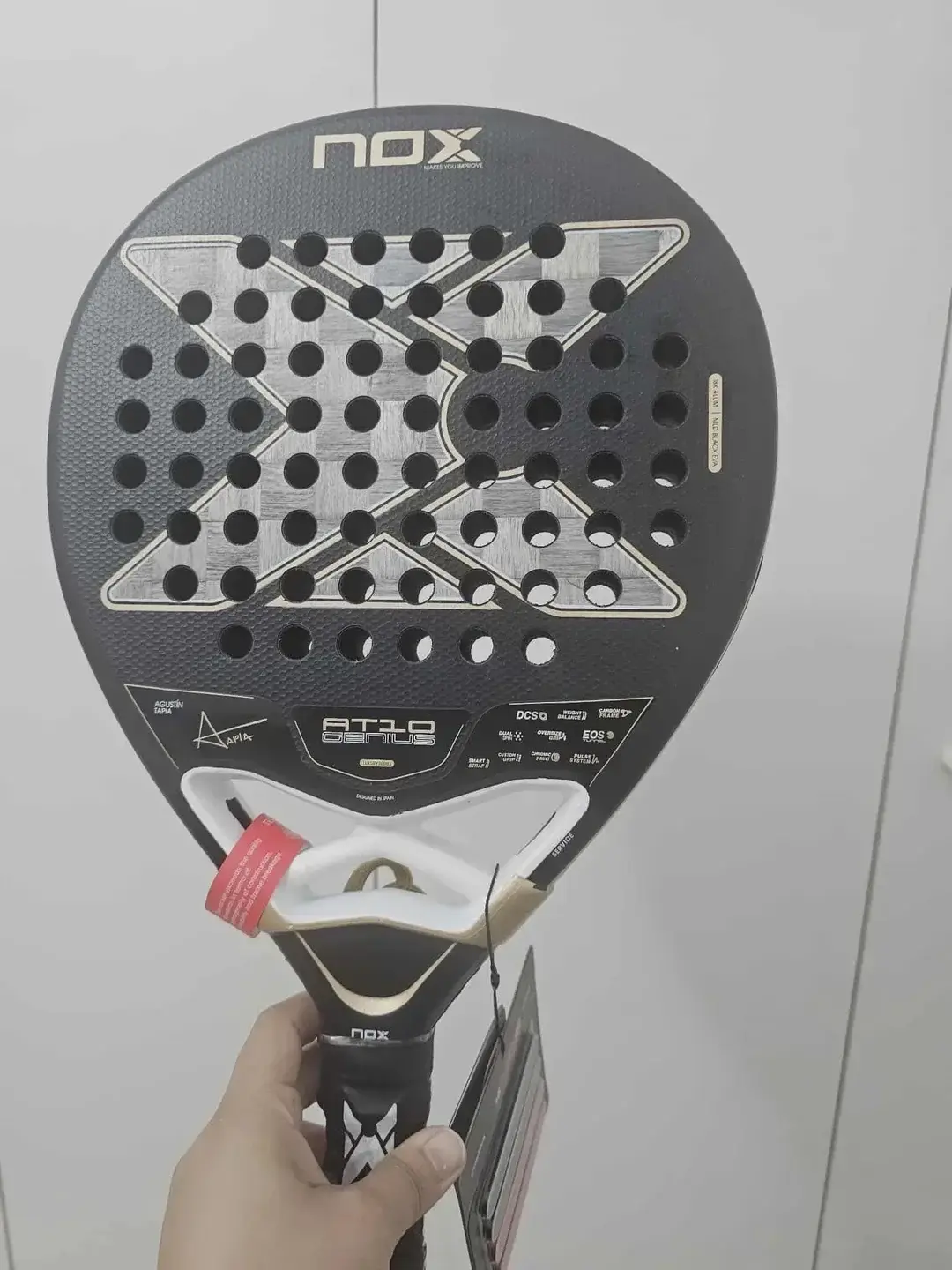
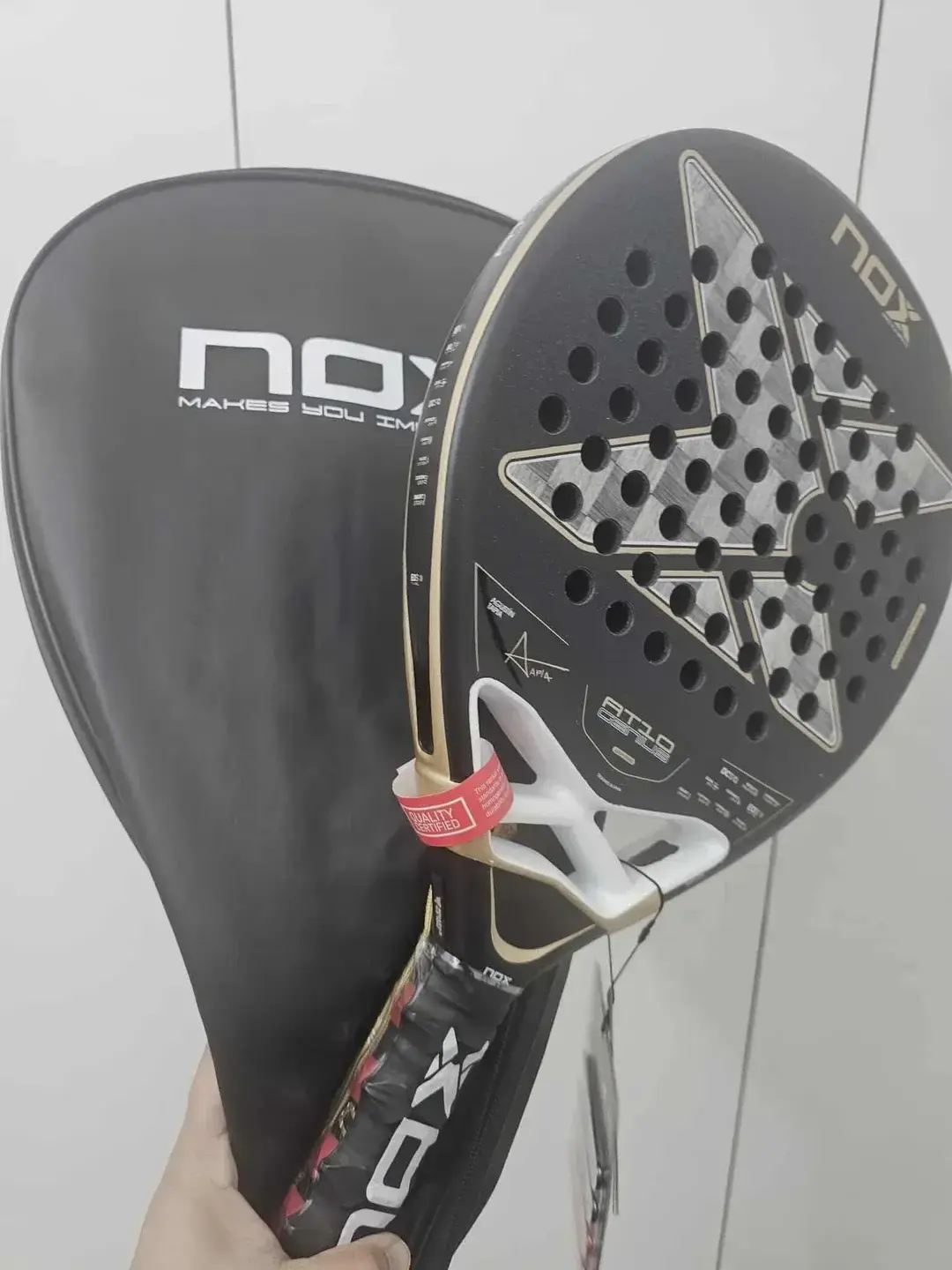
The AT10 Luxury Genius 18K Alum 2026 uses the same teardrop mold shared across the AT10 family, paired with a 38 mm profile and extended handle. The defining variable is the face construction: 18K aluminized carbon combined with MLD Black EVA, configured to deliver longer dwell time and slower rebound than the 12K version.
Despite the higher carbon weave count, the 18K is intentionally tuned softer than the 12K within the AT10 lineup. This contradicts common assumptions about carbon stiffness and is a frequent source of confusion among buyers. In practice, the 18K version sits closer to the middle of the stiffness spectrum, acting as the control reference point of the series.
Manufacturer-declared technologies include Dual Spin surface treatment, Smartstrap, Pulse vibration damping, an extended handle, and the adjustable Weight Balance system. None of these change the fundamental identity of the racket, but together they support a more neutral balance and controlled rebound profile in the 2026 generation.
Technical specifications
| Spec | Value | What it means |
|---|---|---|
| Shape | Teardrop (hybrid control mold) | Balanced power and control |
| Thickness | 38 mm | Thicker = more power and rebound |
| Weight range (claimed) | 360–375 g | Heavier = more stability, lighter = more speed |
| Typical playing weight | ~360–365 g with overgrips | Heavier = more stability, lighter = more speed |
| Balance (observed) | ~25.6–25.9 cm depending on setup | Affects swing feel and power |
| Face material | 18K Alum carbon | Stiff, durable, lively response |
| Core | MLD Black EVA | Good balance of control and feel |
| Surface finish | Dual Spin (sand + micro-3D texture) | Determines feel and response |
| Handle | Extended length | |
| Adjustable balance system | Yes (glued strips) | Affects swing feel and power |
Construction and materials
The AT10 Luxury Genius 18K Alum 2026 is built around a conventional carbon frame combined with a multilayer face structure and MLD Black EVA core. While the overall construction philosophy remains consistent with previous AT10 generations, the 2026 version refines how the face material interacts with the core during ball impact.
The 18K aluminized carbon layer is the defining element here. Compared to tighter and stiffer carbon layouts, this face construction flexes more progressively under load. Instead of producing an immediate rebound spike, the face deforms slightly before transferring energy into the core. This creates a smoother energy return and extends dwell time, particularly noticeable at medium swing speeds.
The MLD Black EVA core remains unchanged in concept, but its interaction with the softer face material results in a more controlled compression profile. Under defensive pressure, the core absorbs pace efficiently without collapsing, while during offensive swings it releases energy in a linear, predictable manner rather than a sudden snap. This balance between absorption and release is central to the racket’s controlled feel.
From a structural standpoint, nothing about the construction aims to maximize power or spin artificially. Instead, the materials are selected and tuned to minimize variability between similar swings. This makes the racket more consistent across long rallies and reduces the likelihood of unpredictable depth or trajectory changes.
Shape and mould behavior
The AT10 18K 2026 uses the same teardrop mould shared across the AT10 lineup, positioning the sweet spot slightly above center while maintaining a relatively compact head geometry. This shape is designed to balance maneuverability and control rather than push mass toward the tip.
In play, the mould produces a neutral swing path with minimal inertia bias. Measured balance values around ~25.6–25.9 cm reinforce this neutrality, allowing quick transitions at the net and stable handling in defensive situations. Compared to diamond-shaped or attack-oriented moulds, the AT10 does not encourage upward mass loading or exaggerated smash mechanics.
The teardrop geometry also defines how forgiveness is distributed. The central and lower-central areas of the face are the most tolerant, supporting defensive blocks and controlled lobs. Contact higher toward the tip is less forgiving, with output dropping progressively rather than abruptly. This behavior rewards clean technique without harshly punishing slight mis-hits.
Overall, the mould favors players who rely on positioning, timing, and shot selection. It does not artificially enhance overhead power, but it provides a reliable platform for consistent all-court play, particularly when rallies extend and pace varies.
12K versus 18K in the AT10 family
Within the AT10 family, the difference between 12K and 18K versions is driven almost entirely by face stiffness and rebound behavior, not by shape, core, or overall construction. Both versions share the same mould, thickness, handle length, and core material, making direct comparison especially meaningful.
The 12K version uses a stiffer carbon face that produces a faster rebound and shorter dwell time. This results in a more reactive feel, quicker ball release, and greater sensitivity to swing speed. Balance measurements for the 12K typically sit slightly lower, around ~25.2–25.5 cm, enhancing maneuverability but also increasing reactivity under incoming pace.
The 18K version shifts this dynamic. With its softer aluminized carbon face, rebound speed is reduced and dwell time increases. Measured balances closer to ~25.6–25.9 cm, combined with slower face response, create a calmer interaction at impact. The ball stays on the face longer, which improves directional control and reduces unintended depth, especially in defensive and net scenarios.
In practical terms, the 12K rewards assertive, aggressive play and precise timing, while the 18K offers a broader usability window. The 18K is more tolerant of small timing errors and fluctuating swing speeds, making it better suited for long matches and varied match situations. Neither version is objectively superior; the choice depends on whether the player values immediacy and reactivity or consistency and composure.
Stiffness, feel, and comfort
In absolute terms, the AT10 18K 2026 falls into the medium stiffness category. It is firmer than the 2024 AT10 generation and slightly firmer than the 2025 18K, but remains clearly softer than the 12K 2026. This positioning is critical to understanding the racket’s identity.
Measured balance values typically fall between 25.6 and 25.9 cm, which places the mass distribution closer to neutral than many control-oriented rackets that drift toward 26.5–27.0 cm. Combined with the 18K face, this produces a rebound that is slower and more progressive rather than abrupt. The ball stays on the face longer, especially at medium swing speeds, which translates into improved directional control and fewer unintended depth errors.
From a comfort perspective, vibration damping is effective but not exaggerated. The racket avoids harsh shock, yet it does not fully mask feedback. Players with sensitive elbows may still need to manage grip size and weight distribution carefully, but compared to firmer carbon layouts the 18K is noticeably less fatiguing over long sessions.
Sweet spot and forgiveness
The sweet spot is centrally located and moderately wide for a teardrop mold. Compared to the 12K 2026, the 18K offers greater tolerance on slightly off-center contact, particularly below the center line of the face. This is where defensive blocks and emergency lobs often occur, and the 18K’s softer response helps maintain usable depth.
Contact above the center reveals the limits of the design. Output drops more gradually than on the 12K, but the racket does not mask poor contact entirely. The trade-off favors consistency: fewer explosive mis-hits, but also less compensation for sloppy technique in the upper third of the face.
Power and smash behavior
The AT10 18K 2026 is not a power-assisting racket. Smash output depends heavily on technique and acceleration. While por-3 finishes are achievable, they require committed mechanics and full swing speed.
Compared to the 12K, the 18K generates less immediate rebound velocity, but offers superior control over smash trajectory. Players who rely on placement, height control, and consistency rather than raw speed will find the 18K easier to manage in match conditions, particularly when fatigue sets in.
Net play and fast exchanges
At the net, the defining characteristic of the 18K is stability under pace. Volleys feel controlled and predictable, with minimal trampoline effect. In fast exchanges, the racket rewards compact swings and angle-based play rather than reactive flicks.
Despite its softer tuning, maneuverability remains high. With a balance under 26 cm, the racket transitions quickly between forehand and backhand volleys. This combination of calm rebound and fast handling makes the 18K particularly effective in sustained net battles where consistency outweighs explosiveness.
Stability on off-center contact
Torsional stability is solid for a racket in this weight and balance class. While not as rigid as head-heavy diamond-shaped designs, the AT10 18K maintains predictable behavior on edge contact.
Several testers reported meaningful improvements after adding 4–8 g of head weight via the Weight Balance system. This adjustment shifts effective balance closer to ~26.2–26.4 cm, improving overhead stability and volley firmness without significantly compromising maneuverability. The ability to tune stability without altering the core feel is a key advantage of this platform.
Practical on-court takeaways
In real match play, the AT10 18K 2026 excels in scenarios that demand control under pressure. Defensive blocks, counter-volleys, and controlled lobs benefit from the racket’s slower rebound and extended dwell time.
Players who generate their own pace will appreciate the racket’s consistency across swing speeds. Those who rely on the racket to create depth or speed will find it less accommodating. Over long matches, the calmer response reduces mental and physical fatigue, particularly in fast, tactical exchanges.
Comparison with NOX rackets
Within the 2026 lineup from NOX, the AT10 18K sits at the geometric and mechanical center of the control-oriented rackets. While multiple models share similar shapes and weight ranges, their face materials, stiffness tuning, and rebound profiles create distinctly different on-court behaviors.
AT10 18K 2026 vs AT10 12K 2026
Both rackets share the same teardrop mold, 38 mm thickness, extended handle, and MLD Black EVA core. The critical difference lies in the carbon layout and face stiffness tuning.
The 12K version uses a tighter, stiffer carbon weave that produces a faster rebound and shorter dwell time. In measured play, this typically results in a slightly lower effective contact time and a more immediate ball release. Balance measurements for the 12K often cluster closer to ~25.2–25.5 cm, making it feel marginally quicker but also more reactive to incoming pace.
The 18K version shifts this behavior through a softer aluminized carbon face. Measured balances around ~25.6–25.9 cm combined with slower rebound produce a calmer response. The ball stays on the face longer, especially at medium swing speeds, which improves directional control and reduces accidental depth. Physically, nothing else changes — but the face elasticity alone is enough to alter the entire playing character.
In practical terms, the 12K rewards aggressive, decisive swings, while the 18K tolerates variability and favors composure.
AT10 18K 2026 vs AT10 18K 2025
At first glance, these rackets appear nearly identical on paper. However, the 2026 version introduces measurable refinements in face response and rebound consistency.
The 2025 AT10 18K exhibits a more elastic, trampoline-like rebound, particularly noticeable on defensive lobs and medium-speed volleys. The 2026 version tightens this response. While still medium in stiffness, it produces less rebound amplification and a more linear energy return. This change reduces depth variability and improves predictability under pressure.
The practical result is that the 2026 version feels more structured and less vague, particularly in fast exchanges. Players who found the 2025 model too soft or imprecise are likely to see the 2026 as a correction rather than a reinvention.
AT10 18K 2026 vs EA10 Hybrid 2026
Although both rackets target control-oriented players, they diverge significantly in physical forgiveness and output generation.
The EA10 Hybrid typically presents a slightly higher effective balance and a more elastic face-core interaction. This creates easier depth from defensive positions and greater tolerance on off-center contact, especially toward the upper half of the face.
By contrast, the AT10 18K has a tighter rebound envelope. Its sweet spot is more defined and centered, and output drops more predictably outside that zone. This makes the AT10 18K more precise but less forgiving. Physically, this difference is driven by face stiffness tuning rather than geometry — the AT10 simply returns less energy unless the player supplies it.
In short, EA10 favors assistance and forgiveness; AT10 18K favors control and discipline.
AT10 18K 2026 vs AT10 18K Attack
In versions where an Attack configuration exists, the primary physical difference is mass distribution, not materials. The Attack variant shifts effective balance upward, typically by ~0.5–1.0 cm, increasing head presence.
This change improves overhead penetration and smash weight but reduces maneuverability and increases torsional demands in fast exchanges. The standard AT10 18K remains more neutral and easier to handle over long rallies, particularly at the net.
Comparison with other brands
Against the Bullpadel Vertex, the AT10 18K feels less head-heavy and more maneuverable, but offers less inherent power. Compared to the Adidas Metalbone Control, the AT10 delivers a smoother, less metallic response with better defensive predictability. Against the Head Speed Pro, the AT10 trades some power potential for improved control under pace and a calmer net presence.
In each case, the AT10 18K positions itself as the more neutral, less polarized option. It does not chase extremes in stiffness or head weight, instead offering a balanced platform adaptable to multiple playing styles.
Technical positioning
The NOX AT10 Luxury Genius 18K Alum 2026 is positioned as a neutral-control reference racket within the modern AT10 platform. Its defining trait is not power, spin, or forgiveness in isolation, but the way it balances stability, dwell time, and predictability without pushing any single parameter to an extreme.
From a mechanical standpoint, the racket sits in a narrow window: medium stiffness, neutral balance around ~25.6–25.9 cm, and a rebound profile that scales linearly with swing speed. This means the racket does very little on its own. It neither amplifies input aggressively nor compensates heavily for imperfect contact. As a result, performance outcomes depend strongly on player intent and technique.
This positioning makes the AT10 18K particularly suitable for players who already generate sufficient pace and value control under pressure over assistance. In match play, the racket excels when rallies extend, pace fluctuates, and decision-making becomes more important than raw acceleration. Defensive blocks, controlled lobs, and counter-volleys benefit from the calmer rebound and longer dwell time, especially compared to firmer or more head-heavy alternatives.
The same traits define its limitations. Players seeking easy depth, automatic power, or a large forgiving sweet spot will likely find the AT10 18K demanding. Compared to the EA10 Hybrid, it provides less help from awkward positions. Compared to the AT10 12K, it lacks the immediate snap and reactivity that aggressive net players may prefer. These are not flaws in construction, but consequences of deliberate tuning choices.
For players upgrading from the 2025 AT10 18K, the 2026 version represents a structural refinement rather than a behavioral shift. The feel is firmer, rebound more controlled, and response more consistent, but the fundamental identity remains intact. Players who liked the 2025 model but wanted more precision will see the upgrade as justified. Players who valued maximum softness may perceive it as less forgiving.
In the broader control-racket landscape, the AT10 18K 2026 positions itself between highly forgiving hybrids and stiff, precision-oriented control frames. It does not chase extremes in stiffness, balance, or surface aggression. Instead, it offers a stable baseline that rewards disciplined technique, thoughtful shot selection, and long-term consistency.
Ultimately, the AT10 18K 2026 is best described as a tool for players who want the racket to stay out of the way. It neither rescues poor execution nor exaggerates good shots. For the right player, this neutrality becomes its greatest strength.
Technical performance score
Ten categories, each 0-10. Methodology →
- Control and directional accuracy8.5
- Defensive output and depth management8.5
- Net play and fast exchanges8.0
- Power ceiling and smash potential7.5
- Sweet spot size and forgiveness8.5
- Stability on off-center contact8.5
- Spin generation and surface effectiveness8.0
- Comfort and vibration management8.0
- Maneuverability and balance behavior8.5
- Versatility across playing styles9.0
Final verdict — NOX AT10 Luxury Genius 18K Alum scores 82/100. A top-tier with balanced performance across categories, best suited to advanced, confident players.
Common questions
Yes. Within the AT10 lineup, the 18K version is deliberately tuned softer than the 12K. The difference comes from the face material, not the core or mold. The 18K Alum carbon produces a longer dwell time and slower rebound, while the 12K delivers a firmer, more reactive response. This makes the 18K easier to control under pressure, especially in defense and net exchanges.
The 2026 version is firmer and more structured than the 2025 model. Rebound is more linear and less trampoline-like, which improves predictability on volleys and defensive shots. Players who found the 2025 version too soft or vague will likely see the 2026 as a clear refinement rather than a radical change.
The racket offers good vibration damping and avoids harsh feedback, but it is not a soft or elastic frame in absolute terms. Players with arm sensitivity will generally find it more comfortable than the 12K, but less forgiving than hybrid models like the EA10. Proper grip sizing and weight setup remain important.
Power is available, but it is technique-dependent. The racket does not provide free speed or automatic depth. Smash performance, including por-3 finishes, requires full acceleration and clean mechanics. In exchange, the racket offers better control of trajectory and fewer unintended long balls.
The sweet spot is centrally positioned and more forgiving than the 12K version, particularly on contact below the center. Upper-face forgiveness is limited, which reinforces the racket’s control-oriented nature. Compared to the EA10 Hybrid, the AT10 18K is more precise but less forgiving.
It leans defensive and all-court rather than purely offensive. The calmer rebound and pace absorption make it strong in blocks, counter-volleys, and resets. Offensive players can still attack effectively, but the racket will not amplify power on its own.
Yes. The adjustable Weight Balance system allows players to add 4–8 g of head weight, typically shifting effective balance from ~25.7 cm toward ~26.2–26.4 cm. This improves overhead stability and smash weight without dramatically reducing maneuverability.
Only if you value consistency and versatility over raw reactivity. The 12K remains the better option for aggressive net players who want instant response. The 18K is the better choice for players who want calmer behavior across a wider range of match situations.
Upper-intermediate to advanced players who generate their own pace and prioritize control, stability, and predictability. It is particularly well suited to all-court and counter-punching styles.
The two faces of NOX rackets are technically identical, with rare exceptions limited to certain LTD models. The “Service” marking does not indicate any difference in performance, materials, or playing characteristics of that side of the racket. It is used only before the match to determine which team serves first. Players can spin the racket on the court, and if the side with the “Service” marking ends up facing up, the guessing team starts the match with the serve.