NOX VK10 Ventus Control 12K 2026
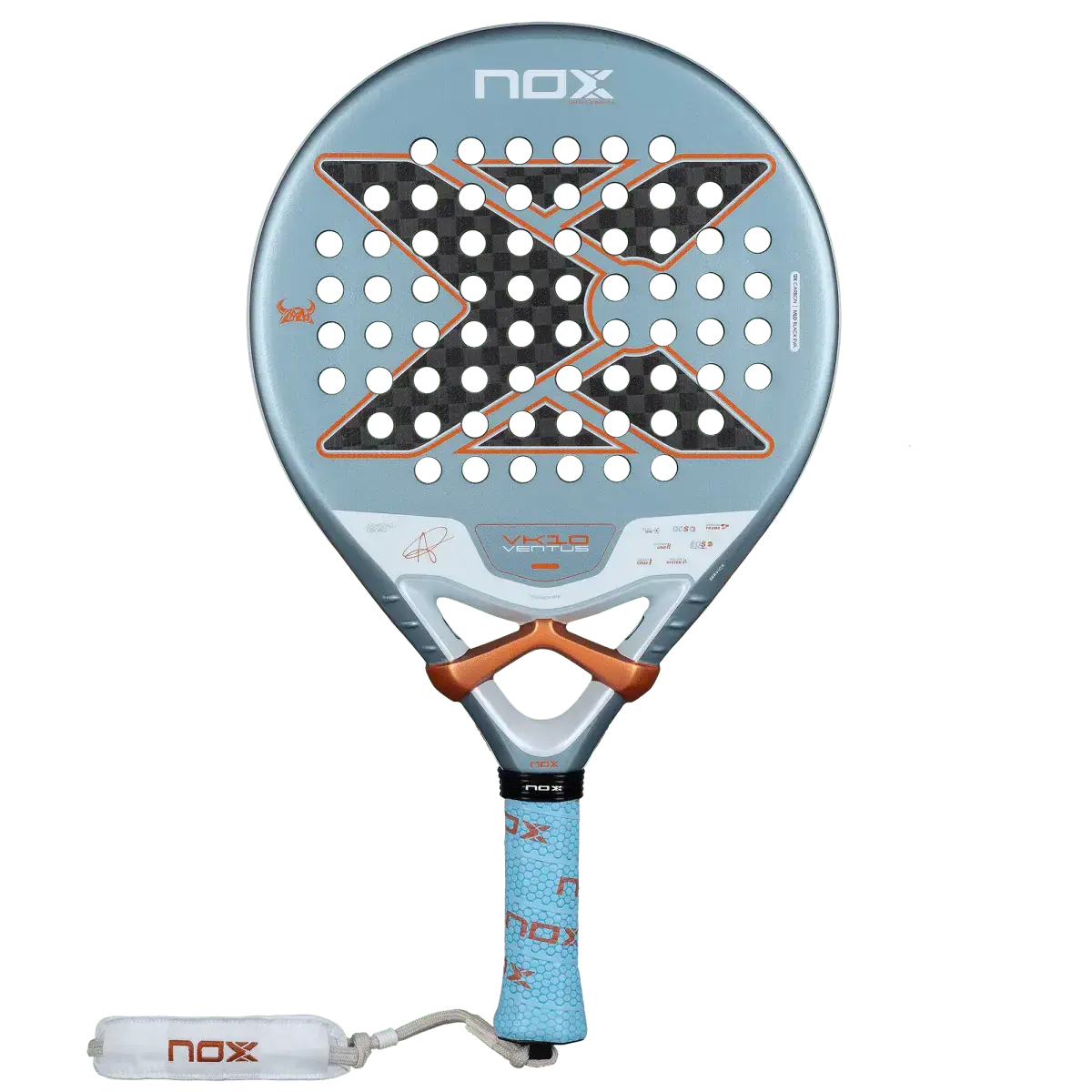
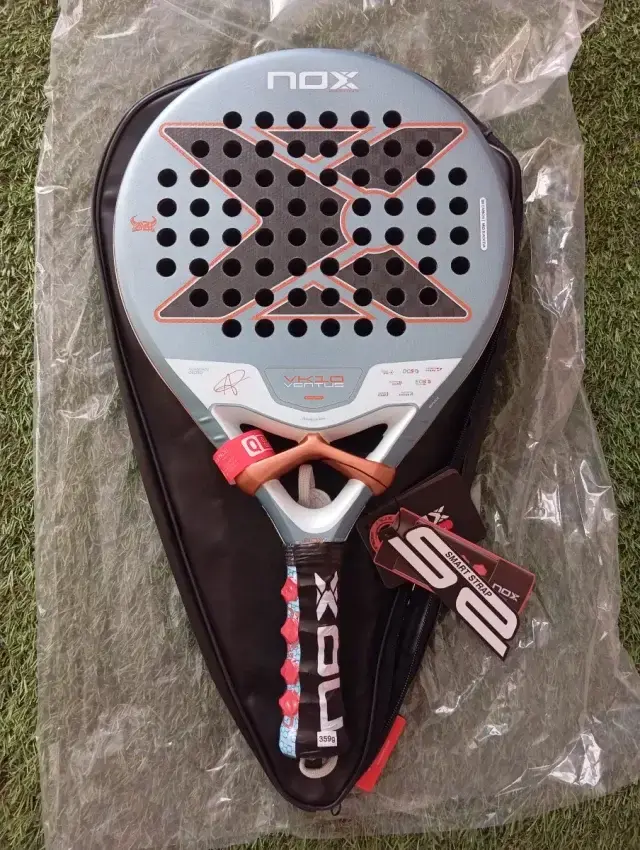
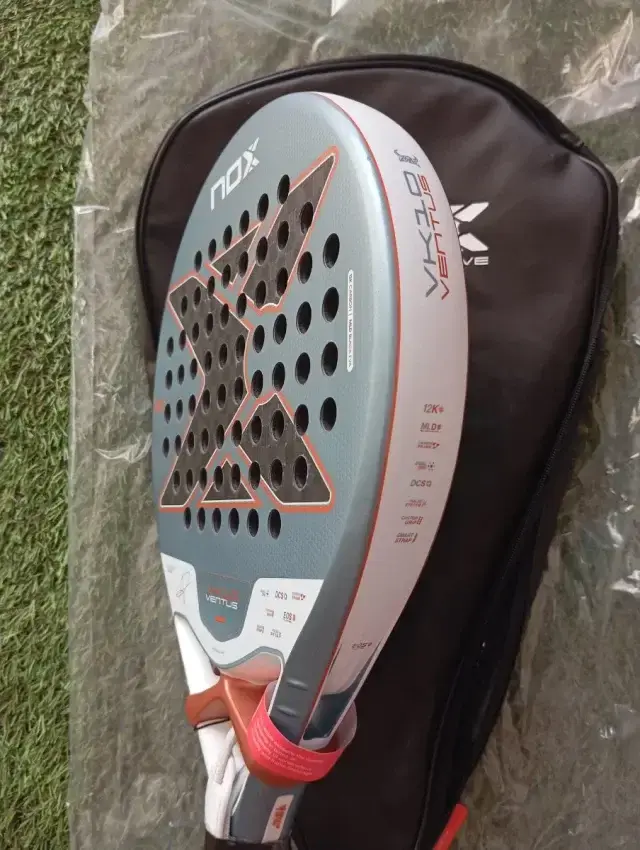
Version and lineup identification
The VK10 Ventus Control 12K 2026 belongs to the Ventus family and is positioned as the control-focused counterpart to more aggressive NOX frames. It carries the signature of Aranzazu Osoro, but the racket itself is not a niche “pro-only” tool. Instead, it targets advanced amateurs and competitive club players seeking stability and confidence rather than maximum output.
Within the NOX lineup, the VK10 Control sits below AT10 models in offensive potential and below Attack frames in overhead authority. Its role is to offer a balanced, controlled alternative for players who do not want the higher swing inertia, stiffness, or narrower sweet spots associated with attack-oriented designs.
Key construction elements include a 12K XTREM carbon face, a medium-density EVA core, and a mould optimized for balance and maneuverability rather than mass transfer.
Technical specifications
| Spec | Value | What it means |
|---|---|---|
| Shape | Round / Control-oriented hybrid | Control-focused, wide sweet spot |
| Thickness | 38 mm | Thicker = more power and rebound |
| Weight range (claimed) | ~360–375 g | Heavier = more stability, lighter = more speed |
| Measured playing weights | typically ~360–370 g (depending on grip build) | Heavier = more stability, lighter = more speed |
| Balance (measured) | approximately ~25.4–25.8 cm | Affects swing feel and power |
| Face material | 12K XTREM Carbon | Good stiffness and durability |
| Core | EVA (medium density) | Good balance of control and feel |
| Frame | 100% Carbon | Structural rigidity and durability |
| Surface | textured finish (spin-oriented, not aggressive) | Determines feel and response |
| Adjustable balance | No | Affects swing feel and power |
Construction and materials
The 12K XTREM carbon face provides a relatively stiff structural base without introducing excessive rebound. Compared to softer or more elastic carbon weaves, this construction shortens dwell time slightly, resulting in a clean, direct response that favors placement accuracy.
The EVA core operates in the medium range, absorbing incoming pace effectively while avoiding the hollow or springy sensation associated with power-focused designs. Under higher swing speeds, the response remains controlled rather than accelerating disproportionately. The full carbon frame contributes to torsional stability, especially noticeable during defensive blocks and counter-volley situations.
Overall, the material combination aims to minimize energy spikes and maintain predictable output across different shot types.
Shape and mould behavior
The round-control mould centralizes the sweet spot and keeps mass distribution closer to the hand. With balance measurements typically staying below 26 cm, swing initiation is quick and recovery between shots is efficient.
This geometry supports defensive reliability, soft hands at the net, and controlled baseline exchanges. However, it also limits leverage on overhead shots, particularly when compared to teardrop or diamond moulds. The racket does not artificially enlarge the hitting area or push mass toward the tip, reinforcing its control-first identity.
The mould is optimized for consistency and maneuverability, not for finishing points quickly.
12K behavior in the Ventus Control
In the VK10 Ventus Control 12K 2026, the 12K XTREM carbon face is used in a fundamentally different way than in AT10 or Attack-oriented frames. Here, stiffness serves stability and precision, not power transfer. The face does not introduce a trampoline effect, even at medium swing speeds, and ball output remains proportional to player input.
Compared to AT10 12K models, the VK10 Control feels less demanding physically. The lower balance and centralized sweet spot allow the player to engage the 12K surface without needing full acceleration to maintain depth. At the same time, the face does not add speed artificially, which reduces volatility and helps keep trajectories low and predictable.
In practice, the 12K construction here favors linear response and directional confidence, especially in rally situations where consistency matters more than point-ending shots.
Stiffness, feel, and comfort
The VK10 Ventus Control 12K feels firm but controlled. Impact feedback is clear and well-defined, yet noticeably calmer than on stiffer attack frames. The combination of the 12K face and medium EVA core filters vibration effectively, particularly on off-center contact and defensive shots.
Compared to AT10 Attack variants, feedback is less abrupt and less punishing. Compared to teardrop AT10 12K models, the VK10 Control feels slightly softer overall, largely due to its balance and mould rather than its materials. Comfort over long sessions is one of its strengths, as the racket avoids sharp impact peaks that often lead to arm fatigue.
For players sensitive to vibration, this model is significantly more forgiving than most power-focused rackets, though still firmer than very soft hybrid designs.
Sweet spot and forgiveness
The sweet spot on the VK10 Ventus Control 12K is clearly centralized and relatively generous for a performance-oriented racket. Practical play suggests a usable hitting area that is wider and more tolerant than AT10 Attack models and slightly more forgiving than AT10 teardrop variants.
Off-center contact above and below the center maintains acceptable depth and directional stability. Lateral mis-hits are handled predictably, with gradual performance drop-off rather than abrupt loss of control. This characteristic makes the racket particularly effective in defensive scrambling situations and extended rallies.
Forgiveness is one of the defining traits of this model. While it does not “save” completely mistimed shots, it significantly reduces penalty on imperfect contact compared to higher-balance frames.
Power and smash behavior
Power generation on the VK10 Ventus Control 12K 2026 is intentionally limited. The racket does not amplify swing speed and provides minimal free acceleration, especially on overhead shots. Smash output is controlled and flat rather than explosive, with depth and placement taking priority over velocity.
Flat smashes are reliable when executed with proper technique, but the racket does not reward partial swings. Por-3 and kick smashes are possible only with full commitment and correct contact height, and even then, the ceiling remains modest compared to AT10 Attack or EA10 Attack models.
This behavior reinforces the racket’s identity as a point-construction tool rather than a finishing weapon. Players who rely on repeated overhead pressure to end rallies will find its power insufficient, while those who prefer to reset, place, and outmaneuver opponents will appreciate its restraint.
Net play and fast exchanges
At the net, the VK10 Ventus Control 12K favors positioning and anticipation over raw hand speed. Swing inertia is moderate, allowing quick adjustments without feeling sluggish, especially when compared to higher-balance attack frames.
In controlled volley exchanges, directional accuracy is a standout trait. The 12K face prevents accidental pop-ups and keeps ball trajectories flat, which is particularly effective when targeting opponents’ feet or creating uncomfortable half-volleys. Touch shots such as drop volleys and angled placements feel natural due to the racket’s calm response and centralized sweet spot.
In very fast hand battles, the VK10 Control does not provide explosive counter-punching. Instead, it rewards early preparation and compact swings. Late reactions are handled more gracefully than with attack-oriented rackets, but the racket will not inject speed automatically. Blocks remain stable, provided contact is clean and the racket face is presented correctly.
Compared to AT10 Attack models, the VK10 Control is significantly easier to manage at the net. Compared to AT10 teardrop models, it feels slightly more neutral and less demanding physically during prolonged exchanges.
Stability on off-center contact
Stability on off-center contact is one of the strongest technical attributes of the VK10 Ventus Control 12K 2026. The combination of a centralized balance point, round control-oriented mould, and 12K XTREM carbon face allows the racket to maintain structural integrity even when contact occurs outside the ideal hitting zone.
On high-face impacts, the frame remains composed and does not introduce unwanted rebound or directional drift. Ball trajectory stays predictable, with depth loss occurring gradually rather than abruptly. This is especially noticeable on defensive blocks and counter-drives, where the racket absorbs pace instead of reflecting it erratically.
Low-face contact is handled better than on AT10 Attack models and slightly better than on AT10 teardrop versions. While depth naturally decreases, feedback remains controlled and vibration does not spike. Lateral mis-hits show minimal torsional twist, indicating good frame stiffness distribution rather than reliance on sheer mass.
Overall, off-center stability is clearly tuned toward consistency under pressure, making the VK10 Control reliable in messy rally situations where perfect preparation is not always possible.
Practical on-court takeaways
In match conditions, the VK10 Ventus Control 12K 2026 excels when rallies extend and point construction becomes more important than immediate finishing. The racket encourages disciplined shot selection, reliable depth, and consistent directional control from both the baseline and the net.
Defensive play is a clear strength. Lobs, resets, and controlled counter-attacks can be executed with confidence, even under pressure. The racket allows players to recover position without overhitting or losing control, which reduces unforced errors during long exchanges.
Offensively, the racket supports placement-based aggression rather than outright power. Players who rely on angles, variation, and tempo changes will extract the most value. The Weight Balance System, when present, allows fine tuning but does not alter the fundamental control-first identity.
Fatigue management is another practical advantage. The moderate swing weight and controlled rebound help sustain performance over long matches without excessive physical strain.
Comparison within the NOX lineup
Within NOX’s 2026 control-oriented range, VK10 Ventus Control 12K and ML10 Ventus Control 3K sit very close in shape intent (round/control), but they deliver different “physics” at contact. The core idea is simple: 12K in the VK10 makes the response more structured and mechanically “clean” under acceleration, while 3K in the ML10 makes the response more elastic, smoother, and more forgiving in low-to-medium pace situations.
VK10 Ventus Control 12K (Osoro) is the more “technical” control tool of the two. The 12K face tends to reduce face deformation at higher swing speeds, so the ball leaves with less wobble when you drive through the shot. In practice, that usually shows up as cleaner directional stability on flat drives and firmer, more deterministic feedback when you hit through the ball. The trade-off is that 12K setups typically feel less “free” on touch and defensive floaters, meaning you may need a bit more intention (and cleaner contact) to produce the same easy depth you get from a more elastic face.
ML10 Ventus Control 3K (Lamperti) is the comfort-and-consistency reference in this pairing. The 3K face generally provides longer dwell time and a softer rebound feel, which helps in two high-frequency situations for most amateurs: defensive resets and net blocks. You get more “auto-stability” in the sense that off-center contact tends to be punished less sharply, and vibration is usually more filtered. The trade-off is that at higher acceleration the face can feel less “locked-in” than the 12K VK10: it remains controlled, but the sensation is more elastic and less crisp.
Comparison with other brands
In the broader market of control-oriented padel rackets, the NOX VK10 Ventus Control 12K 2026 positions itself as a structured, stability-first control frame. Its defining characteristics are directional predictability, controlled acceleration, and reduced volatility under pressure, rather than elastic rebound or free depth generation.
VK10 Ventus Control 12K 2026 vs Bullpadel Vertex Control 2026
The Bullpadel Vertex Control 2026 typically offers a softer, more elastic response, with a larger effective sweet spot and easier depth access from defensive positions. Its rebound behavior is more forgiving on imperfect contact, particularly low on the face.
By comparison, the VK10 Ventus Control 12K feels firmer and more disciplined. Ball output scales more directly with swing input, and trajectory remains flatter and more predictable under acceleration. While the Vertex Control reduces error rate in messy rallies, the VK10 provides better directional stability when the player accelerates deliberately, especially in controlled volleys and flat counter-shots.
VK10 Ventus Control 12K 2026 vs Adidas Metalbone CTRL 2026
The Metalbone CTRL 2026 emphasizes customization and structural stiffness. With its weight system and rigid construction, it can be tuned toward higher balance and more aggressive behavior, but this often comes with increased sensitivity to off-center contact.
The VK10 Ventus Control 12K takes a less aggressive approach. Its balance and swing inertia remain more moderate, and its 12K face produces a calmer, more uniform response across the face. While the Metalbone CTRL can offer higher ceiling potential when perfectly tuned, the VK10 is easier to keep consistent over long matches, with fewer sudden rebound spikes.
VK10 Ventus Control 12K 2026 vs Head Speed Pro / Speed Motion series
Head’s Speed control-leaning models tend to favor maneuverability and softer feel, with quicker handling in fast exchanges and a more forgiving response at the net. Their rebound behavior is generally more elastic, aiding touch shots and defensive resets.
The VK10 Ventus Control 12K trades some of that softness for structure. It feels more planted through the ball, particularly on flat shots and controlled drives. In fast hand battles, the Head Speed models feel quicker; in controlled construction play and directional blocking, the VK10 offers higher stability and less rebound variability.
VK10 Ventus Control 12K 2026 vs StarVie Metheora Control series
StarVie Metheora Control rackets often emphasize comfort and a wide sweet spot, with a more progressive loss of performance on off-center contact. They are particularly forgiving in defensive situations and extended baseline exchanges.
Compared to these, the VK10 Ventus Control 12K is less forgiving but more precise. Its performance window is narrower, yet more stable once engaged correctly. Players who value error reduction through elasticity may prefer the Metheora; players who want controlled acceleration and predictable exits under pressure will align more closely with the VK10.
VK10 Ventus Control 12K 2026 vs Babolat Contact / Counter-style control frames
Babolat’s control-leaning frames often introduce elastic cores and rebound-assisting constructions that help generate depth with compact swings. This supports reactive play and quick transitions but can introduce variability at higher swing speeds.
The VK10 Ventus Control 12K remains more linear. It provides less free depth but greater consistency when the player commits to the shot. Under sustained pressure, its flatter trajectory and reduced trampoline effect help keep the ball inside margins, particularly in neutral and construction phases of rallies.
Technical positioning
The NOX VK10 Ventus Control 12K 2026 occupies a clearly defined position within the NOX lineup and the broader padel market. It is designed as a pure control racket, optimized for consistency, stability, and decision-making under pressure.
Within the NOX range, it sits below the AT10 models in terms of offensive ceiling, but offers superior forgiveness and lower volatility in defensive scenarios. Compared to AT10 teardrop versions, the VK10 Control sacrifices some adaptability in attack in exchange for improved error tolerance and calmer response across the face.
Technically, the racket prioritizes centralized balance, controlled rebound, and torsional stability over power accessibility. The round mould and 12K XTREM face create a performance window that favors baseline management, structured net play, and disciplined point construction.
This positioning makes the VK10 Control particularly suitable for right-side players, intermediate to advanced amateurs, and competitive players who prefer to win points through placement, depth control, and tactical patience rather than finishing speed.
Technical performance score
Ten categories, each 0–10. Methodology →
- Maneuverability and handling7.0
- Net performance under pace7.0
- Control and placement precision9.0
- Defensive output and depth access8.0
- Off-center stability and torsional resistance7.0
- Sweet spot usability7.0
- Spin generation potential7.0
- Power ceiling6.0
- Power accessibility6.0
- Comfort and impact feedback7.0
Final verdict — NOX VK10 Ventus Control 12K scores 71/100. A competent mid-range option with strong control and placement precision, well suited to developing and recreational players.
Common questions
This racket is aimed primarily at right-side players and control-oriented competitors who prioritize rally management, placement, and defensive reliability. It suits intermediate to advanced amateurs who want predictable response rather than power assistance.
Compared to AT10 12K versions, the VK10 Control offers lower swing inertia, a more centralized balance, and a wider effective sweet spot. It sacrifices offensive ceiling and adaptability in attack in exchange for higher forgiveness and calmer response under pressure.
Yes, but depth is player-driven. The racket does not provide trampoline effect; instead, it rewards clean mechanics and full swings. Once technique is consistent, depth control is reliable and repeatable.
Only to a limited extent. While flat drives and controlled counter-attacks are stable, the VK10 Control is not designed for frequent point finishing or overhead dominance. Aggressive players seeking smash-oriented performance will find it restrictive.
Forgiveness is one of its strengths. The round mould and balanced mass distribution keep torsional movement low, making mis-hits more manageable than on teardrop or diamond AT10 models.
Net play is stable and precise when positioning is correct. Volleys stay low and controlled, but acceleration in fast exchanges is limited. The racket favors preparation and placement over reflex punching.
Comfort is solid for a control frame. Impact feedback is firm but filtered, and vibration remains controlled. Players with arm sensitivity will generally find it more tolerable than attack-oriented NOX models.
It feels structured rather than harsh. The stiffness supports directional stability and reduces rebound variability, but it does not produce a soft or “cushioned” sensation.
The two faces of NOX rackets are technically identical, with rare exceptions limited to certain LTD models. The “Service” marking does not indicate any difference in performance, materials, or playing characteristics of that side of the racket. It is used only before the match to determine which team serves first. Players can spin the racket on the court, and if the side with the “Service” marking ends up facing up, the guessing team starts the match with the serve.