Bullpadel XPLO CMF 2026 Review
Version and lineup identification
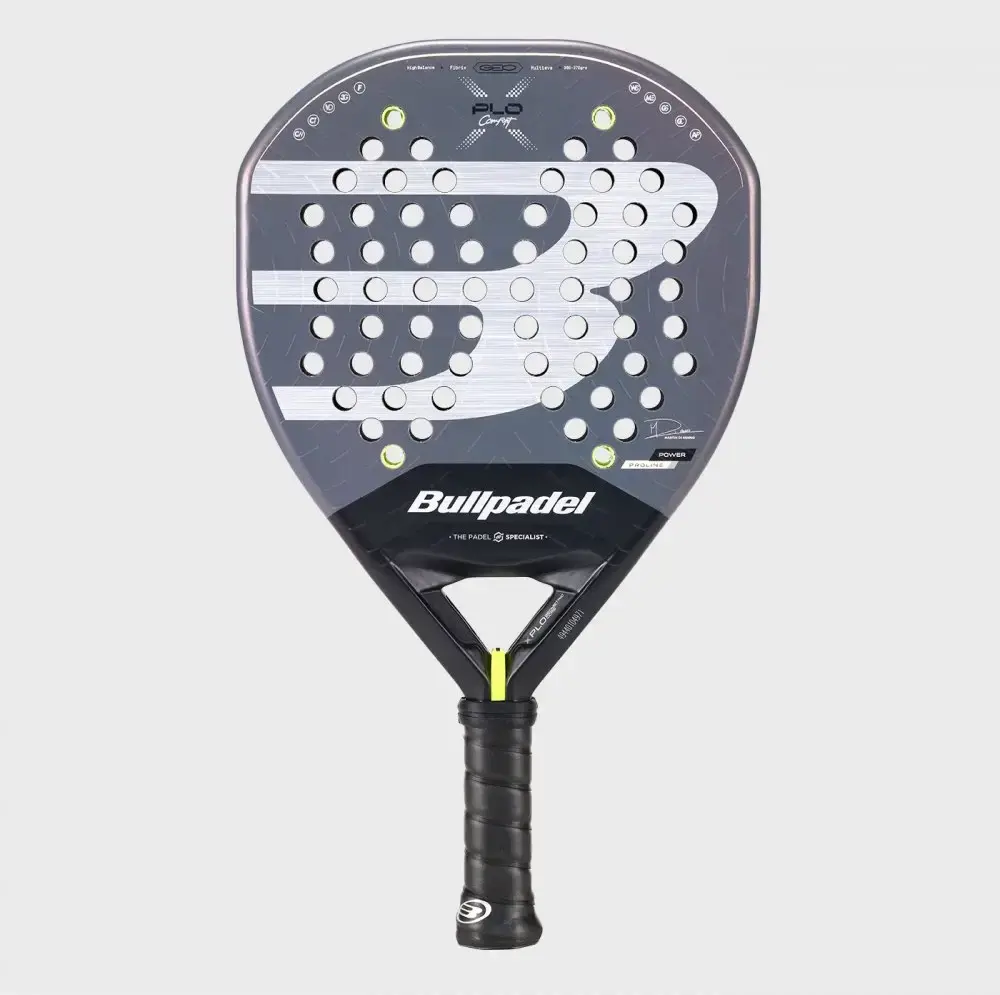
The XPLO CMF 2026 continues Bullpadel's dual-release strategy for the XPLO series, now entering its third year with this comfort-focused variant. The platform was introduced alongside the standard XPLO (12K carbon face) as part of Bullpadel's 2024 lineup refresh, establishing a pattern where Martin Di Nenno's signature model offers both performance-maximized and accessibility-enhanced versions. The 2026 iteration maintains the core architectural distinction: Fibrix composite face on the CMF versus full carbon construction on the standard model.
Within Bullpadel's broader 2026 catalog, the XPLO CMF sits below the standard XPLO in the power hierarchy but above all hybrid-shaped platforms in terms of maximum overhead velocity potential. The racket shares its cyber geometric face profile with the Neuron Edge and Vertex GEO, reflecting Bullpadel's commitment to this widened sweet spot design across multiple attacking platforms. However, the CMF remains the only diamond-shaped model in the 2026 range utilizing Fibrix rather than pure carbon face construction, creating a unique positioning as the most arm-friendly offensive option.
The model carries Martin Di Nenno's endorsement and branding, though field reports indicate his actual match racket employs the harder 12K carbon specification. This divergence is standard practice in padel equipment partnerships, where signature models often span multiple firmness levels to accommodate different consumer segments. The CMF variant specifically targets recreational attackers and intermediate players progressing toward offensive styles, rather than competitive athletes requiring maximum energy return.
Technical specifications
| Spec | Value | What it means |
|---|---|---|
| Shape | Diamond with cyber geometric face (widened upper hitting zone) | High balance, power-oriented |
| Face material | Fibrix (carbon + fiberglass composite) | Softer feel, more forgiving |
| Core | MultiEVA (multi-density foam construction) | Good balance of control and feel |
| Surface texture | 3D rough finish (raised pattern for spin assistance) | Determines feel and response |
| Weight range | 365–375 g (without overgrip, Custom Weight System not installed) | Heavier = more stability, lighter = more speed |
| Balance | Head-heavy (approximately 26.5–27.0 cm measured from handle base) | Affects swing feel and power |
| Thickness | 38 mm (standard padel specification) | Thicker = more power and rebound |
| Frame construction | Carbon reinforcement with CurvActive technology (aerodynamic profiling) | Structural rigidity and durability |
| Handle system | Hesacore grip compatibility, Custom Weight System integration points | |
| Hole pattern arrangement | Reduced hole density in upper face zone (marketed for faster ball output) | |
| Playing weight | Typically 370–380 g with single overgrip and weight system elements | Heavier = more stability, lighter = more speed |
Construction and materials
The XPLO CMF's defining construction element is its Fibrix face material, a proprietary carbon-fiberglass composite that Bullpadel deploys exclusively in comfort-oriented models. This hybrid layup combines carbon fiber's structural rigidity with fiberglass's dampening properties, creating a face that maintains dimensional stability under load while absorbing higher-frequency vibrations. The carbon component provides the load-bearing framework and prevents excessive face deformation during high-velocity impacts, while the fiberglass layers introduce compliance that extends dwell time and reduces vibration transmission to the handle.
Beneath the Fibrix face sits Bullpadel's MultiEVA core, a multi-density foam construction featuring graduated firmness zones. The core architecture places softer EVA near the face contact surfaces, providing initial impact cushioning, with progressively denser foam toward the core's center plane to prevent excessive compression and maintain rebound efficiency. This layered approach distinguishes MultiEVA from single-density cores, offering a broader usability window where the racket maintains consistent performance characteristics across varying swing speeds and impact intensities. The combination of Fibrix face and MultiEVA core creates a compound damping system that significantly reduces the harsh feedback typical of full-carbon offensive rackets.
The frame employs Bullpadel's CurvActive technology, which shapes the frame cross-section to reduce aerodynamic drag during swing acceleration. The frame material itself is carbon composite, providing necessary torsional rigidity to counteract the head-heavy balance and prevent excessive frame twist on off-center impacts. Frame reinforcement extends into the throat area where the carbon layers transition into the handle integration zone, creating a stiff junction that efficiently transfers energy from the handle through the frame to the face plane.
The 3D rough surface texture is applied as a molded pattern rather than post-production sandblasting. This approach creates raised geometric elements across the face that engage the ball's felt surface during contact, enhancing spin generation without the durability concerns associated with sandpaper coatings. The texture depth is moderate—aggressive enough to influence ball rotation on brushing contacts but not so pronounced as to create inconsistent rebound behavior. The cyber geometric face shape combines with this texture pattern to create a distinctive visual signature, though the functional benefit lies primarily in the widened upper hitting zone rather than aesthetic differentiation.
Shape and mould behavior
The XPLO CMF employs Bullpadel's cyber geometric diamond profile, a modified diamond shape featuring an exaggerated widening in the upper third of the face. This architectural departure from traditional diamond geometry serves a specific functional purpose: it relocates the "power zone"—the area where optimal mass concentration and balance convergence occur—to a larger facial region than conventional diamonds offer. The widening creates approximately 15-20% more surface area in the upper hitting zone, translating to a wider lateral margin for error on overhead shots while maintaining the head-heavy balance characteristic that defines diamond category behavior.
The geometric modification influences swing mechanics differently than standard teardrops or traditional diamonds. During overhead preparation, the widened upper face creates higher rotational inertia than a teardrop of equivalent weight, requiring slightly earlier initiation of the swing arc to achieve comparable racket head velocity at ball contact. However, compared to a conventional diamond with concentrated mass in a narrower apex, the cyber shape distributes that mass laterally, creating a more "planted" sensation through the contact zone. This manifests as enhanced directional stability when striking balls within the geometric widening, though it doesn't eliminate the need for centered contact to achieve maximum velocity transfer.
In defensive positioning, the head-heavy character remains apparent during rapid grip transitions and low volley responses. The elevated balance point creates lag in racket head acceleration from stationary positions, requiring anticipatory positioning rather than reactive adjustments. Players accustomed to round or balanced hybrid geometries will notice this constraint most acutely in fast-exchange situations where the racket must change direction quickly. The cyber widening provides minimal functional advantage in these scenarios—the benefit emerges primarily during prepared attacking strokes where the player can leverage the expanded upper sweet spot.
The mould's interaction with the Fibrix face creates a performance profile distinct from the same geometry with full carbon construction. The softer face material absorbs some of the momentum that conventional diamonds redirect into ball velocity, creating a sensation of controlled power rather than explosive rebound. Field testing confirmed this trade-off: the racket provides adequate force for recreational overhead effectiveness while avoiding the "all-or-nothing" character of harder diamonds where slight timing errors produce either devastating winners or frame-bouncing mishits. This moderated behavior makes the cyber shape more forgiving than its geometry alone would suggest.
Stiffness, feel, and comfort
The XPLO CMF registers in the soft-medium firmness range, substantially more compliant than the standard XPLO's medium-hard specification. This softness originates primarily from the Fibrix face composite, which exhibits greater deflection under load compared to full carbon layups. During contact, the face undergoes visible compression—particularly noticeable on high-velocity defensive blocks—creating extended dwell time that players perceive as a "cushioned" sensation. This extended contact phase provides temporal feedback that some players find reassuring, offering more time to perceive ball behavior against the face, though it reduces the immediate tactile snap associated with stiffer platforms.
Impact feedback through the handle remains well-dampened across the velocity spectrum. Low-speed touch shots produce muted vibration transmission, while high-velocity overheads generate noticeable but comfortable feedback without harsh peaks that stress the wrist or elbow joints. The MultiEVA core contributes significantly to this dampening characteristic, absorbing mid-frequency vibrations before they reach the handle integration zone. Players with existing elbow sensitivity or tennis elbow history will find this compliance profile substantially more tolerable than full-carbon alternatives, though it comes at the cost of reduced sensory precision for advanced players who rely on detailed tactile feedback for spin manipulation and placement refinement.
The stiffness-to-weight ratio creates an unusual pairing: the racket feels softer than its 370+ gram playing weight might suggest. This disconnect occurs because the Fibrix face's compliance partially masks the mass sensation during contact, creating an impression of lighter swing weight than the scales indicate. However, this perceptual benefit disappears during rapid transitions where the actual mass must be accelerated—the racket reveals its true weight when changing directions quickly or recovering from extended volleys. Female testers and players with less upper-body strength reported fatigue accumulation during long training sessions, indicating the weight remains consequential despite the softness.
Temperature sensitivity proved moderate during cold-weather testing. The Fibrix face maintained reasonable compliance in low ambient conditions where pure carbon can feel excessively boardy, though it still exhibited some stiffening compared to room-temperature behavior. Players in cold climates will find this racket more tolerable than harder alternatives, though optimal performance remains tied to warmer conditions. The 3D rough texture showed no temperature-related degradation, maintaining consistent ball engagement across the thermal range encountered during testing.
Sweet spot and forgiveness
The XPRO CMF's sweet spot architecture represents its most significant departure from conventional diamond specifications. Field testing estimated the usable hitting area at approximately 70% of the face surface—a dramatic expansion compared to the 20-30% sweet spot typical of traditional diamonds. This enlargement stems from two complementary design elements: the cyber geometric widening increases the lateral dimension of the upper face where diamond rackets concentrate their optimal zone, while the Fibrix face's compliance extends the velocity and precision thresholds beyond which contact quality degrades unacceptably.
However, this expanded sweet spot contains an important internal distinction: the platform differentiates between a "sweet spot" (where contact produces acceptable results) and a "power spot" (where optimal velocity generation occurs). The power spot remains concentrated in the upper third of the face, within the geometric widening, where the head-heavy balance and face stiffness converge optimally. Strikes within this zone produce the racket's maximum velocity potential and deliver the crispest feedback. Contact outside this power spot—but still within the broader sweet spot—generates adequate depth and placement accuracy without the harsh penalties typical of traditional diamonds, though velocity output drops noticeably and feedback becomes more muted.
Vertical positioning within the sweet spot proved more critical than lateral placement. Testers noted that high contact points within the geometric widening produced significantly better results than center-face or low strikes, even when lateral centering was comparable. This vertical sensitivity reflects the head-heavy balance: striking too low on the face positions the impact point below the optimal mass concentration, reducing energy transfer efficiency and creating leverage that twists the handle despite adequate lateral alignment. Players must adjust their overhead timing to make high face contact consistently—a learning curve requirement that intermediate users should anticipate.
Off-center forgiveness represents a genuine advantage over conventional diamonds. Strikes landing 3-4 cm off the central axis still produce playable results, particularly when vertical positioning remains high on the face. The ball doesn't "die" on these contacts—a critical differentiator from traditional diamonds where mishits often produce embarrassingly short returns. However, torsional twist remains perceptible on significantly off-axis impacts (beyond 4-5 cm), and while the ball clears the net, placement accuracy suffers. The Fibrix face's compliance helps maintain ball control during these mishits by extending contact duration, allowing the face to stabilize through the impact phase rather than immediately rejecting the ball at an unpredictable angle.
Power and smash behavior
The XPLO CMF delivers moderate power output, positioned substantially below the standard XPLO and other full-carbon diamonds in Bullpadel's range while exceeding hybrid-shaped models in maximum velocity potential. One tester rated the racket at 6-7 out of 10 for power generation, accurately capturing its intermediate positioning. The Fibrix face's compliance absorbs impact energy that harder alternatives redirect into ball velocity, creating a sensation of controlled acceleration rather than explosive release. Players accustomed to high-modulus carbon diamonds will perceive this as a power deficiency; those transitioning from softer platforms will find adequate velocity for recreational competition.
Smash effectiveness depends critically on contact point height. Strikes landing within the upper geometric widening—where the power spot concentrates—produce satisfactory overhead velocity with acceptable feel. The head-heavy balance assists here, allowing players with moderate swing speed to generate adequate racket head velocity through leverage rather than pure muscular acceleration. However, contact dropping to mid-face or lower results in noticeably reduced velocity and a sensation of the ball "sinking" into the face without crisp rebound. This vertical sensitivity requires timing adjustment for players unaccustomed to diamond geometries, particularly on low-bouncing balls or rushed preparation.
The hole pattern arrangement in the upper face—marketed by Bullpadel as enabling faster ball output—provides minimal perceptible benefit in field testing. While the reduced hole density in the power spot theoretically increases face stiffness in that zone, the Fibrix material's inherent compliance dominates the performance equation. The hole spacing contributes more to the racket's visual identity than its functional differentiation from conventional hole patterns. Players should focus on contact point quality and swing mechanics rather than expecting the hole arrangement to generate unusual velocity characteristics.
Consistency across multiple overhead attempts proved adequate for intermediate play. The enlarged sweet spot means players don't require pinpoint contact precision to produce acceptable results, reducing the mental pressure during match situations where smash opportunities arise. However, the racket doesn't reward perfect technique with exceptional velocity spikes the way harder diamonds do—the performance ceiling remains moderate even with ideal execution. This flattened performance curve suits developing players who benefit from reduced variance, though advanced competitors seeking maximum overhead threat will find the power ceiling limiting. Cold-weather testing revealed the racket maintained reasonable smash effectiveness in low temperatures, avoiding the excessive stiffness that can make full-carbon platforms uncomfortable in cold conditions.
Net play and fast exchanges
The XPLO CMF demonstrates solid performance in volley-based exchanges, benefiting from the geometric face's lateral stability while managing the inherent challenges of head-heavy mass distribution. The cyber widening provides a larger hitting window for punch volleys and blocks, reducing the precision demands compared to traditional diamonds where the sweet spot narrows significantly. Players can connect with incoming pace 2-3 cm off the central axis and still produce directionally stable returns, a meaningful advantage during high-velocity exchanges where perfect centering becomes impractical.
The Fibrix face's compliance proves advantageous in pace absorption scenarios. When blocking aggressive smashes or defending against fast exchanges, the softer face material compresses to dissipate incoming energy, creating more controllable rebound velocities than rigid carbon alternatives. This dampening characteristic suits players who prioritize placement accuracy over immediate counter-attack velocity—the racket excels at neutralizing opponent pace and returning the ball with depth and precision rather than explosive counter-punches. Multiple testers noted the racket felt particularly secure during volley battles, providing confidence that the ball would remain on the intended trajectory rather than spraying unpredictably off the face.
However, the head-heavy balance creates lag during rapid transitions from defensive to offensive positioning. When absorbing a low volley and immediately transitioning to an overhead counter, the racket's elevated balance point requires extra milliseconds to accelerate upward. Players with strong wrist mechanics can compensate through anticipatory positioning, but reactive players accustomed to lighter or more balanced platforms will notice this constraint. The sensation is less acute than with traditional diamonds due to the cyber shape's lateral mass distribution, but it remains perceptible during extended fast exchanges requiring constant position adjustments.
Touch control at the net registers as adequate rather than exceptional. The Fibrix face's compliance extends dwell time, theoretically providing more temporal window for directional adjustments, but the softer material reduces tactile precision compared to high-modulus carbon. Players executing drop volleys or angle-seeking placement shots will find the feedback somewhat vague—the racket communicates general ball behavior without the crisp definition that advanced players rely on for millimeter-level placement refinement.
For intermediate players focused on keeping balls in play and maintaining rally structure, this trade-off remains acceptable. Competitive players requiring touch precision will find the platform's feedback insufficient for their technical demands.
Stability on off-center contact
Off-center stability represents a relative strength within the diamond category, though it remains a compromise area compared to hybrid or round geometries. The cyber geometric face's lateral widening provides improved resistance to torsional twist on horizontally off-axis impacts, particularly in the upper third where the face expansion concentrates. Strikes landing 3-4 cm left or right of center within this zone produce manageable frame rotation, allowing players to maintain directional control with moderate grip compensation. The expanded face width essentially spreads the mass distribution laterally, creating a broader zone where the racket's rotational resistance remains adequate.
Vertical off-axis impacts prove more problematic. Strikes landing significantly below the geometric widening—in the traditional diamond throat area—encounter the narrow frame geometry typical of this category, creating pronounced leverage that twists the handle despite the Fibrix face's dampening properties. The head-heavy balance exacerbates this effect: low impacts position the ball contact point far below the racket's center of mass, creating a long moment arm that generates substantial rotational torque. Players must maintain high contact points consistently to avoid this torsional instability, a requirement that elevates the technical threshold for effective deployment.
The Fibrix face contributes to stability through compliance rather than rigidity. During off-center impacts, the face deforms more extensively than pure carbon, extending contact duration and allowing the racket to stabilize through the ball's compression phase. This temporal advantage reduces the immediate shock that can cause premature release or grip slippage, though it doesn't eliminate the fundamental physics of off-axis impacts. Players experience this as a softer "failure mode"—mishits remain noticeable but don't produce the jarring feedback or complete loss of control typical of harder alternatives.
Frame stiffness in the throat and lower regions provides adequate torsional resistance for recreational play but falls short of elite-level demands. The carbon frame construction maintains dimensional stability under normal loading, but high-velocity impacts combined with significant off-axis contact can produce perceptible frame flex. This flex manifests as energy dissipation rather than dramatic frame twist—the ball remains playable but loses velocity and precision. Advanced players generating high swing speeds on mistimed attacks will notice this limitation more acutely than intermediate users with lower force generation. The trade-off remains characteristic of softer construction: improved comfort and forgiveness at the cost of reduced stability margins under extreme loading.
Practical on-court takeaways
The XPLO CMF functions effectively as a transitional platform for intermediate players developing offensive capabilities. Its primary value proposition—accessible diamond geometry with arm-friendly construction—delivers on promise within specific player profiles. The racket suits attackers who want head-heavy leverage for overhead assistance but lack the physical strength or technique to manage full-carbon diamonds' harsh feedback. Players transitioning from hybrid or round geometries will find the cyber shape more forgiving than traditional diamonds, reducing the adaptation curve while still introducing the overhead-oriented positioning that defines the category.
The expanded sweet spot creates meaningful practical benefits during match situations. Players don't require elite-level contact precision to generate adequate overhead velocity, reducing mental pressure during smash opportunities and allowing more aggressive attacking decisions without excessive error risk. This psychological advantage proves particularly relevant for intermediate competitors developing confidence in offensive positioning—the racket permits aggressive shot selection without the punishing feedback that can discourage attacking play. However, advanced players seeking maximum overhead threat will find the power ceiling constraining, particularly against higher-level opponents requiring exceptional velocity to create winning opportunities.
Weight management remains critical for optimal deployment. Players should strongly consider the 365 g specification rather than the upper 375 g range, particularly those with less upper-body strength or history of elbow sensitivity. The racket's playing weight exceeds its static measurement by 5-10 g with overgrips and weight system elements installed, potentially pushing total weight beyond comfortable limits. Female players and older athletes with diminished strength should test carefully before committing—multiple testers noted fatigue accumulation and head drop during extended sessions. Removing the Hesacore grip or weight system elements provides customization flexibility, though this requires experimentation to maintain preferred balance characteristics.
The Fibrix face requires acceptance of its inherent performance trade-offs. Players valuing arm comfort and extended sweet spots will appreciate the construction, while those prioritizing maximum power and tactile precision will find it limiting. The racket doesn't suit beginners (too heavy and demanding) or advanced players (too soft and velocity-limited), creating a narrow optimal user window. Within that intermediate corridor—roughly levels 4-6 on European classification scales—the platform excels, particularly for players managing elbow concerns while maintaining offensive ambitions. Outside this range, more specialized options deliver better performance alignment.
Comparison within the brand lineup
The XPLO CMF occupies a specific positioning within Bullpadel's 2026 architecture as the only diamond-shaped model prioritizing comfort over maximum performance. Compared to the standard XPLO, the CMF sacrifices approximately 10-15% of overhead velocity potential in exchange for substantially softer feedback and reduced vibration transmission. This trade-off creates clear differentiation: the standard XPLO targets advanced players requiring maximum attack output, while the CMF serves intermediate users developing offensive skills or managing physical limitations. Both rackets share the cyber geometric profile and head-heavy balance, ensuring similar swing mechanics and positioning requirements despite their material differences.
Against the Vertex Hybrid—Bullpadel's most popular 2026 model—the XPLO CMF offers higher power ceiling through head-heavy geometry while accepting reduced maneuverability and defensive capability. The Vertex Hybrid's round-leaning shape and medium balance create superior control and faster transitions, making it more versatile across playing situations. Players prioritizing smash effectiveness and overhead threat should favor the XPLO CMF; those emphasizing consistency and all-court capability align better with the Vertex Hybrid. Both models share similar comfort profiles, with the Vertex Hybrid's full carbon construction providing slightly firmer feedback than the XPLO CMF's Fibrix face.
The Hack Hybrid provides an instructive comparison as Bullpadel's firmer alternative to the Vertex Hybrid. The Hack employs 18K carbon versus the Vertex's 12K layup, creating marginally higher stiffness and power output while maintaining hybrid geometry's maneuverability advantages. Positioned between the Vertex Hybrid and XPLO CMF in the power hierarchy, the Hack Hybrid suits players wanting slightly more overhead velocity than the Vertex provides without committing to diamond geometry's overhead specialization. The XPLO CMF exceeds the Hack Hybrid's power ceiling through geometric advantage but requires acceptance of reduced versatility and increased swing inertia.
Within the comfort-oriented segment, the XPLO CMF stands alone—Bullpadel's other 2026 models employ full carbon construction, making this the exclusive option for players requiring arm-friendly materials in an attacking geometry. This creates a binary choice within the offensive category: accept full-carbon firmness with the standard XPLO, Neuron Edge, or Vertex GEO, or compromise power potential with the XPLO CMF. No intermediate firmness option exists in diamond geometry, forcing players to choose definitively between comfort and maximum performance. This positioning makes the XPLO CMF particularly valuable for its target demographic, as no other Bullpadel platform offers comparable arm friendliness in an overhead-oriented package.
Comparison with other brands
The XPLO CMF's Fibrix construction places it at the softer extreme of the diamond category when comparing across major brands. The NOX AT10 Attack 18K employs aluminized carbon that provides dampening characteristics through its metallic integration while maintaining substantially firmer feel than the XPLO CMF's carbon-fiberglass composite. This translates to approximately 1.5-2 points higher power output for the NOX in typical usage, though the Bullpadel offers superior arm comfort and marginally wider sweet spot through its cyber geometric profile. Players choosing between these models face a direct trade-off: the NOX delivers more competitive overhead velocity with enhanced control precision, while the Bullpadel prioritizes physical comfort and forgiveness.
Against HEAD's Extreme Pro, the XPLO CMF represents an entirely different design philosophy. The HEAD employs unidirectional carbon layup maximizing stiffness and power potential, creating one of the firmest diamonds in the current market. The Extreme Pro exceeds the XPLO CMF's power output by approximately 20-25%, but demands significantly higher technical proficiency and physical tolerance. The HEAD's sweet spot measures substantially smaller—perhaps 30-40% of the face versus the Bullpadel's 70%—making it unforgiving of contact errors that the XPLO CMF absorbs adequately. These platforms serve non-overlapping user bases: the HEAD targets advanced players requiring maximum attack output, while the Bullpadel serves intermediate users prioritizing accessibility.
The Babolat Technical Viper 3.0 provides the closest cross-brand comparison, also employing a carbon-fiberglass composite face (Carbon Flex) over multi-density core construction. However, the Babolat's layup skews firmer than the Bullpadel's Fibrix specification, positioning it between the XPLO CMF and full-carbon alternatives in the stiffness spectrum. The Technical Viper delivers marginally higher power output (approximately 0.5-1.0 points on the 10-point scale) while maintaining reasonable arm comfort, though it offers less sweet spot expansion than the XPLO CMF's cyber geometry. Players requiring maximum softness should favor the Bullpadel; those accepting slightly firmer feedback for increased velocity may prefer the Babolat.
The cyber geometric profile differentiates the XPLO CMF from all comparison models, which employ traditional diamond shapes with concentrated upper-face mass. This architectural distinction creates the Bullpadel's lateral sweet spot advantage—none of the comparison rackets offer equivalent horizontal forgiveness in the power zone. However, this geometric modification comes with the perception trade-offs noted in field testing: the shape appears less conventional and may deter players preferring traditional aesthetics. From a pure performance perspective, the geometric widening delivers measurable benefits within its intended use case (intermediate players requiring enlarged attack windows), though it provides minimal advantage for advanced users with consistent contact precision.
Technical positioning
The XPLO CMF executes a specific technical mandate: deliver diamond geometry's overhead advantages to intermediate players through comfort-first construction. This positioning reflects market reality—substantial player populations want attacking racket characteristics without accepting the physical demands and error punishment typical of pro-level offensive platforms. The Fibrix face construction sacrifices approximately 15% of the maximum velocity potential available from equivalent-geometry full-carbon alternatives, reinvesting that performance ceiling into dampening characteristics that reduce vibration transmission and extend usability windows.
The cyber geometric profile represents Bullpadel's architectural solution to diamond shapes' inherent limitations. Traditional diamonds concentrate their sweet spot in a narrow upper-face zone, requiring precise contact execution that many intermediate players cannot deliver consistently. By laterally widening the upper third of the face, the cyber design expands the optimal hitting area without fundamentally altering the head-heavy balance that defines diamond category behavior. This creates a platform that "feels" more forgiving than conventional diamonds while maintaining the leverage-assisted overhead velocity generation that justifies diamond geometry selection. The modification succeeds within its intent, though it doesn't eliminate diamond shapes' fundamental trade-offs—reduced maneuverability and defensive capability compared to hybrid or round alternatives.
The head-heavy balance specification (~26.5-27.0 cm) positions the XPLO CMF in the moderate-high range for diamond rackets. This balance point provides meaningful overhead assistance for players with moderate swing speeds while avoiding the extreme head weighting that can feel uncontrollable for less experienced users. More aggressive balance specifications (27.5+ cm) would increase maximum velocity potential but narrow the user base substantially. The current specification represents a compromise: adequate overhead leverage for intermediate attackers without the specialized technique requirements that extreme head weighting demands.
The weight range (365-375 g static) creates potential deployment challenges depending on player strength. The lower 365 g specification suits most intermediate users adequately, while the upper 375 g range approaches excessive for female players and older athletes. Playing weight increases by 5-10 g with overgrips and weight system elements installed, potentially pushing total above 380 g—a threshold where fatigue accumulation becomes significant for non-elite players during extended sessions. The racket's technical positioning would benefit from tighter weight tolerance or recommendation toward the lower specification, as the upper range limits accessibility for portions of the intended user base.
Technical performance score
Ten categories, each 0-10. Methodology →
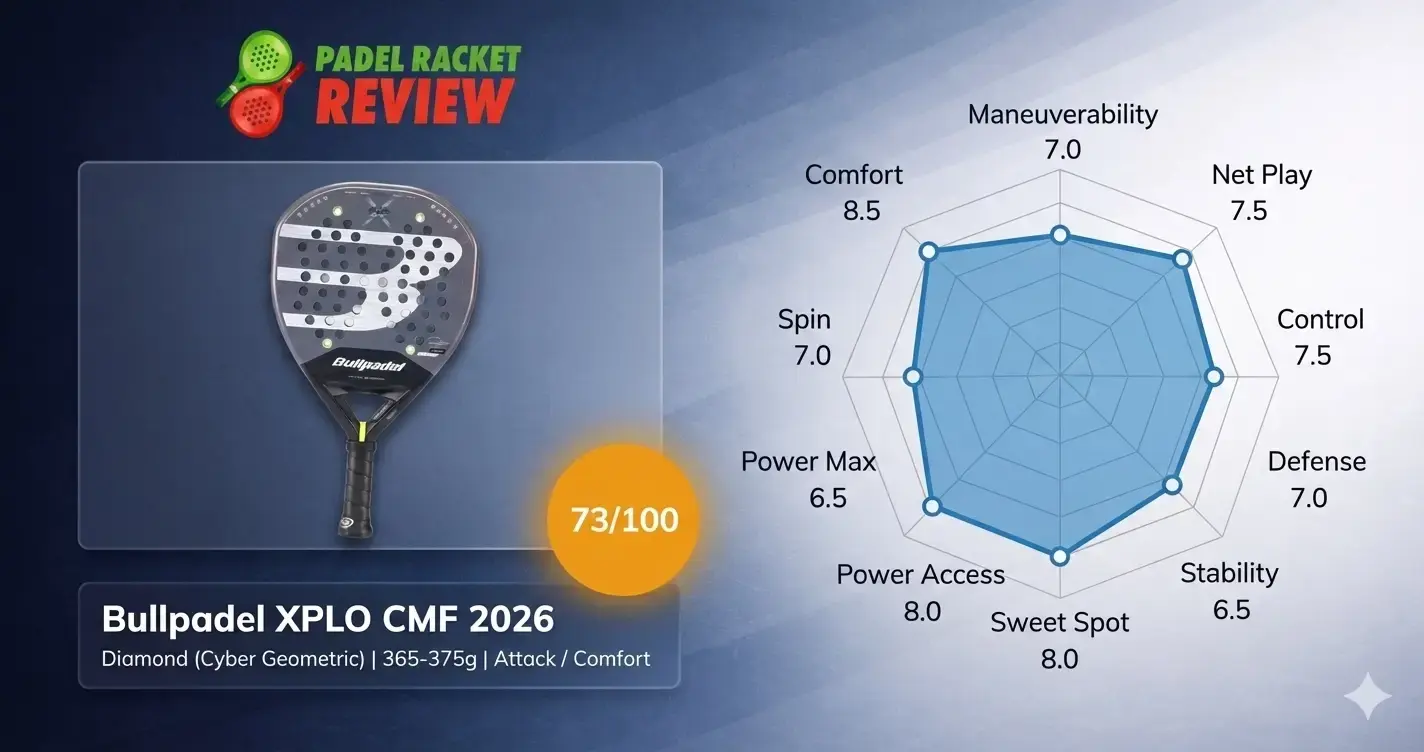
- Maneuverability and handling7.0
- Net performance under pace7.5
- Control and placement precision7.5
- Defensive output and depth access7.0
- Off-center stability and torsional resistance6.5
- Sweet spot usability8.0
- Spin generation potential7.0
- Power ceiling6.5
- Power accessibility8.0
- Comfort and impact feedback8.5
Final verdict — Bullpadel XPLO CMF scores 73/100. A competent mid-range option with balanced performance across categories, well suited to developing and recreational players.
Common questions
Yes, the XPLO CMF specifically targets players managing elbow concerns through its Fibrix face construction. The carbon-fiberglass composite absorbs substantially more impact vibration than pure carbon alternatives, reducing stress on the wrist and elbow joints. Multiple testers explicitly endorsed the model for players with tennis elbow history, noting the dampened feedback across the velocity spectrum. However, the 365-375 g weight range remains consequential—players should consider the lower 365 g specification to minimize swing-related strain, particularly if combining arm sensitivity with less upper-body strength. The racket provides genuine comfort advantages while maintaining adequate power for recreational competition.
The cyber geometric widening expands the sweet spot from approximately 20-30% (typical diamond) to roughly 70% of face area, substantially reducing precision demands on overhead execution. The lateral expansion in the upper face provides wider margin for horizontal centering errors while maintaining the head-heavy balance that defines diamond category behavior. However, the shape creates an internal distinction: a general sweet spot where contact produces acceptable results, and a concentrated power spot in the upper geometric widening where optimal velocity generation occurs. Players must maintain high contact points to access maximum performance, requiring vertical precision despite the horizontal forgiveness. The shape feels more "planted" through contact compared to traditional diamonds' concentrated mass distribution.
Field testing consensus positioned the XPLO CMF in the intermediate corridor—approximately levels 4-6 on European classification scales. The racket proves too soft for advanced players requiring maximum overhead velocity in competitive scenarios, with testers explicitly stating it's inadequate for "pro-level play." Conversely, beginners find the 365-375 g weight and head-heavy balance demanding for baseline technique development. The optimal user profile combines: developing offensive skills without elite-level contact precision, moderate physical strength adequate for the weight range, preference for comfort over maximum power, and progression toward attacking playing style. Players outside this intermediate range achieve better performance alignment with more specialized platforms.
Weight considerations prove critical for female deployment. One female field tester noted the racket caused visible head drop during extended rallies, indicating excessive swing inertia for her strength profile. Female players with strong upper-body development may manage the platform adequately, particularly at the lower 365 g specification with weight system elements removed. However, most female intermediate players will find lighter alternatives (350-360 g range) or more balanced geometries easier to deploy effectively over full training sessions. The Fibrix face's comfort advantages don't offset the fundamental weight challenges for many female users. Testing before committing remains essential, with realistic assessment of sustained maneuverability during match-length rallies rather than brief hitting sessions.
The face material creates all performance differentiation: Fibrix carbon-fiberglass composite on the CMF versus 12K pure carbon on the standard model. This translates to approximately 10-15% reduced power ceiling on the CMF, substantially softer feedback with extended dwell time, better arm comfort with reduced vibration transmission, and marginally wider forgiveness window through face compliance. Both rackets share the cyber geometric profile, head-heavy balance specification (~26.5-27.0 cm), MultiEVA core construction, and 365-375 g weight range. The standard XPLO targets advanced players requiring maximum attack output who can manage firm feedback; the CMF serves intermediate users developing offensive capabilities or managing physical limitations. The geometric advantages remain identical; the material choice determines user appropriateness.
The choice depends on playing style priorities. The XPLO CMF delivers higher power ceiling through diamond geometry and head-heavy balance, making it superior for overhead-oriented attackers who position aggressively and seek maximum smash effectiveness. The Vertex Hybrid offers better maneuverability, faster defensive transitions, superior control consistency, and easier deployment across all court positions through its round-leaning hybrid shape and medium balance. Both provide similar comfort profiles—the Vertex Hybrid's full carbon is slightly firmer than the XPLO CMF's Fibrix but remains arm-friendly. Players emphasizing attacking threat and willing to accept reduced versatility favor the XPLO CMF; those prioritizing all-court consistency and defensive capability align better with the Vertex Hybrid. Neither platform outperforms universally—selection requires honest assessment of playing style and positional preferences.