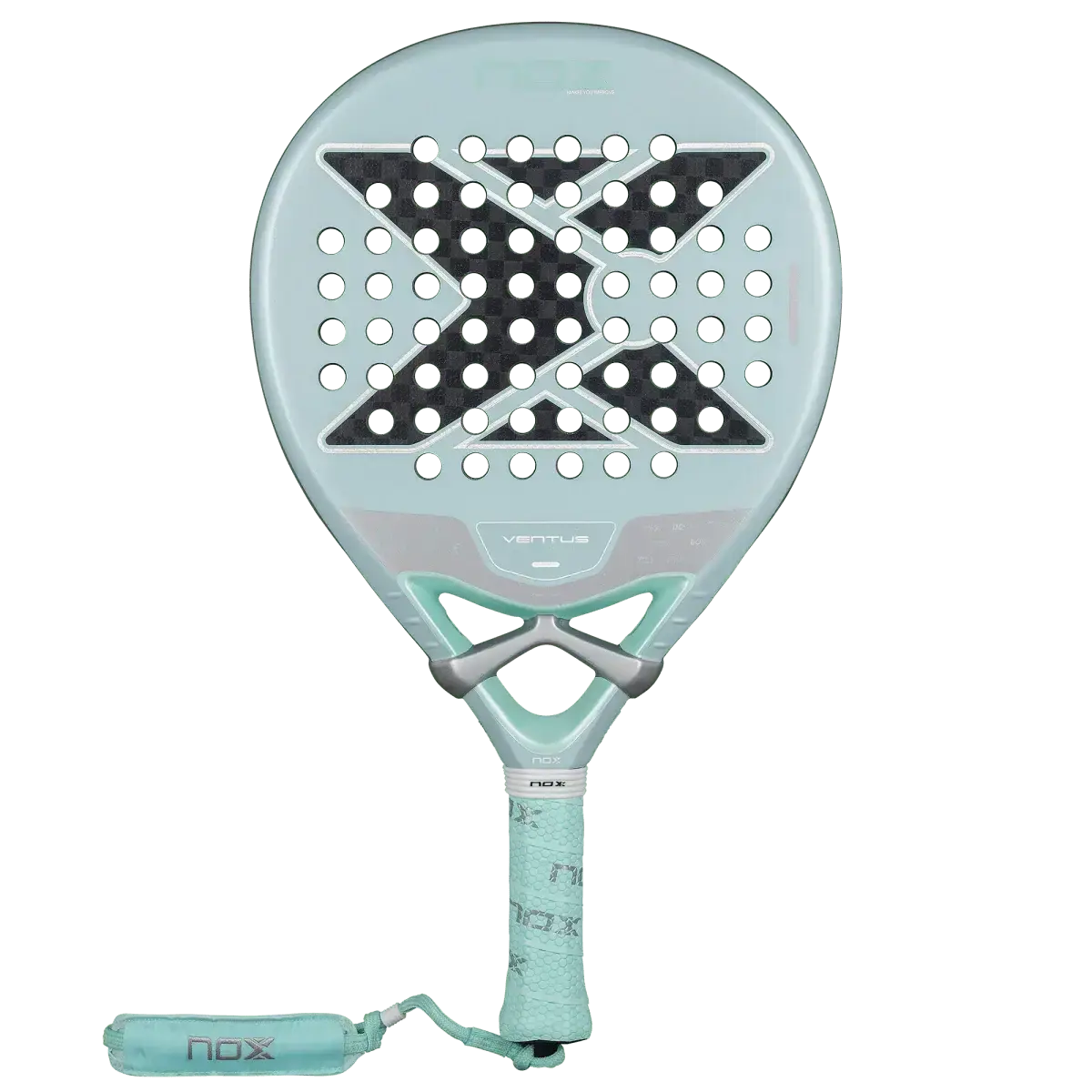
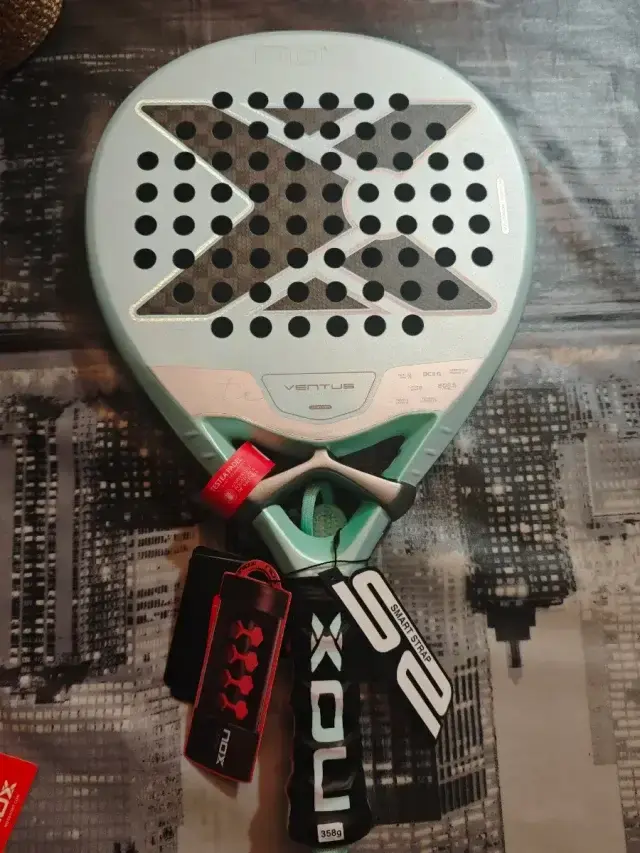
NOX Ventus Hybrid 12K Lite 2026
Version and lineup identification
The Ventus Hybrid 12K Lite belongs to the 2026 NOX Ventus family and represents the lightweight, control-oriented branch of the lineup. Within the Ventus range, it sits below the standard Ventus Hybrid 12K in terms of mass and stiffness, trading structural weight and inertia for increased maneuverability and reduced fatigue.
The “Lite” designation is not cosmetic. Compared to the standard Ventus Hybrid 12K, this version operates with a lower real-world weight window and a slightly lower effective balance, fundamentally altering how the racket behaves in fast exchanges and defensive situations. While both rackets share the same hybrid shape and 12K carbon face, the Lite version is clearly tuned for accessibility and stability rather than power potential.
In the broader NOX catalog, the Ventus Hybrid 12K Lite positions itself well below AT10 models in terms of swing inertia and overhead authority, and closer to ML10-style control rackets, albeit with a slightly more modern, hybrid-oriented response.
Technical specifications
| Spec | Value | What it means |
|---|---|---|
| Shape | Hybrid | Versatile — power and control balanced |
| Thickness | 38 mm | Thicker = more power and rebound |
| Weight range (claimed) | 355–365 g | Heavier = more stability, lighter = more speed |
| Measured weights (video sources) | ~358–364 g | Heavier = more stability, lighter = more speed |
| Balance (measured) | ~25.7–25.8 cm | Affects swing feel and power |
| Face material | 12K Carbon | Good stiffness and durability |
| Core | MLD Black EVA | Good balance of control and feel |
| Frame | 100% Carbon | Structural rigidity and durability |
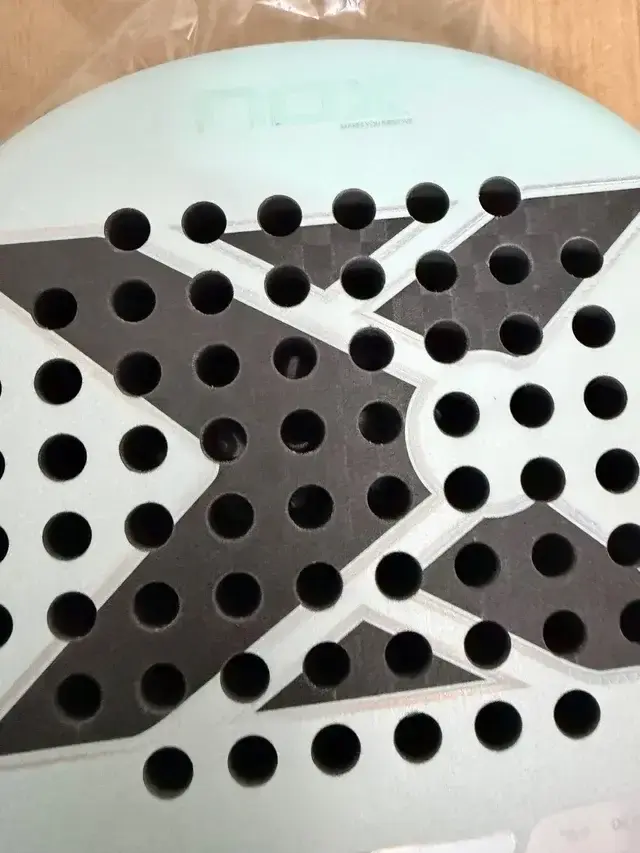
| Surface | Dual Spin (micro 3D texture + sand finish) | Determines feel and response |
| Handle length | ~12.0 cm |
Construction and materials
The Ventus Hybrid 12K Lite uses a full carbon frame combined with a 12K carbon face and MLD Black EVA core. While this material configuration mirrors that of several AT10 models, the overall feel is noticeably different due to the reduced mass and lower swing inertia.
The 12K carbon face produces a medium stiffness response with a relatively dry, controlled rebound. There is no pronounced trampoline effect, and ball output scales gradually with swing speed. The MLD Black EVA core absorbs pace efficiently, particularly on blocks and defensive shots, keeping rebound predictable and reducing unwanted depth on passive contact.
The construction prioritizes structural clarity and comfort over explosive energy return, reinforcing the racket’s role as a control-first, fatigue-friendly option.
Shape and mould behavior
The hybrid mould positions the sweet spot centrally and slightly higher than a classic round shape, but lower than teardrop or diamond attack designs. Combined with the measured balance below 26 cm, this geometry results in a racket that feels neutral in the hand and highly responsive during quick directional changes.
This mould does not amplify overhead leverage. Instead, it favors stability during controlled rallies, easy redirection at the net, and consistent ball placement from the back of the court. The shape works in tandem with the low weight to reduce late-contact penalties, making the racket forgiving during stretched defensive situations.
The trade-off is clear: while maneuverability and consistency are excellent, overhead dominance and finishing authority remain limited by design.
Stiffness, feel, and comfort
The Ventus Hybrid 12K Lite sits clearly on the softer and more forgiving side of the NOX 12K spectrum. While the 12K carbon face itself is structurally firm, the reduced overall mass and lower swing inertia significantly soften the perceived impact feel compared to heavier NOX models.
In practical terms, contact feels controlled and slightly muted rather than crisp or explosive. The MLD Black EVA core absorbs incoming pace efficiently, especially on defensive shots and compact swings. This results in lower vibration transmission through the handle and a noticeably calmer response on off-center contact.
Compared to the standard Ventus Hybrid 12K, the Lite version feels less rigid and less demanding physically. Compared to AT10 12K models, stiffness is clearly lower, with more dwell time and less resistance at high swing speeds. Comfort over long sessions is a strong point, particularly for players sensitive to cumulative arm fatigue.
Sweet spot and forgiveness
The sweet spot on the Ventus Hybrid 12K Lite is relatively large and centrally positioned, which is a direct consequence of the hybrid mould, lower balance (~25.7–25.8 cm), and reduced head mass.
In real match play, performance loss on off-center contact is gradual rather than abrupt. Balls struck slightly low or toward the sides of the face retain acceptable depth and directional control, especially when compared to teardrop AT10 models or diamond-shaped attack frames. This forgiveness supports defensive play, resets under pressure, and extended rallies where perfect positioning is not always possible.
Compared to the standard Ventus Hybrid 12K, the Lite version offers a slightly larger usable hitting area, mainly because the lower inertia reduces twisting on mis-hits. This makes it more tolerant during late reactions and stretched defensive situations.
Power and smash behavior
Power generation on the Ventus Hybrid 12K Lite is deliberately limited. The racket does not provide free power and does not amplify ball speed through mass or trampoline effect. Instead, output scales modestly with swing speed, keeping trajectories predictable and controlled.
On flat smashes, the lower weight (~358–364 g) and balance below 26 cm restrict mass transfer. Even with full acceleration, the racket produces controlled depth rather than point-ending speed. Por-3 and kick smashes are technically possible but require very clean mechanics and full commitment, as the racket offers little assistance in vertical launch or elastic rebound.
Compared to the standard Ventus Hybrid 12K, the Lite version clearly sacrifices finishing potential. Compared to AT10 12K or AT10 Attack variants, the difference in overhead authority is substantial. This racket is not designed to finish points aggressively; it is designed to avoid overhitting and to keep power manageable in all situations.
Net play and fast exchanges
At the net, the Ventus Hybrid 12K Lite excels in speed of execution. The low swing inertia allows rapid preparation, quick redirection, and easy handling in fast exchanges. Volleys feel controlled and easy to keep low, with minimal risk of accidental pop-ups.
In hand battles, the racket favors timing and placement over brute force. Blocks are reliable even when contact is late, and compact strokes remain effective due to the controlled rebound of the 12K face. However, the racket does not add punch on its own—winning fast exchanges depends on placement rather than overpowering the opponent.
Compared to the standard Ventus Hybrid 12K, the Lite version is noticeably quicker and less physically demanding. Compared to AT10 models, net play feels significantly lighter and more forgiving, especially during prolonged exchanges.
Stability on off-center contact
Stability on off-center contact is one of the strengths of the Ventus Hybrid 12K Lite within its category. While absolute torsional resistance is lower than on heavier rackets, the reduced mass minimizes rotational shock on mis-hits.
High-center contact remains stable and predictable, while lateral mis-hits result in manageable loss of pace rather than sudden directional collapse. Low-face contact is also more forgiving than on stiffer, heavier models, where the same error would typically produce a harsher response.
Compared to the standard Ventus Hybrid 12K, stability is slightly improved on reactive shots due to lower inertia. Compared to AT10 models, overall stability is lower, but error punishment is significantly softer.
Practical on-court takeaways
In match conditions, the VK10 Ventus Control 12K 2026 excels when rallies extend and point construction becomes more important than immediate finishing. The racket encourages disciplined shot selection, reliable depth, and consistent directional control from both the baseline and the net.
Defensive play is a clear strength. Lobs, resets, and controlled counter-attacks can be executed with confidence, even under pressure. The racket allows players to recover position without overhitting or losing control, which reduces unforced errors during long exchanges.
Offensively, the racket supports placement-based aggression rather than outright power. Players who rely on angles, variation, and tempo changes will extract the most value. The Weight Balance System, when present, allows fine tuning but does not alter the fundamental control-first identity.
Fatigue management is another practical advantage. The moderate swing weight and controlled rebound help sustain performance over long matches without excessive physical strain.
Comparison within the NOX lineup
Within the NOX 2026 lineup, the Ventus Hybrid 12K Lite represents the most accessibility-focused implementation of the Ventus concept. Its role is fundamentally different from both the AT10 family and the ML10 control line, even though they may overlap superficially in weight or materials.
Compared to the standard Ventus Hybrid 12K XTREM, the Lite version reduces overall swing inertia through lower static weight and slightly lower effective balance. In practical terms, this shifts the racket’s behavior from “balanced hybrid control” toward “reactive and forgiving hybrid control.” The standard Hybrid 12K provides better mass-based stability on volleys and overheads, while the Lite version prioritizes maneuverability, faster preparation, and lower fatigue in extended rallies.
Against the AT10 12K Alum, the contrast is structural rather than incremental. The AT10 12K is a player-driven frame designed for acceleration stability and linear power scaling under clean mechanics. Its teardrop geometry and firmer response reward proactive shot-making and controlled aggression. The Ventus Hybrid Lite, by comparison, is more tolerant of imperfect positioning and late contact. It offers less overhead authority and lower power ceiling, but significantly higher usability when defending, blocking, or resetting under pressure.
When compared to the AT10 18K Alum, the difference becomes one of response character. The AT10 18K provides a calmer, more elastic rebound with greater directional control at medium swing speeds, but still expects full-body engagement to perform optimally. The Ventus Hybrid Lite sacrifices that structured response in favor of easier access to depth and consistency, especially in neutral or defensive patterns.
Against the ML10 Ventus Control 3K, the Ventus Hybrid Lite occupies a middle ground. The ML10 Control 3K is the most comfort-oriented and forgiving racket in the lineup, with a round shape and centrally distributed sweet spot that minimizes penalty on off-center contact. The Ventus Hybrid Lite feels slightly firmer and more directional, offering better transition play and marginally higher offensive potential, while still maintaining high comfort and low fatigue.
In summary, within the NOX lineup the Ventus Hybrid 12K Lite is best understood as a usability-first racket. It is not designed to extract maximum performance from advanced mechanics, but rather to stabilize play, reduce errors, and support consistency across long matches.
Comparison with other brands
When compared to hybrid and control-oriented rackets from other manufacturers, the NOX Ventus Hybrid 12K Lite positions itself as a low-fatigue, high-forgiveness option rather than a performance-maximizing tool. Its defining trait is not power or spin output, but reliability under imperfect conditions.
Against the Bullpadel Flow Light, the Ventus Hybrid Lite feels more structured and stable. While the Flow Light emphasizes ease of swing and accessibility, its rebound can feel more elastic and less predictable at higher ball speeds. The Ventus Hybrid Lite offers better directional control and more consistent depth, particularly in defensive exchanges and controlled volleys.
Compared to the Adidas Drive or Drive CTRL series, the Ventus Hybrid Lite delivers a more refined and less hollow impact feel. Adidas Drive models tend to prioritize softness and comfort but can lack stability when pace increases. The NOX provides firmer feedback and better control when redirecting faster balls, especially at the net.
Against the Babolat Contact or Reflex Lite models, the difference lies in response discipline. Babolat’s lighter frames often provide quicker acceleration and easier lift, but can become erratic under pressure. The Ventus Hybrid Lite trades some of that liveliness for predictability, keeping trajectories lower and more controlled in blocks and resets.
Compared to Head Evo or Flash Lite variants, the Ventus Hybrid Lite again emphasizes control over assistance. Head’s Lite models typically offer easier access to power but less directional precision. The NOX feels calmer and more composed, especially in defensive phases and long rallies.
Across these comparisons, the Ventus Hybrid 12K Lite consistently favors players who value consistency, control, and reduced physical strain over aggression or finishing power.
Technical positioning
The NOX VK10 Ventus Control 12K 2026 occupies a clearly defined position within the NOX lineup and the broader padel market. It is designed as a pure control racket, optimized for consistency, stability, and decision-making under pressure.
Within the NOX range, it sits below the AT10 models in terms of offensive ceiling, but offers superior forgiveness and lower volatility in defensive scenarios. Compared to AT10 teardrop versions, the VK10 Control sacrifices some adaptability in attack in exchange for improved error tolerance and calmer response across the face.
Technically, the racket prioritizes centralized balance, controlled rebound, and torsional stability over power accessibility. The round mould and 12K face create a performance window that favors baseline management, structured net play, and disciplined point construction.
This positioning makes the VK10 Control particularly suitable for right-side players, intermediate to advanced amateurs, and competitive players who prefer to win points through placement, depth control, and tactical patience rather than finishing speed.
Technical performance score
Ten categories, each 0–10. Methodology →
- Maneuverability and handling8.0
- Net performance under pace7.0
- Control and placement precision8.0
- Defensive output and depth access8.0
- Off-center stability and torsional resistance7.0
- Sweet spot usability8.0
- Spin generation potential7.0
- Power ceiling6.0
- Power accessibility7.0
- Comfort and impact feedback8.0
Final verdict — NOX Ventus Hybrid 12K Lite scores 72/100. A competent mid-range option with strong control and placement precision, well suited to developing and recreational players.
Common questions
It is ideal for amateur to intermediate players, right-side doubles players, and anyone prioritizing consistency, comfort, and low fatigue over power.
The Lite version is lighter, faster to handle, and more forgiving, while the standard version offers better stability and overhead authority.
Generally no. Players who rely on repeated overhead finishing will find the power ceiling limiting.
Forgiveness is one of its strengths. Performance loss on mis-hits is gradual rather than abrupt.
No. Power must be generated by the player. The racket prioritizes control over acceleration.
Yes. Impact feedback is filtered and vibration is low, making it suitable for longer sessions.
It offers slightly more offensive potential and transition play while retaining high forgiveness.
Yes, especially for beginners who want a racket they can grow with rather than outgrow quickly.
The two faces of NOX rackets are technically identical, with rare exceptions limited to certain LTD models. The “Service” marking does not indicate any difference in performance, materials, or playing characteristics of that side of the racket. It is used only before the match to determine which team serves first. Players can spin the racket on the court, and if the side with the “Service” marking ends up facing up, the guessing team starts the match with the serve.