Stiga Cybershape 18K Review
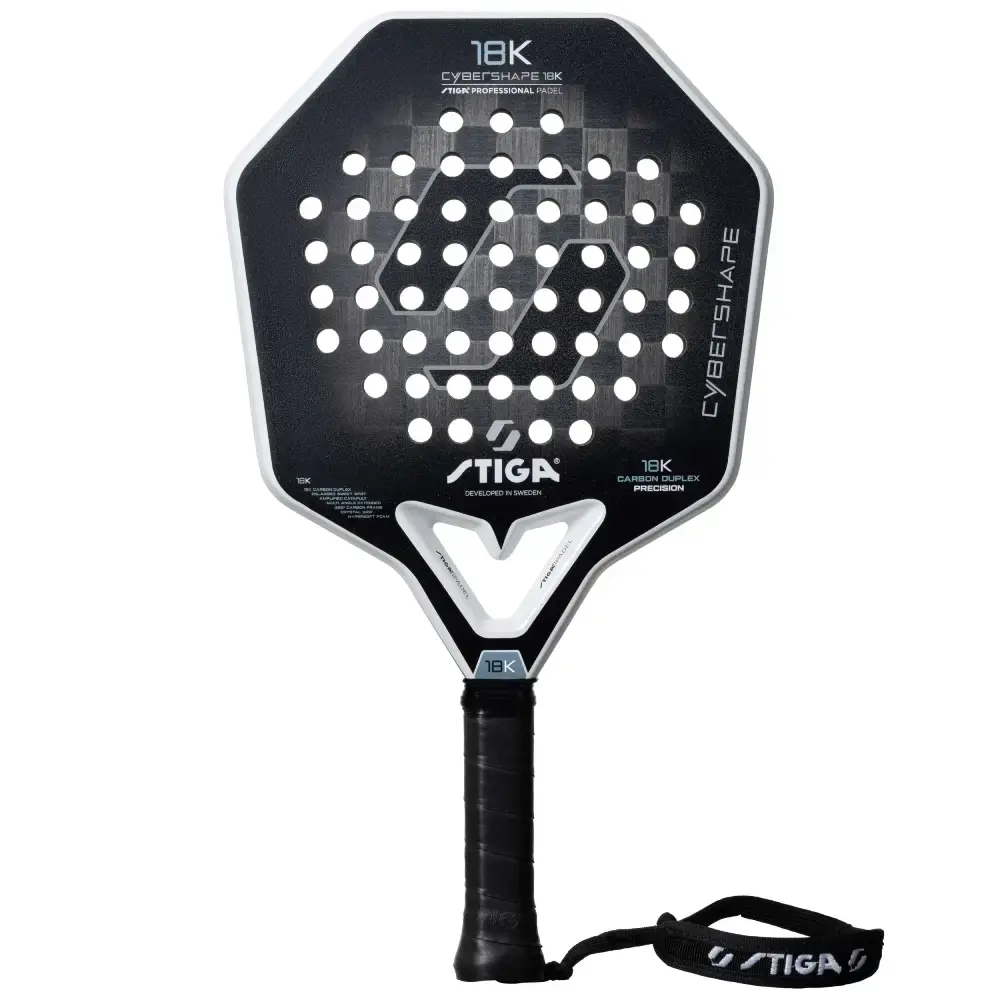
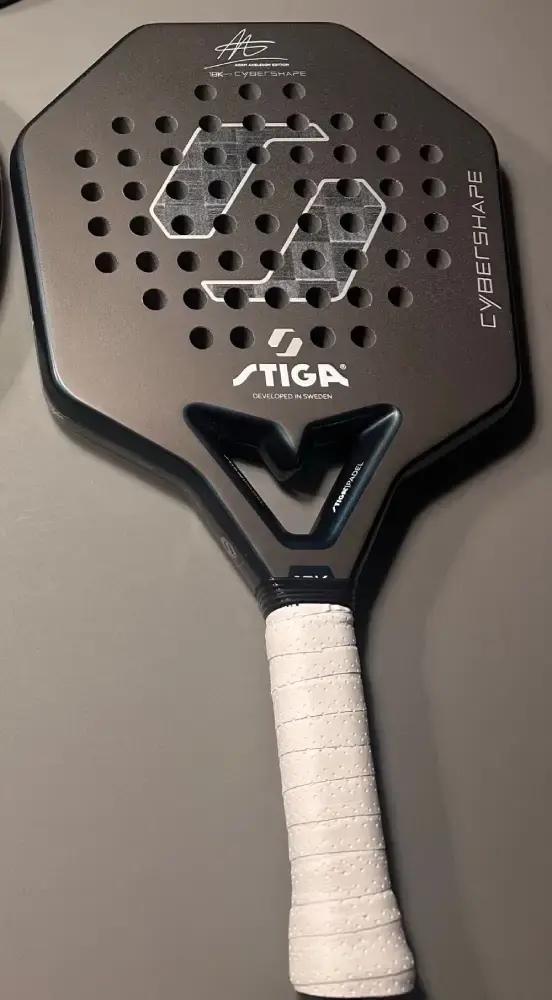
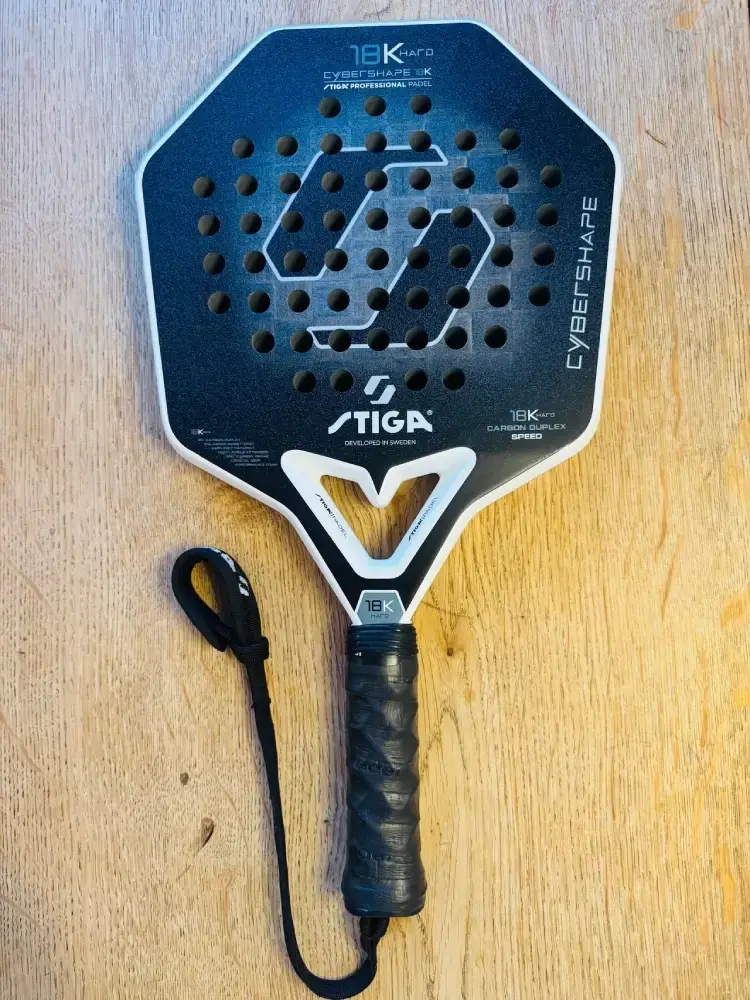
Version and lineup identification
The Cybershape 18K sits within Stiga’s Cybershape padel lineup as the balanced, non-“Hard” version. It uses an 18K carbon face combined with a medium-density EVA core, positioned below the Cybershape 18K Hard in stiffness and above softer fiberglass-based control frames.
Unlike multi-mould lineups from brands such as NOX or Adidas, all Cybershape models share the same head geometry. Performance differences come from carbon layup, core density, and stiffness rather than from shape changes.
Technical specifications
| Spec | Value | What it means |
|---|---|---|
| Shape | Polygonal / squared (Cybershape geometry) | Determines sweet spot and power profile |
| Thickness | 38 mm | Thicker = more power and rebound |
| Weight range (measured) | ~357–368 g (without overgrip) | Heavier = more stability, lighter = more speed |
| Playing weight | ~370–372 g (with 1–2 overgrips) | Heavier = more stability, lighter = more speed |
| Balance (measured) | ~26.5–26.7 cm | Affects swing feel and power |
| Face material | 18K Carbon | Stiff, durable, lively response |
| Core | Medium-density EVA | Good balance of control and feel |
| Frame | Full carbon construction | Structural rigidity and durability |
| Surface texture | Rough / crystal-style texture | Determines feel and response |
| Adjustable balance system | No | Affects swing feel and power |
Construction and materials
The 18K carbon face provides a medium-firm response that prioritizes stability over elasticity. Compared to softer fiberglass or 3K constructions, dwell time is shorter, but contact remains controlled rather than harsh. Impact feedback is clear and direct, allowing players to read contact quality without excessive vibration.
The EVA core sits in the medium range, avoiding the spongy feel of beginner-oriented control rackets. It absorbs pace adequately in defensive blocks while maintaining enough resistance to prevent excessive ball launch on compact swings.
Frame construction is notably rigid and well-finished. Multiple reviewers highlight durability, with minimal cosmetic damage after repeated glass or fence contact, suggesting high structural integrity rather than cosmetic-focused design.
Shape and mould behavior
The defining element of the Cybershape 18K is its non-elliptical geometry. The squared head redistributes mass laterally and vertically, producing a noticeably larger effective hitting area compared to conventional round shapes.
The sweet spot is not only larger but also vertically extended. Practical testing consistently places it from the upper-middle section down toward the geometric center, resulting in a usable zone that feels approximately 15–20% larger than standard round control rackets. Importantly, performance drop-off outside the center is gradual rather than abrupt.
Despite a measured balance around 26.5–26.7 cm, the racket does not feel head-heavy in motion. The geometry compensates for balance by reducing rotational instability, which explains why many players describe it as unexpectedly maneuverable for its weight and balance numbers.
This shape behavior strongly favors defensive consistency, controlled volleys, and spin-based overheads, while limiting flat acceleration and point-ending power.
Stiffness, feel, and comfort
Impact feel is firm and direct. The 18K carbon face combined with a rigid frame produces clear feedback with minimal filtering. Players consistently report high contact awareness but reduced comfort compared to softer constructions.
Vibration control is adequate but not generous. The racket does not feel harsh in isolated impacts, yet long sessions can increase arm fatigue, especially for players sensitive to stiffness or using minimal grip cushioning.
Compared to modern comfort-oriented control rackets, the Cybershape feels structurally rigid and honest, prioritizing information over cushioning. Comfort is acceptable for technically clean players but not a defining strength.
Sweet spot and forgiveness
One of the most discussed aspects of the Cybershape 18K is the perceived sweet spot size and position. While the racket does not feel forgiving in the traditional sense, the effective hitting zone is vertically extended, particularly toward the upper-central face.
Clean contact in this region produces stable, repeatable ball output with minimal deviation. Horizontal forgiveness, however, is more limited. Off-center hits toward the lateral edges lose depth and control more quickly than on round control frames with softer faces.
Forgiveness is therefore directionally asymmetric:
- Vertical margin is better than expected due to geometry
- Lateral margin remains limited due to stiffness and face behavior
Power and smash behavior
Power generation on the Cybershape 18K is entirely player-driven. The racket offers very little free acceleration and does not amplify ball speed through trampoline effect. Smash output scales almost linearly with swing speed.
Flat smashes benefit from the upper sweet spot extension, allowing solid mass transfer when contact is clean and high. However, maximum power ceiling remains moderate. The racket does not produce explosive finishes comparable to diamond attack frames or high-balance power models.
Kick and topspin smashes require full acceleration and correct technique. The stiff face limits dwell time, reducing vertical lift assistance. As a result, smash success depends more on timing and mechanics than on racket elasticity.
This behavior reinforces the Cybershape’s positioning as a control-first, precision-oriented racket, where finishing shots are possible but not emphasized.
Net play and fast exchanges
At the net, the Cybershape 18K performs best in structured exchanges. Volleys feel precise and predictable when the player is set early. The short dwell time helps keep balls low but provides little assistance on late reactions.
In fast hand battles, the racket does not compensate for poor positioning. Blocks require active technique, and reactive flicks are less forgiving than with softer-faced rackets.
Maneuverability remains acceptable due to balanced mass distribution, but the stiff response increases execution demands.
Stability on off-center contact
Torsional stability is solid when contact occurs within the central vertical band of the face. The rigid frame and stiff face maintain directional integrity on high-center hits.
On lateral mis-hits, however, performance drops quickly. Ball speed decreases noticeably, and feedback becomes sharper. This is consistent with the racket’s stiffness profile and limited lateral forgiveness.
Stability is therefore situationally strong rather than universally forgiving. The racket rewards controlled preparation and consistent contact zones.
Practical on-court takeaways
The Stiga Cybershape 18K is a concept-driven racket that prioritizes geometry-based control over traditional material-based forgiveness. It suits players who value precision, feedback, and repeatability, and who are willing to adapt to a non-standard visual and tactile experience.
It is not a comfort racket, not a power amplifier, and not universally forgiving. Its strengths emerge in structured rallies, controlled net play, and consistent overhead preparation. Players relying on passive depth, elastic response, or defensive bailout shots may find it demanding.
Comparison within the Stiga lineup
Within the Stiga padel range, the Cybershape 18K occupies a very specific position defined more by geometry and stiffness than by balance or raw power. While all Cybershape models share the same polygonal head concept, their on-court behavior diverges significantly depending on face material and layup.
Compared to the Cybershape Carbon, the 18K version is noticeably stiffer and more demanding. The Carbon variant offers higher dwell time and easier depth generation, making it more tolerant under defensive pressure. The 18K sacrifices this elasticity in favor of cleaner rebound and tighter directional control, especially on volleys and flat strokes.
Against the Cybershape Hard, the 18K is less extreme in power delivery but more predictable. The Hard version pushes stiffness and smash output further, reducing forgiveness on off-center contact. The 18K sits slightly below in power ceiling but maintains a broader usable performance window across rally situations.
Relative to the Cybershape Tour, the 18K is clearly more specialized. The Tour emphasizes balance and adaptability for mixed play styles, while the 18K commits fully to precision and structure. Players transitioning from round or teardrop control rackets will generally find the Tour easier to adapt to than the 18K.
In summary, the Cybershape 18K is the most control-pure and stiffness-driven interpretation of the Cybershape concept, trading accessibility for structural clarity and consistency.
Comparison with other brands
Outside the Stiga ecosystem, the Cybershape 18K does not align cleanly with traditional control or power categories due to its non-standard head geometry. Instead, it competes indirectly with stiff, precision-focused rackets rather than classic round control frames.
Compared to rackets such as the Adidas Metalbone CTRL 3.5, the Cybershape 18K feels significantly more rigid and mechanically direct. While the Metalbone CTRL relies on balance tuning and frame flexibility to manage control, the Cybershape achieves control through face stiffness and vertical sweet spot distribution. The result is higher predictability on flat contact, but less margin when defending under pressure.
Against hybrid stiff frames like the NOX AT10 18K, the Cybershape 18K offers less elastic rebound and lower power accessibility. The AT10 provides more assistance in transitional shots and overheads, whereas the Cybershape demands cleaner technique but rewards it with sharper placement accuracy.
Compared to lightweight attack-oriented rackets such as the Xcalion H1 Max, the Cybershape 18K sits on the opposite end of the design philosophy. Where Xcalion emphasizes ultra-low mass and maneuverability despite stiffness, Stiga focuses on structural stability and controlled inertia. The Cybershape feels heavier and slower in acceleration, but more stable through the hit.
Overall, the Cybershape 18K is best understood as a structural precision tool, not a comfort-control or hybrid-power alternative.
Technical positioning
The Stiga Cybershape 18K is positioned as a specialized control racket for advanced players who prioritize mechanical consistency, directional accuracy, and structured feedback over comfort or power assistance.
Its polygonal head design creates a vertically elongated sweet spot that favors compact, well-timed strokes rather than reactive or improvised play. Combined with a very stiff 18K carbon face, this results in a racket that performs optimally only when swing mechanics are clean and preparation is early.
From a technical standpoint, the Cybershape 18K sits outside mainstream control categories. It is less forgiving than traditional round rackets, less explosive than modern diamond frames, and less adaptable than hybrid all-court models. Its value lies in repeatability and precision, not versatility.
This makes it most suitable for intermediate-to-advanced players with stable technique, especially those who play a control-oriented right-side role and prefer to dictate rallies through placement rather than speed or spin variation.
Technical performance score
Ten categories, each 0-10. Methodology →
- Maneuverability and handling7.0
- Net performance under pace7.0
- Control and placement precision8.0
- Defensive output and depth access7.0
- Off-center stability and torsional resistance7.0
- Sweet spot usability8.0
- Spin generation potential6.0
- Power ceiling6.0
- Power accessibility6.0
- Comfort and impact feedback8.0
Final verdict — Stiga Cybershape 18K scores 70/100. A competent mid-range option with balanced performance across categories, well suited to developing and recreational players.
Common questions
It is best suited for intermediate to advanced players who prioritize control, directional accuracy, and structured shot execution. Players with compact swings and good preparation benefit most from its geometry.
The shape produces a vertically elongated sweet spot and stable face behavior, which can improve consistency on flat shots. However, it also increases swing inertia and reduces forgiveness on lateral mis-hits.
Compared to classic round frames, the Cybershape 18K offers more vertical stability but less overall forgiveness. It rewards clean contact more clearly and penalizes late or off-axis hits more directly.
No. The 18K carbon increases stiffness and response clarity, not power assistance. Power must be generated by the player, and medium-effort swings produce limited depth.
Comfort is average. Feedback is firm and direct, and players with arm sensitivity should be cautious, especially during extended play.
Only partially. While control is strong, depth generation from defensive positions requires active acceleration, and the racket does not provide free lift or rebound.